The Truth Behind User False Crypto Scam Story To Frame Binance

When a user's crypto story unravels, the real scandal isn't what they lost—it's what they tried to pin on Binance.
The Anatomy of a Frame Job
Digital forensics don't lie. Transaction trails cut through fabricated narratives like a hot knife through butter. When investigators peel back the layers of a supposed 'scam,' they often find user error masquerading as exchange malpractice—a classic case of blaming the casino after a bad hand.
Why Binance Becomes the Target
Market leaders attract more than just volume—they become lightning rods for blame. When portfolios bleed red, some traders reach for scapegoats faster than they check their own security settings. The psychology's straight from Wall Street's playbook: never let a good loss go to waste without someone to sue.
The Verification Gap
Blockchain's transparency creates an ironic twist. Every transaction lives forever on-chain, creating an immutable audit trail that exposes fabricated claims. While traditional finance might swallow a 'the check got lost' excuse for weeks, crypto settlements expose the truth in minutes—no sympathetic bank manager required.
Platforms Fight Back
Exchanges now deploy forensic teams that make SEC investigators look casual. They track wallet movements across continents, analyze timestamp discrepancies, and reconstruct transaction flows with terrifying precision. The message to bad actors: your fabricated story won't survive first contact with the blockchain.
Next time you hear about exchange 'malpractice,' remember—in crypto, the receipts aren't just metaphorical. They're cryptographic, public, and brutally honest about who actually messed up.
What Happened?
In recent reports, a new cryptocurrency scam was reported by Binance when one of the users reported to the customer support, saying that he was swindled by a purported Binance executive. The user claimed that money was transferred following fund transfer promises through a private chat.
The accusation was so serious that the exchange initiated an in-depth internal investigation. As the investigation continued, discrepancies started to appear in the evidence presented, and this brought doubt over the validity of the assertion and the true motive of the complaint.
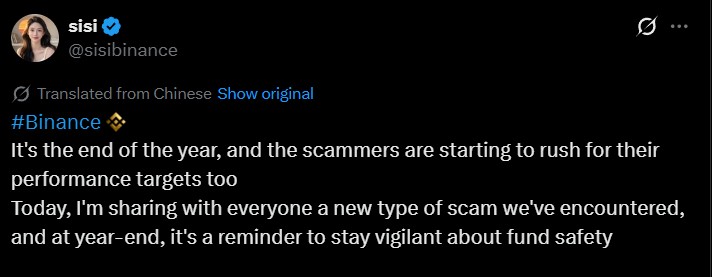
Source: sisi X account
Why and How Did a User Accuse Binance?
The user sued Binance by providing screenshots of a private Telegram message and a transaction history, saying that a company's executive had personally requested money and vanished.
The story was crafted in such a way that it seemed urgent and emotionally compelling.
The user tried to put pressure on the customer service by posing as a victim and affecting the public opinion through a possible social media blowout.
The seemingly rational reason was financial reimbursement or a refund by positioning the platform and its executive as the cause of the so-called loss.
Binance Response: The Investigation
Binance exchange took the allegation seriously and launched an internal security, compliance, and blockchain analysis team investigation. The company was reviewing on-chain data, authenticating account ownership, and checking the authenticity of chats. The real executive whose name was employed in the claim was also contacted.
In the process, the exchange reiterated its duty to users but adopted a zero-tolerance policy towards deception. The inquiry was to establish the truth without favor or prejudice to safeguard the real users as well as the integrity of the platform.
Truth From Investigation: False Claim Revealed
The investigation eventually proved that the allegation was bogus. Key findings included:
The wallet address that was stated to be that of the scammer was probably owned by the user himself.
The transfer evidence presented was not a direct executive request but an escrow site.
The screenshots of chats depicted too simplified dialogues, which are not consistent with the actual support interactions.
The user did not give any history of live chat, saying it was deleted because of privacy settings.
The challenged executive account was confirmed to be a genuine executive who was not aware of the incident.
No account fraud or unauthorized conduct was identified.
There were indications that there was an intentional effort to create pressure through false records and fake confrontation.
The Exchange concluded that the case was a self-organized scam aimed at taking advantage of customer service and the trust of the population.

Source: Official
Safety Tips and Warnings
The Binance Changpeng Zhao (CZ) insists that users should go through the website's official safety tips:
The exchange does not demand transfers of funds in private.
Check contacts using official applications only.
Disregard unsolicited investment or support messages.
Call in case of suspicious activity.
Conclusion
By highlighting this fake scheme, the exchange reiterated its dedication to transparency, user protection, and accountability, and reminded the crypto community to be more aware of changing and deceptive fraud schemes.
Disclaimer: This is not financial advice. Please DYOR before investing. CoinGabbar is not responsible for any financial losses. Crypto assets are highly volatile, and you can lose your entire investment.
