PwC Doubles Down on Crypto Expansion as U.S. Regulatory Fog Lifts

Big Four giant PwC is accelerating its crypto push, betting that newfound regulatory clarity in the U.S. is the green light the industry's been waiting for.
From Sideline Observer to Center Stage
For years, professional services firms tiptoed around digital assets. The legal gray area made traditional audits and advisory work a compliance nightmare. Now, with clearer rules of the road emerging from Washington, PwC is shifting gears from cautious exploration to full-throttle expansion.
The Services Suite: More Than Just Counting Bitcoin
This isn't just about helping clients with their crypto taxes—though that's a booming line itself. The firm is building out a full stack: audit frameworks for tokenized assets, risk assessments for DeFi protocols, and even consulting on central bank digital currency (CBDC) rollouts. They're positioning themselves as the bridge between chaotic crypto-native startups and the rigid world of institutional finance.
Why the Sudden Hurry?
Market maturity is forcing the issue. Institutional capital is no longer just dipping a toe—it's diving in. Hedge funds, asset managers, and even pension funds are demanding the same level of professional oversight for their digital holdings as they get for stocks and bonds. PwC sees a land grab opportunity to become the default trusted advisor in a sector still rife with, let's be honest, cowboys and charlatans.
The Cynical Take
Of course, there's a certain irony in a legacy auditing powerhouse—whose bread and butter is verifying the past—staking its future on assets that promise to disrupt the very foundations of traditional record-keeping. It's the ultimate hedge: getting paid to usher in the revolution that could, one day, make a sizable chunk of their own services obsolete. A classic finance move—charge fees to manage the disintermediation threatening your fee structure.
The race is on. With the regulatory dam cracking, the flood of institutional capital into crypto is inevitable. PwC isn't just preparing for the deluge; they're selling the shovels, building the levees, and offering insurance—all while quietly betting on which parts of town will get washed away first.
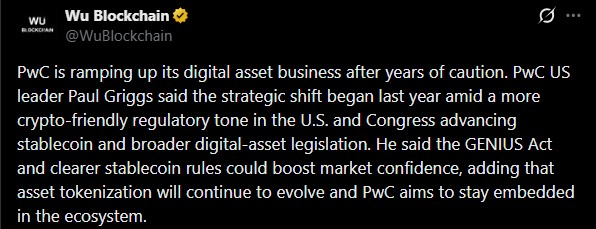
Following long uncertainty, U.S. lawmakers are now moving forward with clearer digital-asset rules, and a heavy enforcement stance, which kept many institutions hesitant.
A major milestone came on July 18, when President Donald TRUMP signed the GENIUS Act (S.1582) into law. The legislation created a federal framework for stablecoins, allowing both banks and approved nonbank firms to issue them under clear reserve and disclosure rules.
Adding on, the recent proposals from the Federal Deposit Insurance Corporation (FDIC) aim to simplify approval processes and reduce state-level hurdles for cryptocurrency companies, making it easier for firms like PwC to expand services in the sector.
According to Griggs, this clarity and support is essential for building confidence in institutions and broader digital assets adoption.
How PwC Crypto Involvement Matter For Digital Assets
PwC (PricewaterhouseCoopers), is one of the Big Four professional services firms, alongside Deloitte, EY (Ernst & Young), and KPMG. The organization provides services in Audit & Assurance, business consulting, tax services, and deals & Corp. Finance.
The audit firm’s deeper involvement sends a strong signal to traditional finance. As a trusted auditor and advisor, PwC’s involvement reduces operational and compliance risk for institutions entering cryptocurrency.
It boosts the trust and engagement especially after failure like FTX, institutions demand transparent audits and risk controls, areas where PwC crypto services play a critical role.
How It Matter for Advisory Giant Itself
PricewaterhouseCoopers started crypto engagement in early 2015–2016 with researching Bitcoin adoption and experimenting with blockchain tools like its Vulcan platform. Today, the accounting giant runs a global digital assets practice with over 350 specialists across 30+ countries.
Griggs noted that the company has already seen steady growth in crypto-related audit and consulting work. As tokenized assets MOVE closer to mainstream finance, demand for trusted accounting, compliance, and advisory services is rising.
PwC crypto efforts are now more focused on stablecoins advisory, blockchain infrastructure, and the auditing of tokenized real-world assets such as bonds, funds, and commodities.
According to Boston Consulting Group (BCG), pilot projects involving real-world asset tokenization reached $2.8 billion by 2025, highlighting strong institutional interest. The Big Four firm’s move positions it to play a leading role as these pilots scale into full-fledged markets.
Regulatory Clarities Emerging As A Wide Adoption Tool
PwC’s renewed commitment reflects a broader shift across traditional finance. As regulations become clearer, large institutions are preparing for a future where blockchain technology integrates directly with legacy systems.
According to AIMA surveys, over 55% of traditional hedge funds held cryptocurrencies exposure in 2025, up from 47% a year earlier. The corporate services leader projects that 76% of global investors plan to increase digital asset holdings, with nearly 60% allocating more than 5% of assets under management.
For now, as more Big Four firms follow suit, PwC crypto expansion could help bridge the gap between traditional finance and the on-chain economy, bringing credibility, structure, and scale to the next phase of digital asset adoption.
