IPOR Fusion Vault Hack on Arbitrum: Full Depositor Refund Confirmed - A Rare Win for Crypto Users

In a twist that defies crypto's 'code is law' fatalism, the IPOR Fusion Vault hack on Arbitrum is ending not with a whimper, but a full refund. Every depositor gets made whole—a resolution so clean it feels like a glitch in the DeFi matrix.
The Breach and the Bounce-Back
An exploit hit the vault, targeting its yield-generating mechanics. Instead of the usual radio silence and legal posturing, the team moved fast. They identified the flaw, paused operations, and secured the remaining funds. The kicker? A commitment to cover 100% of user losses from the project's own treasury. No vague promises, no haircuts—just capital returned.
Why This One Didn't End in Tears
Speed and transparency cut through the chaos. The team communicated the incident and their action plan in real-time, bypassing the days of speculation that usually fuel panic. By leveraging the Arbitrum chain's lower fees and faster settlements, the recovery process itself became more feasible. It's a case study in how the right infrastructure can turn a disaster into a manageable incident.
The New (and Uncomfortable) Standard
This sets a dangerous precedent for users—actually expecting to get their money back after a hack. It throws a harsh light on projects that hide behind 'immutable' smart contracts as an excuse for negligence. In traditional finance, this would be basic fiduciary duty; in crypto, it's headline news. One cynical observer might note it's easier to refund users when your token hasn't already bled 90% from its all-time high—the math gets simpler.
Full restitution is a powerful signal. It builds trust in a sector drowning in skepticism. But let's be clear: it shouldn't be remarkable. It should be the baseline. The real test isn't surviving one hack; it's building systems so robust that the next one never happens. Until then, a clean refund is the best damage control money can buy—proving that sometimes, the most revolutionary act in decentralized finance is honoring a central promise.
What Happened?
On January 6, 2026, the team was alerted to a suspicious transaction on the USDC Fusion Optimizer Vault on Arbitrum. Following a quick research, it was established that the attack had emptied a certain legacy vault of $336,000 USDC. Luckily, the loss is a minor fraction of the total funds of Fusion, and other vaults were not affected.
Security companies like Hexagate and Blockaid were able to cooperate, which helped to detect the incident early, and SEAL is assisting in recovery. The attack demonstrates the fact that even minor misconfigurations of legacy smart contracts can lead to serious vulnerabilities.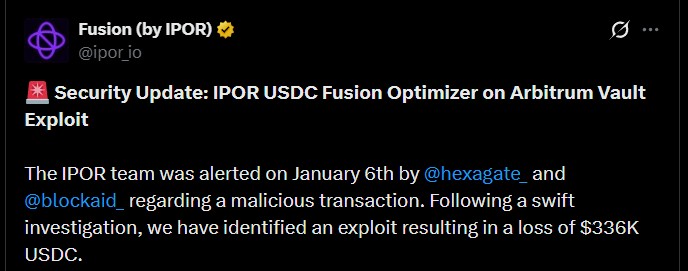
Source: Official X
How the Attack Worked?
The breach was due to a flawless storm of susceptibility in the old-fashioned vault:
Vault Logic Error: The impacted vault lacked a validation in its instantWithdraw method. This enabled unauthenticated fuses (logic modules that operated withdrawals) to run arbitrary code.
Admin Account Delegation (EIP-7702): The administrator account was delegating its permissions to a contract that had a function that allowed arbitrary calls. The attacker used this to deceive the Vaults into thinking that the transaction was approved.
Injection of a Malicious Fuse: The attacker used such privileges to inject a malicious fuse. This fuse could withdraw assets because of the missing fuse validation, which transferred 336K USDC to the address of the attacker.
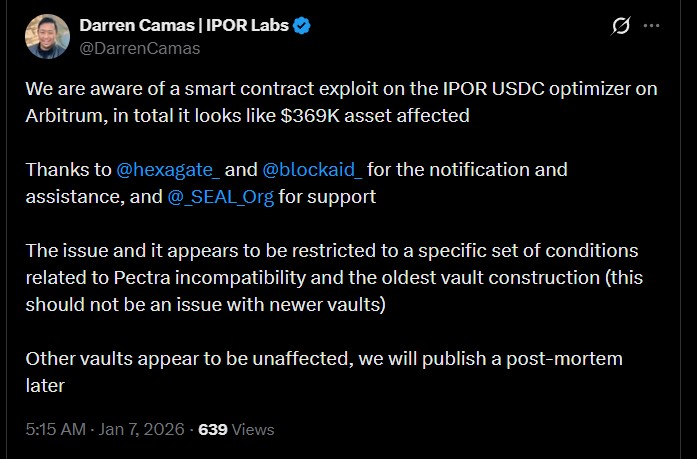
Source: X
Why This Vault Was Vulnerable
This attack was against a legacy that was deployed approximately 490 days before the implementation of more stringent fuse validation policies. The vulnerable EIP-7702 delegated contract was applied to a small number of older vaults. Newer Fusion Vaults have more validation, and this prevents similar attacks.
In brief, a lack of proper validation and the misuse of delegation provided a special vulnerability, which is impossible to replicate in other vaults.
What's the Response of IPOR?
The team acted fast to guarantee deposit safety:
Recovery Efforts: In conjunction with Hexagate, Blockaid, and SEAL, we are going to monitor and possibly recapture stolen money.
Compensation: The IPOR DAO treasury will bear the loss, with all the depositors that are affected being completely compensated.
Security Assurance: The rest of Fusion Vaults are not impacted and are safe.
IPOR has also undertaken to publish a post-mortem report of the exploit, its causes, and the preventive measures that are being taken.
What's Now and What's Ahead?
Although the immediate effects are included, this event is a reminder that the use of legacy smart contracts on Layer-2 networks is associated with certain risks.
In the future, IPOR may probably be stricter in terms of validation, review delegation procedures, and will keep in close collaboration with security companies to eliminate such exploits.
Conclusion
The IPOR Fusion exploit was minor yet instructive in crypto market today: old misconfigurations resulted in a loss of $336K, which was entirely refunded by the DAO, highlighting the ongoing danger of smart contract security.
Disclosure: This is not a financial recommendation. Do your own research prior to investing. CoinGabbar has no liability for any financial losses. crypto assets have a high level of volatility, and you might lose all your investments.
