Bharat Web3 Association’s Budget Demands: Will India Finally Fix Its Crypto Tax Nightmare?

India's crypto industry just fired a warning shot at the government—fix the tax regime or watch innovation flee.
The Bharat Web3 Association, the sector's main lobby, has submitted its pre-budget wishlist. The demands are clear: slash the punishing 1% TDS on crypto transactions and rethink the 30% flat tax on virtual digital asset profits. The current rules, they argue, aren't just harsh—they're pushing talent, capital, and entire companies offshore.
A Tax System Built for Exodus
Since the taxes hit in 2022, trading volumes on domestic exchanges have plummeted. The 1% tax deducted at source on every transaction sucks liquidity dry, making day-to-day trading and legitimate market-making nearly impossible. Meanwhile, that steep 30% levy on gains—with no option to offset losses—treats a volatile, high-risk asset class like a lottery win.
The association's plea isn't just about relief; it's about survival and sovereignty. They warn that over-regulation is creating a classic case of capital flight, where the most promising Web3 builders simply incorporate elsewhere. It’s the financial equivalent of training your best engineers only to see them build skyscrapers for another country.
Will Delhi Listen?
The ball is now in the government's court. The upcoming budget is a litmus test. Will policymakers recognize Web3 as a strategic tech sector worthy of a sensible framework, or double down on a revenue-grab that's backfiring? The industry has laid out the math—now it's waiting to see if the government can do more than just count the rupees it's scaring away.
After all, in global finance, capital tends to flow to the friendliest jurisdiction—a truth as old as money itself, and one that traditional bankers have exploited for centuries while pretending to be shocked by crypto doing the same.
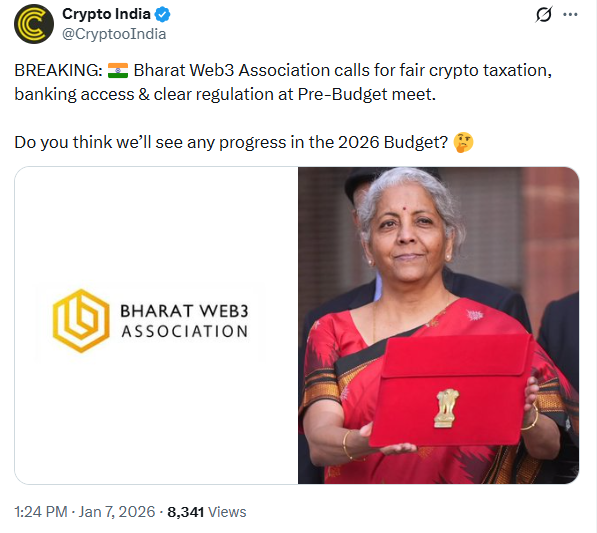 Source: X(formerly Twitter)
As of today, January 7, 2026, the Indian Web3 ecosystem remains at a crossroads. While the global market cap sits at a healthy $3.30 trillion, domestic players are struggling under a rigid 30% tax and a 1% TDS that many claim is "suffocating" market liquidity.
The "Survival" Wishlist: What BWA is Chasing
The Bharat Web3 Association budget demands center on three critical pillars that founders believe will determine if India remains a Web3 superpower or becomes a mere talent exporter to hubs like Dubai and Singapore.
The TDS Rollback: BWA is pushing to slash the 1% Tax Deducted at Source (TDS) to a mere 0.01%. The industry argues that the current 1% rate is not just a tax; it’s a capital lock-up that prevents high-frequency trading and professional market making.
Offsetting Losses: Unlike stocks or real estate, crypto investors in India currently cannot offset losses in one coin against gains in another. The Web3 Association budget demands seek to bring VIRTUAL Digital Assets (VDAs) in line with traditional securities, allowing for "fair" profit-loss calculations.
Formal Banking Access: Despite the 2020 Supreme Court ruling, many BWA startups still face "shadow bans" from major commercial banks. The BWA has called for clear circulars from the RBI to ensure legitimate, FIU-registered businesses aren't cut off from the financial grid.
The Economic Stake: $1 Trillion at Risk
BWA Chairperson Dilip Chenoy has been vocal about the "brain drain" threat. India currently houses over 1,200 BWA startups and 17% of the world's blockchain developers. However, without "fair and predictable taxation", the capital meant for these startups is moving to more progressive jurisdictions.
The government has already seen the potential, collecting over ₹437 Cr in crypto taxes during the last financial year. However, the BWA argues that a lower tax rate WOULD actually increase total revenue by bringing the millions of users who migrated to offshore platforms back to regulated Indian exchanges like CoinDCX.
Conclusion
The Bharat Web3 Association budget demands represent a desperate but logical plea for common sense. For over three years, the "30% tax + 1% TDS" combo has acted as a wall that only hurts compliant Indian businesses while doing nothing to stop offshore trading. If the 2026 Budget doesn't at least lower the TDS, we might see the final "hollowing out" of the domestic exchange industry. The government has the data; now they just need the political will to treat code as a commodity, not a vice.
