World Liberty Trust’s Bold Move: Applying for National Bank Charter with Just USD1 Capital

One dollar. That's all it takes to potentially reshape the banking landscape.
World Liberty Trust's application for a national bank charter with a symbolic USD1 capital base isn't just paperwork—it's a direct challenge to the fortress of traditional finance. This isn't about building vaults; it's about proving that trust and technology matter more than marble columns.
The Charter Play
National bank charters typically require capital reserves that would make a central banker blush. World Liberty Trust's approach flips the script. They're betting that regulatory innovation can coexist with radical minimalism. The message? Legacy infrastructure is the real liability, not the size of your balance sheet.
Why This Matters Now
Traditional banks spend billions complying with rules written for a pre-digital age. This application suggests a new model: lightweight, software-native, and built for the asset classes that old banks still don't understand. It's regulatory arbitrage with a straight face.
The Cynical Take
Let's be real—the old guard will call this reckless. They've spent decades building moats with other people's money, and now someone's offering a drawbridge for a buck. Nothing terrifies a legacy institution more than efficiency.
If approved, this charter wouldn't just create a new bank. It would expose how much of traditional finance is just expensive theater. The real question isn't whether USD1 is enough capital—it's whether the existing system has ten times that in unnecessary overhead.
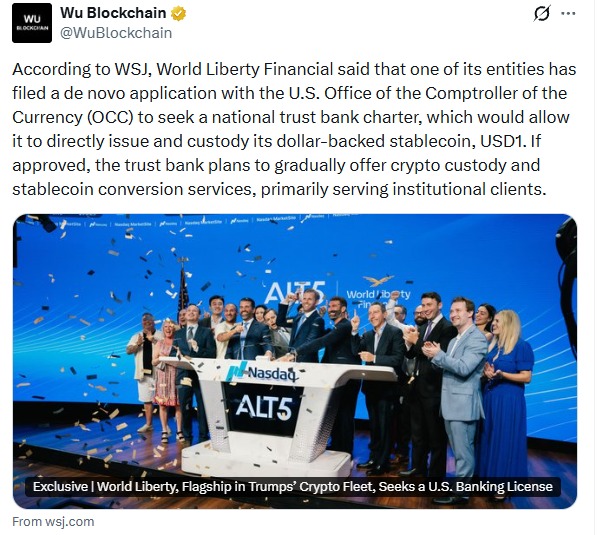
The timing of this World liberty trust application is no accident. It comes right after a new law called the GENIUS Act passed in late 2025, which finally gave clear rules for how digital dollars should work in America.
Breaking Down the World Liberty Trust(WLT) Application and USD1
So, what does this organization actually change?
Right now, the USD1 stablecoin has about $3.4 billion in circulation. That is a huge amount of money, but WLT has to use other banks and partners to hold the actual cash that backs those tokens. By getting their own charter from the OCC, they can bring everything "under one roof."
What the New Bank Will Do?
According to the official filing, the new bank won't be for regular people to open checking accounts. Instead, it will focus on big "institutional" clients who think of them as the whales of the financial world, like investment firms and crypto exchanges.
One of the biggest perks mentioned in the Organization is that they want to offer "fee-free" swaps. This means these big companies could trade their U.S. dollars for USD1 without paying the usual extra costs. This could make USD1 a much more popular choice for professional traders.
The 2026 Crypto Banking Wave
World Liberty isn't the only one knocking on the OCC's door. Their World Liberty Trust application follows a busy month where other major players like Ripple and Circle also got preliminary approval for similar licenses. This shift is happening because the federal regulatory framework is finally opening up.
A "trust bank" is a bit different from a normal bank. It cannot give out loans or take your monthly paycheck deposits. Instead, its job is to act as a "fiduciary." This means its only goal is to keep assets SAFE and make sure every single USD1 token is backed 1:1 by real cash or safe government bonds.
Dealing with Conflict of Interest
Because this project involves the President's family, there has been plenty of talk about conflicts of interest. The team behind the WLT says they have planned for this. The TRUMP family holds "non-voting" shares, which means they won't be making the daily business decisions. The goal is to keep the bank's operations separate from politics while following all the standard anti-money laundering rules.
Conclusion
The World Liberty Trust application is a clear sign that the "Wild West" days of crypto are ending. By asking for a federal charter, the Trump team is trying to build a bridge between traditional banking and the new world of digital finance. It is a smart business move: if you own the bank that mints the stablecoin, you control the most profitable part of the ecosystem. While critics will worry about the political ties, the fact remains that USD1 is positioning itself to be a massive player in the institutional market throughout 2026.
YMYL Disclaimer
This article is for informational purposes only and should not be considered financial, legal, or investment advice. cryptocurrency investments carry risk. Readers should conduct independent research or consult a professional before making financial decisions.
