SlowMist IDE Security Alert Exposes Hidden Folder Attacks Targeting Vibe Coding Developers

Another day, another clever exploit targeting the crypto ecosystem's builders. This time, it's not a flashy protocol hack or a phishing scam—it's a subtle, insidious attack vector lurking in the very tools developers use to create the next big thing.
The Invisible Threat in Your Workspace
Security researchers at SlowMist have raised the alarm on a sophisticated attack method exploiting hidden folders within integrated development environments (IDEs). The technique specifically targets projects built using Vibe Coding methodologies, a popular approach for rapid blockchain application development. The attack doesn't smash through the front door; it slips in unnoticed, embedding malicious code in places most developers never think to look.
How the Attack Unfolds
The mechanism is deceptively simple. Attackers compromise dependencies or development toolchains, injecting scripts that create or manipulate hidden directories (think `.config` or `.vscode` folders with a malicious twist). Once the developer's environment is infected, the malware can exfiltrate private keys, alter smart contract code before deployment, or establish a persistent backdoor. It turns the creator's toolkit against them. Because these folders are often ignored by version control and routine checks, the compromise can persist undetected for months.
Why Vibe Coding is a Prime Target
Vibe Coding's emphasis on speed, modularity, and open-source collaboration makes it uniquely vulnerable. Developers frequently pull in third-party modules and templates to accelerate work—a perfect vector for poisoned packages. The community-driven nature, while a strength, also widens the attack surface. It's the digital equivalent of a Trojan horse gift-wrapped as a productivity booster.
The Bottom Line for Builders
This isn't just a technical vulnerability; it's a direct assault on the integrity of the development lifecycle. A single compromised developer environment can cascade into a fully backdoored protocol, putting user funds and network security at grave risk. The alert mandates a shift in DevSecOps practices: rigorous auditing of all dependencies, including IDE extensions, and implementing strict integrity checks for hidden project files.
In a sector where moving fast and breaking things is often celebrated, this alert is a stark reminder that what you break might just be your own security—and your users' trust. After all, in crypto, the only thing that should be hidden in a folder is your seed phrase, not a hacker's payload. It's a costly lesson that sometimes, the most dangerous code is the code you didn't even know you ran.
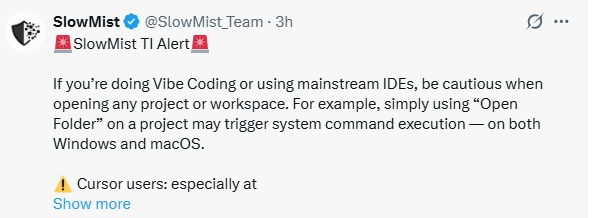
Source: X (formerly Twitter)
What Is the SlowMist IDE Security Alert About?
The IDE Security Alert comes from blockchain security firm SlowMist.
The team warned that developers should be extremely careful when doing “Vibe Coding” or using mainstream IDEs.
According to SlowMist, clicking “Open Folder” on a malicious project can instantly trigger system-level commands.
This attack works silently in the background. Users do not need to run any code. The act of opening a folder is enough.
The issue affects both Windows and macOS systems, making it a cross-platform threat.
Why Cursor and AI IDE Users Face Higher Risk
SlowMist highlighted that users of Cursor face a higher risk. AI-powered IDEs often scan files, load tasks, and interact with project settings automatically. If attackers design a project folder carefully, these automated actions can be abused.
The SlowMist IDE Security Alert explains that attackers can steal data, install malware, or even drain crypto private keys. Several AI coding users have already reported real losses, proving this is not a rare edge case.
Why Simply Opening a Folder Is Dangerous?
Most development IDEs are powerful. They can automatically read configurations, execute extensions, and set up the development environment. The above-mentioned popular development IDEs act similarly to save development time.
However, according to the warning, such convenience comes with risks. Harmful scripts could be embedded even in project files, leading to damage even before those concerned are aware of the problem.
A Pattern Unfolds Among Crypto Security Threats
This warning is part of a larger trend. There have been recent warnings from wallet services such as OKX Wallet and Phantom Wallet regarding solana signature phishing. This type of phishing attack deceives victims into signing what appear to be harmless transactions, while also transferring the victim’s account ownership on Solana.
Experts from Slow Mist pointed out that contemporary attacks target user behavior, not vulnerabilities. Attackers target trust and regular activity.
MetaMask Phishing Shows the Same Risk
Another example is the recent phishing wave targeting MetaMask users. Fake 2FA alerts pressured users into entering recovery phrases on look-alike websites. Again, no hacking tools were needed. Fear and urgency did the work.
These cases show that the SlowMist IDE safety alert is part of a larger shift. Attackers no longer wait for mistakes. They design traps into normal behavior.
How Developers Can Stay Safe?
Slow Mist advises developers to treat unknown project folders like unknown USB drives. Never open untrusted repositories directly. Use VIRTUAL machines or sandbox environments for testing. Always verify sources before opening folders, especially in AI-powered IDEs.
Conclusion
The SlowMist IDE Security Alert is a wake-up call for developers. Powerful tools bring powerful risks. In today’s environment, even one careless click can compromise an entire system. Slowing down, verifying sources, and staying cautious may be the strongest tools developers have right now.
This article is for informational purposes only and does not provide financial, investment, or cybersecurity advice.
