Trump’s Russia Sanctions Bill Slams India, China With 500% Tariffs - A Geopolitical Earthquake

Washington just fired a shot across the global economic bow. The newly proposed sanctions legislation—dubbed the 'Trump Bill'—doesn't just target Moscow; it sets its sights on major economies doing business with Russia. The headline threat? Punitive tariffs soaring to 500%.
The New Front in Economic Warfare
Forget subtle diplomatic pressure. This bill represents a blunt-force instrument. It aims to cripple Russia's war machine by severing its international supply chains, with secondary sanctions designed to force a stark choice on trading partners: cut ties with Moscow or face devastating financial penalties from the U.S.
Why 500%? The Calculus of Pain
The number isn't arbitrary. A 500% tariff isn't a tax; it's an economic blockade. It instantly renders target goods uncompetitive, effectively banning them from the American market. For export-reliant nations, this creates an immediate, multi-billion-dollar dilemma. It's a classic move from the old playbook—using market access as the ultimate leverage.
The Domino Effect on Global Trade
The immediate fallout scrambles decades of trade policy. Supply chains already strained by pandemic-era disruptions now face a new, politically charged bottleneck. Companies with footprints in the U.S., India, and China are recalculating risk overnight, facing a potential trilemma of compliance, cost, and market access. Some legacy finance desks are probably still trying to price this risk into spreadsheets built for a more predictable world—good luck with that.
A Provocative New World Order
This move signals a stark departure from multilateralism. It's unilateral economic statecraft at its most aggressive, testing the resilience of the post-WWII global trading system. The bill bets that America's consumer market remains the ultimate prize, strong enough to compel compliance from even its largest strategic rivals. The closer? In an era where digital assets operate 24/7 across borders, watching nation-states try to rebuild walls with 500% tariffs feels like watching a blacksmith compete with a laser cutter. The future of value transfer might just be laughing from the blockchain.
What Is the Trump Russia Sanctions Bill?
The Russia sanctions bill is a bipartisan proposal by Senator Lindsey Graham and Senator Richard Blumenthal. It allows the US President to impose heavy tariffs and secondary sanctions on countries that buy Russian oil, gas, uranium, and energy products.
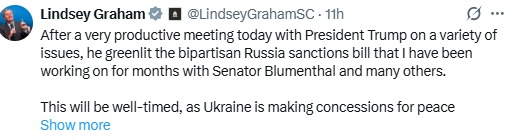
Source: X (formerly Twitter)
Countries like India, China, and Brazil are directly mentioned because they import large volumes of Russian oil. Just a few days back Trump threatened India with Tariffs spike for Russian oil trade.
It is important to note that this draft is not law yet. It still needs approval from the US Congress. However, Trump’s public support has increased the chances of it moving forward.
Why This Bill Matters for Global Markets?
If it passes, this proposal from the Trump Administration could drive the price of oil and trade higher around the world. Higher tariffs tend to translate to higher inflation and slower economic growth.
This is more than just political. It directly affects oil prices, exchange rates, gold, as well as risk assets such as cryptos. The recent events in the U.S. have shaken the Venezuelan leadership as well as given the US control over Venezuelan oil exportation.
Crypto Market Reacts With Risk-Off Move
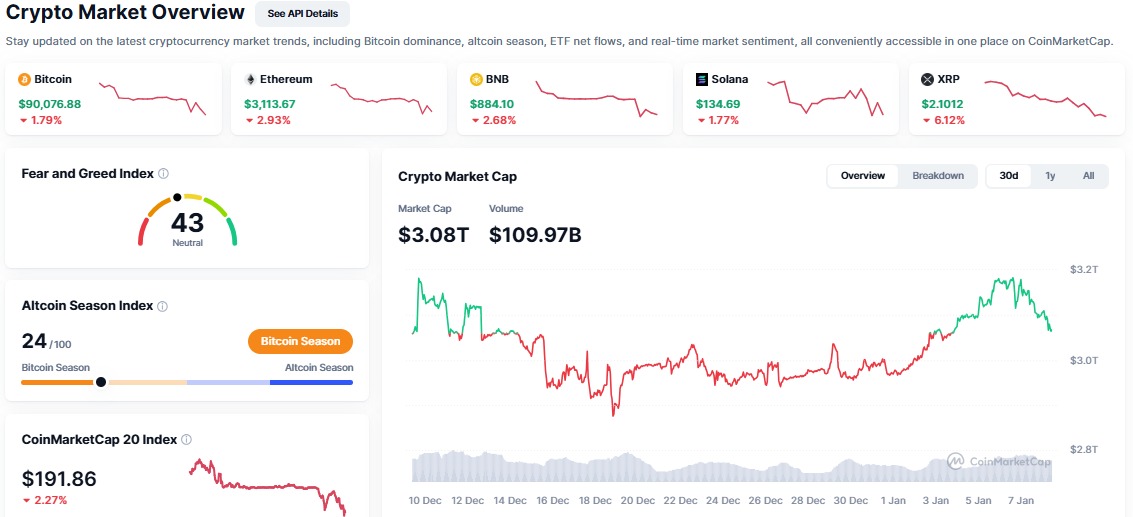
In the last 24 hours, the total crypto market fell 2.87%, wiping out part of its recent weekly gains as per the CoinMarketCap. This move fits a classic “risk-off” reaction. When global tensions rise, investors reduce exposure to volatile assets and move toward cash or safer options.
Source: CoinMarketCap
Bitcoin Under Pressure From ETFs and Liquidations
According to bitcoin news data, Bitcoin dropped 2.14% in the past 24 hours to around $89,900. The fall was sharper than the overall market. The major reasons behind Bitcoin price crash are:
ETF Outflows: Around $486 million exited spot Bitcoin ETFs, the biggest single-day outflow since November 2025. XRP ETFs also saw $40.8 million in outflows.
Liquidation Cascade: A break below the $90,000 level triggered over $128 million in long liquidations, adding selling pressure
The Crypto Fear and Greed Index currently stands near 43, indicating neutral-to-cautious sentiment. Clearly, traders are nervous as the Russia sanctions bill adds another LAYER of uncertainty to global markets.
What Comes Next?
If it moves to a Senate vote next week, volatility may continue. Any updates related to Trump news on tariff or trade pressure on India and China could further impact crypto prices.
For now, the crypto market is reacting not to blockchain news, but to global power shifts, trade wars, and energy politics.
Conclusion
The Trump Russia Sanctions Bill is a major macro risk event. Even before it was signed into law, it had already shook global markets and pushed crypto into this short-term pullback. With geopolitics heating up, more volatility in Bitcoin, altcoins, and traditional markets is what a trader should expect.
This article is for informational purposes only and not a financial advice, kindly do your own research before investing.
