India’s Crypto Tax Risk Escalates as Income Tax Department Bolsters RBI’s Stance

Hold onto your private keys—India's regulatory noose just tightened.
The Taxman Cometh for Crypto
In a move that sent shivers through local trading desks, India's Income Tax Department has thrown its weight behind the Reserve Bank of India's historically skeptical view of digital assets. This isn't a new law; it's a powerful alignment. It signals that tax authorities are now fully synchronized with the central bank's playbook, turning up the heat on compliance and scrutiny for every rupee earned from crypto transactions.
What This Alignment Means for Your Portfolio
Think enhanced surveillance and fewer loopholes. The collaboration suggests a fortified front for tracking transactions, enforcing the existing 30% tax on crypto gains, and the 1% TDS at source. For investors, it translates to a higher probability of audits and a lower tolerance for "creative" accounting. The era of flying under the radar is over—the state now has two powerful agencies comparing notes.
The Bigger Picture: Control vs. Innovation
This partnership underscores a classic tension. While the global finance world dabbles in CBDCs and tokenization, India's authorities are prioritizing control and revenue capture. It's a stark reminder that in the eyes of many regulators, crypto remains less a technological revolution and more a taxable event—or, as some in traditional finance might cynically quip, just another asset class for governments to lean on when fiscal pressures mount.
The message is clear: navigate this landscape with precision, or prepare to pay up.
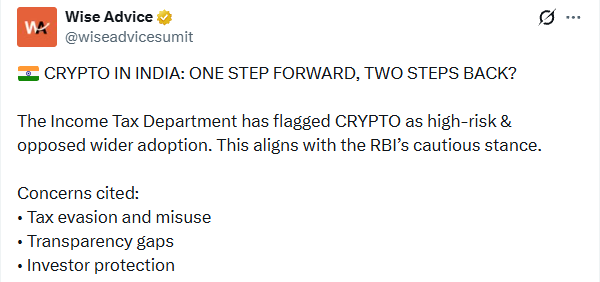
The big problem for the tax department is that crypto is "borderless". Unlike a bank transfer where there’s a clear paper trail, crypto can move across the world in seconds through private wallets or overseas apps. This makes it a nightmare for the government to track who owns what and who owes taxes. By speaking up now, the I-T department has officially joined the RBI in a unified front, treating crypto more like a threat to the country’s wallet than a helpful new technology.
A Unified Front: I-T Department and RBI Coordinate on Crypto Risk
The government is no longer just "concerned" they are taking action. Over the last few weeks of 2025 and into early 2026, thousands of Indian crypto users woke up to official emails known as Section 133(6) notices. These aren't just "hello" notes; they are serious demands for information.
The tax office is now using data from the 49 exchanges registered with the Financial Intelligence Unit (FIU). This means if you’ve traded on a major Indian app, they likely already know your numbers. They are cross-checking the 1% TDS (the tax cut from every trade) with your yearly income reports. If things don’t add up, you’re going to have to explain why.
The Strategy of Containment
Right now, India’s plan seems to be "regulatory containment". Think of it like putting digital asset in a very small, very expensive box. By keeping a flat 30% tax on any profits and refusing to let people subtract their losses, the government is making it very hard for the average person to make money.
Officials told Parliament that because Bitcoin is decentralized, it’s "virtually impossible" to recover unpaid taxes without help from other countries. So, instead of trying to chase every single coin, they are making the rules so strict that only the most dedicated (or daring) traders will stay in the game.
Safeguards vs. Friction
To keep things transparent, every company dealing in digital asset must now register with the government. While this sounds like a good safety measure, many experts say it’s actually creating "friction". For example, if you make a profit on bitcoin but lose an equal amount on Ethereum, you still have to pay 30% on the Bitcoin win. You can’t use the loss to balance it out. It’s a "heads they win, tails you lose" situation for the taxpayer.
Conclusion
As we get deeper into 2026, the message from New Delhi couldn't be clearer: the "free-for-all” days of Indian crypto are done. For the millions of Indians who were excited about the digital economy, the reality is a bit of a cold shower. With the tax office and the RBI now working as a team, the focus is entirely on control and compliance. For now, the Indian market is a place where you can still play, but you’ll have to pay a very high price to do so.
