$600B Trump Tariffs Hang in Balance Ahead of Supreme Court Decision

The fate of a $600 billion trade policy swings on a judicial gavel. The Supreme Court prepares to decide whether former President Trump's signature tariff framework stands or falls—a ruling that could reshape global supply chains overnight.
The Legal Precipice
Nine justices now hold the power to validate or vaporize one of the most contentious economic maneuvers in recent history. The case doesn't just review policy—it challenges the very authority behind it, questioning the limits of executive power in trade wars. Legal scholars are glued to the docket, while warehouse managers from Long Beach to Hamburg hold their breath.
Market Jitters & The Ripple Effect
Futures markets twitch with every rumor from the courthouse steps. A reversal would unleash a tsunami of recalculations across manufacturing, retail, and agriculture. Companies that spent years rejigging their supply lines for a tariff-heavy world face yet another costly pivot. Analysts whisper about 'regulatory whiplash'—the exhausting cost of doing business when the rules change every election cycle.
The $600 Billion Question
At its core, this is a battle over who controls the economic levers. The figure isn't just a number; it's a symbol of a protectionist stance that defined an era. Overturn it, and you unravel years of corporate strategy. Uphold it, and you cement a precedent that could empower future administrations to wage trade battles with a freer hand. The decision cuts both ways, leaving no market untouched.
A Provocative Close
One thing's certain: the winners will be the lawyers and consultants billing by the hour to navigate the aftermath—because in global finance, complexity is always a revenue stream. The gavel falls soon. The $600 billion question awaits its answer.
What's the News?
The US markets experienced intense volatility after the December employment report indicated that unemployment had dropped to 4.4% and the Supreme Court was yet to give its long-awaited decision on the tariffs that the President had imposed.
Supreme Court Delays Trump Tariff Decision
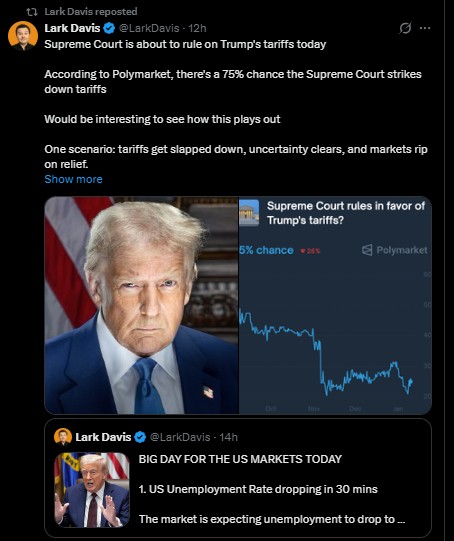
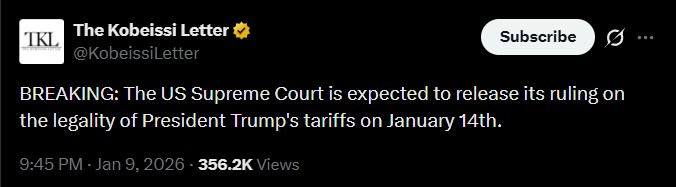
President Donald Trump’s long-standing tariff strategy is once again shaking US markets as the Supreme Court prepares to rule on the legality of his emergency trade measures. The decision, expected on January 14, could determine the future of nearly $600 billion worth of tariffs imposed since 2018 under emergency powers that bypassed Congress.
Source: Lark Davis X
According to Polymarket, the probability of the taxes being ruled illegal briefly surged above 70% before easing to around 31% after the court delayed its ruling. In case it is struck down, the US government might have to pay back about $133 billion that it has been collecting from importers, and this could have a Ripple effect on the world trade and financial markets.
Trump has made an overt appeal to the Americans to pray that the court will reach a favorable decision, highlighting the importance of tariffs to his economic and political agenda.
Court Delays Keep Volatility Alive.
The markets were on the verge of getting an instant decision on January 9, but the Supreme Court decided not to issue its verdict, prolonging the guessing. More than 1,000 companies have attacked the tariffs, claiming that TRUMP had gone beyond executive powers by citing national emergency legislation as a means of long-term trade policy.
An earlier Federal Reserve study in 2021 had previously estimated the tariffs to have cost the US economy almost $195 billion, but the proponents claim that they served to shield the home manufacturing. No verdict is reached yet, and the investors are waiting anxiously, either a relief rally or the new turbulence, depending on the result.
Source: X
US Employment Data Complicates Tariff Debate as Unemployment Falls
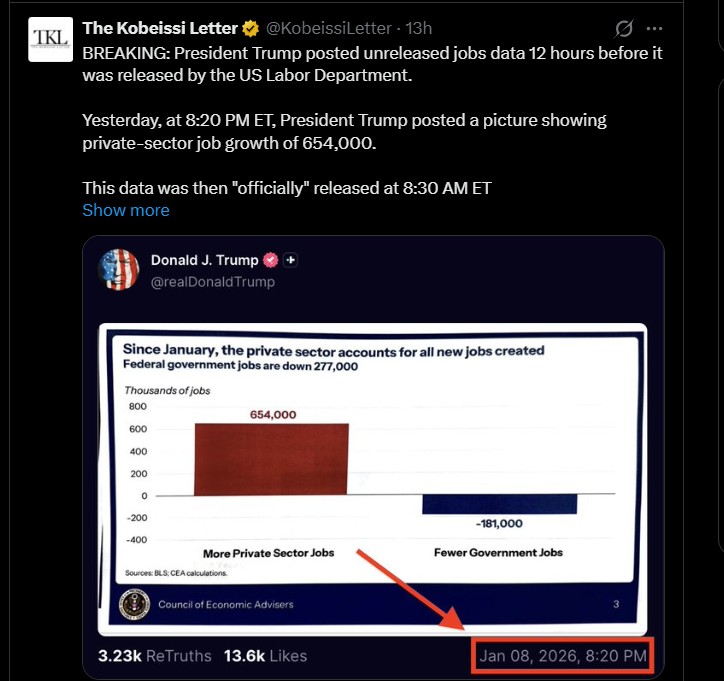
As the crypto markets were shaken by tariff uncertainty, new labor data was a shock. In December, the US unemployment rate dropped to 4.4%, which is below the expectations of 4.5%.
The figure for November was also adjusted downwards, which supports the evidence of a strong labor market. Nevertheless, the rate of job creation was low, as only 50,000 new jobs were created, which was lower than expected. This ambivalent image indicates that there is no growth in the economy that is accelerated; rather, it is stable.
Source: X
How Jobs Data Strengthens Trump's Tariff Position?
The higher unemployment indicator makes the economic story of rates difficult. Advocates claim that tariffs have served to preserve jobs and manufacturing in the country, whereas opponents fear they contribute to inflation and increased consumer prices.
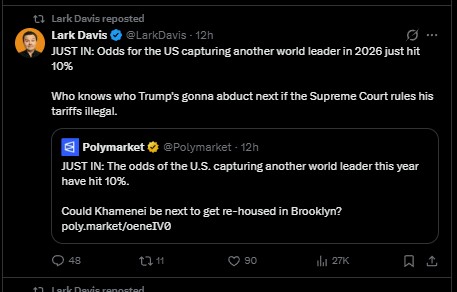
A strong labor market will minimize the pressure on the Federal Reserve to lower the rates aggressively. Falling unemployment will further reinforce the Fed's pause position, with January rate cut odds already approaching 13 percent, which will provide Trump with additional ammunition to justify tariffs as economically viable.
Source: X
What is So Important about Trump Tariffs to Markets?
The Trump tariffs that have been introduced have turned out to be a significant political and economic concern before the midterm election. Recently, the President has further increased the populist economic policies, such as demands for lower gas prices, limits on credit card interest rates, and vigorous arm-twisting of the Fed to reduce rates.
Should the tariff be ruled unconstitutional by the Supreme Court, there WOULD be relief in the markets as uncertainty is eliminated. Nevertheless, traders are also worried about unforeseen policy moves by Trump, which would create new volatility in stocks, bonds, and cryptocurrencies.
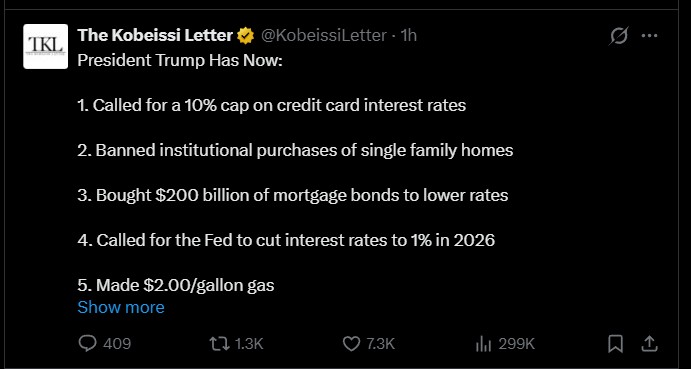
Source: X
Final Words
The fact that the labor market has improved to a greater extent than was expected, combined with uncertainty regarding the rates proposed by Trump, has preconditioned further volatility. As a major Supreme Court ruling approaches, the US markets are going into a critical and uncertain phase.
Disclaimer: This is not financial advice. Please DYOR before investing. CoinGabbar is not responsible for any financial losses. Crypto assets are highly volatile, and you can lose your entire investment.
