Altcoins Defy Gravity as Bitcoin Plunges 24% in November

While Bitcoin takes a 24% nosedive this month, alternative cryptocurrencies are showing surprising resilience—proving there's more to crypto than just the king coin.
The Great Decoupling
Altcoins aren't just holding their ground—they're staging a quiet rebellion against Bitcoin's dominance. While BTC investors watch their portfolios bleed red, alt traders are finding pockets of green in unexpected places.
Strength in Diversity
Major altcoins across DeFi, gaming, and infrastructure sectors are demonstrating remarkable stability. Some are even posting modest gains while Bitcoin continues its downward spiral—because nothing says 'mature market' like selective panic.
The Silver Lining Playbook
Traders are rotating into alt positions faster than Wall Street bankers can say 'diversification.' The smart money knows that when Bitcoin catches a cold, some alts barely sneeze—though others do catch pneumonia.
As traditional finance pundits predict crypto's imminent demise (again), the altcoin market quietly builds its case for independence. Because sometimes the best hedge against Bitcoin volatility is, well, not Bitcoin—a concept that would give your average financial advisor an aneurysm.

November, typically one of the bullish months of the year, has been covered in red, as Bitcoin has fallen sharply.
But in the middle of this chaos, altcoins are acting in a way no one expected. Well-known analyst Bull Theory says altcoins are not crashing with Bitcoin, they are actually holding up better.
This rare behaviour may be the first sign that the market is getting ready for a new phase.
Altcoins Refuse to Collapse, While Bitcoin Bleeds
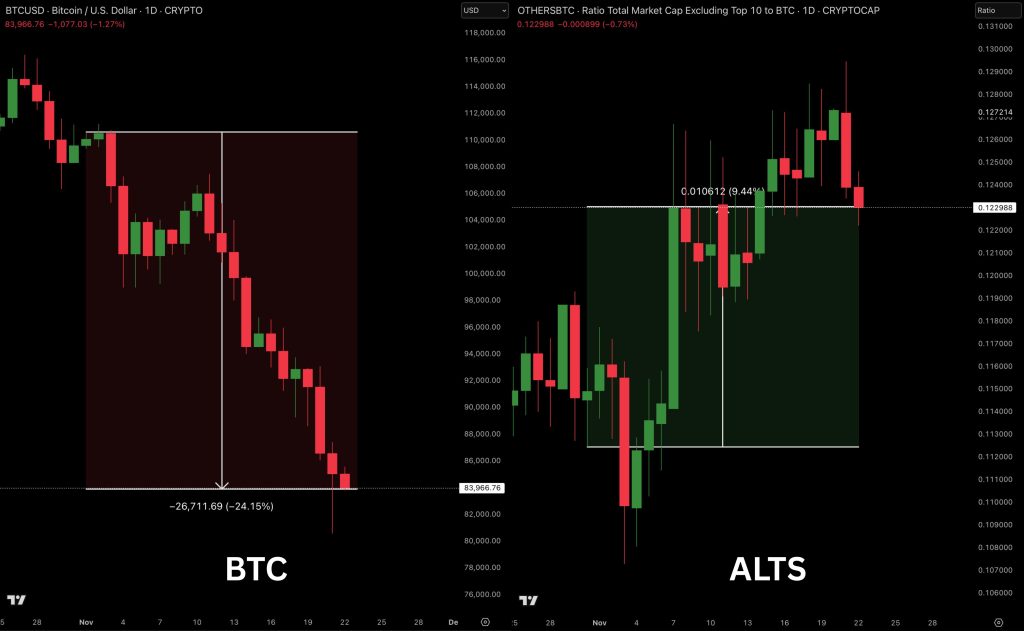
Crypto analyst Bull Theory highlighted a major change occurring quietly on the charts. While bitcoin has fallen more than 24% in November, the ALT/BTC ratio has increased by nearly 9.5%.
Normally, when Bitcoin falls this much, altcoins fall even harder. But this time, they are holding up instead of breaking down.
According to the analyst, this typically occurs only after a strong wave of altcoin seller exhaustion, when most holders have already sold, leaving little selling pressure behind.
However, the ALT/BTC chart supports this view, showing that altcoins faced heavy selling in October, but from early November they slowly started to rise, even as Bitcoin continued to fall.
60% of Binance Volume Goes to Altcoins
Backing this view, CryptoQuant analyst Maartunn pointed out a big shift in trading activity on Binance. He noted that altcoins now make up around 60% of all trading, the highest level seen since early 2025.
In comparison, Bitcoin and ethereum together account for only about 20%.
This kind of trading split has often appeared during periods when traders become more active and take more risks.
Bitcoin Reaches Oversold Levels
While altcoins are showing unexpected strength, Bitcoin is hitting some of its most oversold levels in years. The daily RSI has dropped to its lowest point in two years, and the weekly RSI is now back to where it was in January 2023.
On top of that, the daily MACD is at its lowest reading ever recorded. These kinds of signals usually appear when a sell-off is close to ending, not when a new downtrend is just starting.
These signs usually show up when a big fall is almost done, not when a new crash is starting. This means Bitcoin might be close to finding a short-term bottom soon.
As of now, bitcoin is trading around $83,953, reflecting a jump of 2.5% seen in the last 24 hours.
