Aptos (APT) Crashed 90%—Here’s Why Big Money Still Isn’t Fleeing

Aptos bled out. The APT token shed a staggering 90% from its peak, a wipeout that would send most retail portfolios into a tailspin. Yet, the whales—the institutional players and venture funds with skin in the game—aren't hitting the sell button. Why hold a bag that's lost nine-tenths of its value? The answer cuts to the core of high-stakes crypto investing.
The Long Game vs. The Quick Flip
Major backers aren't trading memecoins. They placed foundational bets on Aptos's tech stack—its parallel execution engine and Move programming language—designed to solve blockchain's scaling trilemma. A 90% drawdown in a bear market? For them, that's a brutal stress test, not a failure signal. It's the difference between speculating on price and investing in infrastructure, a nuance often lost between quarterly earnings reports.
Ecosystem Momentum Defies Token Price
While APT's price action paints a grim picture, development activity tells a different story. Developer onboarding, Total Value Locked (TVL) in decentralized finance, and key partnerships have continued their crawl forward, independent of the token's market sentiment. Smart money watches these metrics, not just the candlestick charts. They're betting the underlying utility will eventually drag the market price kicking and screaming back to reality—or at least that's the hope they're selling.
The Sunk Cost Fallacy or Strategic Conviction?
Let's be cynical: some holders are simply trapped. Exiting a position that large after a 90% drop is an admittance of failure most fund managers would rather bury in a footnote. Other times, it's pure strategy; accumulating more at a severe discount lowers the average entry price, setting the stage for a legendary comeback narrative... if one ever materializes. It's a high-risk game of patience, where the only thing harder than losing 90% is explaining to your investors why you did.
So, while retail traders rage-quit, the institutions are playing a different game entirely. They're not looking at the same chart. They're weathering the storm, convinced the foundational tech will outlast the market's manic depression. Whether that's visionary or foolish is a bet that's still very much in play—and one that costs 90% less to make than it used to.

Aptos has become one of the toughest stories in the altcoin market this year. The APT price has collapsed nearly 90% from its highs close to $20, turning what was once a next-gen Layer-1 contender into one of the most heavily discounted cryptos of the cycle. Retail faith has evaporated, builders have gone quiet, and social sentiment has flatlined. Yet, one group still hasn’t walked away—the major investors who backed Aptos early.
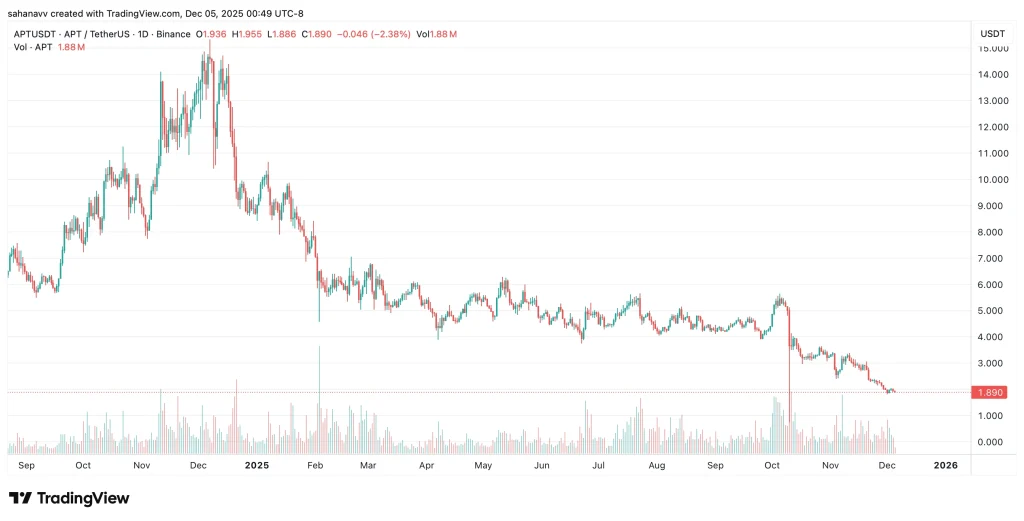
A Crisis Driven by Tokenomics, Not Technology
Aptos is not in trouble because its tech lags behind competitors. It’s struggling because its tokenomics worked against its own ecosystem.
A massive total supply of 1.18 billion APT and a circulating supply already crossing 733 million created a relentless supply overhang. Monthly unlocks of 11.3 million tokens continuously flood the market, generating steady sell pressure. November’s unlock—worth tens of millions—lined up with yet another sharp dump.
The unlock design was too aggressive for a young L1 still trying to build narrative momentum. Staking exacerbated the issue: almost 80% of the supply is staked at ~7% yield. This looks healthy on paper, but creates:
- Continuous dilution
- Locked liquidity
- A shortage of new buyers whenever the unlocks hit
This combination crushed momentum long before the market did.
A Chain Without a Clear Identity in a Competitive Market
The ecosystem’s challenge isn’t inactivity—it’s direction. On-chain data shows stablecoin growth, RWA initiatives, and partnerships, yet no breakout consumer app to define Aptos.
Meanwhile:
- Solana captured retail culture, DEX dominance, and meme velocity
- Sui gained developer mindshare in the Move-language niche
- Ethereum L2s pulled in real DeFi capital
Aptos ended up in the middle—good tech, but no narrative powerful enough to attract attention in a market where attention is oxygen.
So Why Haven’t Big Investors Left?
Despite the brutal year, Aptos still holds long-term value drivers that institutional backers care about:
The Road to Recovery: A Necessary Reset
Aptos is not dead. It’s at a reset phase, and the next steps will determine its future. Critical fixes include:
- Tokenomic restructuring: burns, reduced unlock velocity, sustainable staking
- Introducing liquid staking to unlock liquidity without mass selling
- Building at least one viral consumer app
- Owning a strong identity: “Institutional-grade RWAs + AI tooling on Move.”
If Aptos can execute even half of this ahead of the next liquidity cycle, a recovery toward the $5–$6 range becomes realistic. Beyond that, new highs depend on one thing alone—delivery, not promises.
