Stablecoins Are Quietly Winning Real-World Adoption. YouTube Just Showed Us Why.

Forget the hype—the real crypto revolution isn't happening on a volatile chart. It's happening in the quiet corners of everyday commerce, and a recent move by YouTube just proved it.
The Mainstream's Silent Embrace
While traders chase the next meme coin, stablecoins are doing the actual work. They're cutting out the friction of traditional payment rails, bypassing multi-day settlement times, and offering a digital dollar that doesn't swing wildly with market sentiment. It's infrastructure, not speculation.
Why YouTube's Move Matters
When a platform of that scale integrates stablecoin payments, it sends a signal. It's a validation that goes beyond crypto-native circles and lands squarely in the laps of millions of mainstream users. It's about utility—paying creators across borders without the traditional finance tax of high fees and slow transfers.
The Quiet Victory Lap
This isn't a niche experiment anymore. From remittances to corporate treasuries, the use cases are stacking up. The adoption is organic, driven by a simple value proposition: moving money should be as easy as sending a message. It turns out the killer app for blockchain wasn't a new form of money—it was a better way to use the old one.
The Bottom Line
The legacy system, with its love for taking a cut for the privilege of waiting, is getting a run for its money—literally. The real-world adoption of stablecoins is a quiet, persistent trend that's building the financial rails of the next decade. And for the traditional finance crowd still debating whether crypto is 'real'? They might not see it coming until it's already settled.
YouTube’s recent move highlights a bigger trend: mainstream platforms are choosing stablecoins, not Bitcoin or Ethereum, for real-world payments. When money actually needs to move, volatility isn’t an option—speed and predictability are. Stablecoins, which were once backend tools for traders, now process trillions and increasingly power creator payouts, gig work and cross-border commerce. YouTube isn’t the story; it’s the latest signal that stablecoins are becoming crypto’s first true mass-market utility.
YouTube’s New Payout Option Signals a Bigger Shift
As per the latest reports, YouTube has introduced stablecoin payouts—allowing U.S. creators to receive revenue in PayPal’s PYUSD via PayPal’s rails. This update is seen as a headline-worthy update this week. But the story isn’t really about YouTube. It’s about a macro trend hiding in plain sight: the largest platforms are integrating stablecoins, not bitcoin or Ethereum, into their payment infrastructure.
And that’s not a coincidence. Functionally, stablecoins solve problems BTC and ETH were never designed to fix: volatility, settlement speed, and global accessibility. YouTube is simply the latest proof.
Stablecoins Process More Value Than Most Blockchains Combined
Stablecoins have become the dominant FORM of on-chain money movement. The market cap of stablecoins has seen a drastic rise since Q4 2024, elevating the levels from around $170 billion to as high as $308 billion. At the same time, the event of a non-zero transfer of Stablecoin has been maintaining a steep ascending trend, reaching levels over a million per day.
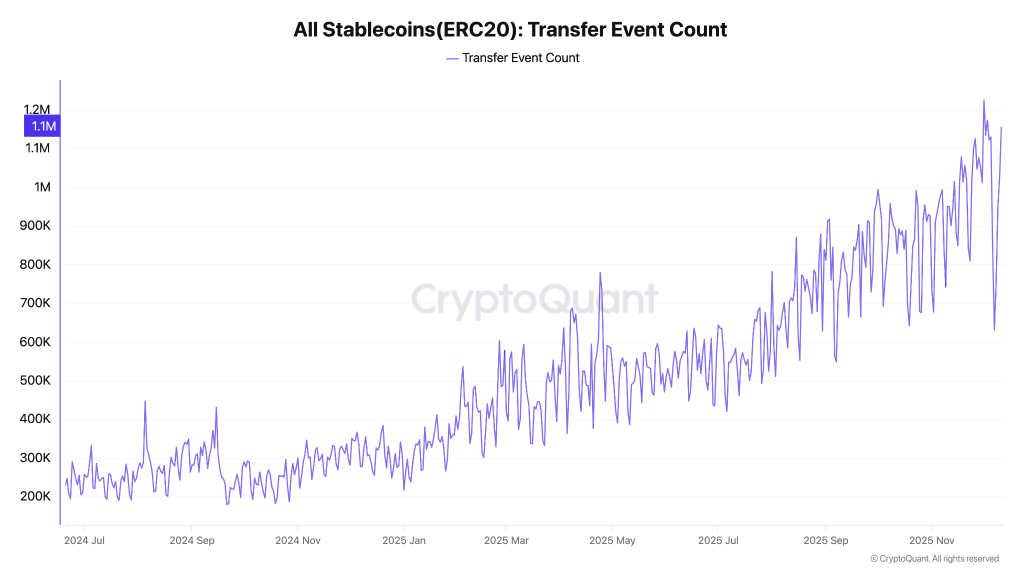
Alongside, over $8.9 trillion in stablecoin volume flowed across blockchains in the first half of 2025 — already outpacing many traditional settlement networks. Stablecoins accounted for around 30% of all crypto transaction volume between January and July 2025, according to TRM Labs. This isn’t speculation-driven liquidity—it’s transactional liquidity. And that distinction explains why large companies are choosing tokens like USDC and PYUSD as settlement tools.
Global Payments Networks Are Quietly Going On-Chain
The US GENIUS Act has been one of the major bullish factors for stablecoins, strengthening them and bringing them under regulation. Visa and Mastercard, two of the world’s largest payment networks, have both moved aggressively toward stablecoin integrations.
- Visa has launched stablecoin payout pilots targeting creators, gig workers, and freelancers—the same user demographic YouTube serves.
- Mastercard is building stablecoin rails into its Global Dollar Network, enabling cross-border settlement using USDC and PYUSD.
- OKX recently enabled USDC and USDT payments at GrabPay merchants in Singapore, bringing stablecoins to everyday retail.
What crypto exchanges did for traders, these companies are now doing for mainstream users. On the other hand, the corporations and the institutions are also preparing for a major shift. A JPMorgan note estimates stablecoins could generate $1.4 trillion in new USD demand by 2027, largely driven by global settlement and treasury flows. An EY-Parthenon survey shows 54% of corporates expect to adopt stablecoins within 6–12 months for cross-border payouts and treasury management.
Bitcoin Stores Value, Stablecoins Move It
Bitcoin may store value, and ethereum may enable innovation, but neither is built for everyday payments. Stablecoins are. They’re becoming the settlement layer for creators, businesses and institutions that need instant, borderless dollars without price swings. YouTube adopting PYUSD is one more data point in a structural shift: stablecoins are quietly becoming the rails of global money movement. The next phase of crypto adoption won’t be led by price action—it will be led by stablecoins powering real economic activity behind the scenes.
