Bitcoin’s Price Puzzle: Why It’s Stagnant While Gold & Silver Soar

Gold and silver are hitting fresh highs, leaving Bitcoin in the dust. What's holding crypto's flagship asset back?
The Safe-Haven Stampede
Traditional markets are rattled. Investors are piling into precious metals—the classic panic trade. Gold's surge screams uncertainty; silver's rally echoes it. Meanwhile, Bitcoin sits on the sidelines, watching the flight to safety bypass the digital frontier.
Liquidity's Lopsided Legacy
Old-school markets have deep, established pools of capital that move with herd instinct. When fear spikes, that capital floods into familiar harbors. Crypto's liquidity, while growing, still can't match the century-old plumbing of commodity markets—a fact that becomes painfully obvious during risk-off scrambles.
The Regulatory Overhang
While metals trade on clear, global frameworks, digital assets navigate a patchwork of regulatory fog. This uncertainty acts as an anchor, giving institutional money an excuse to wait on the sidelines or stick with the devil they know. It's the ultimate bureaucratic speed bump.
Narrative Divergence
Gold sells a story of timeless value preservation. Bitcoin sells a story of technological revolution. In times of acute stress, the simpler, older story wins. The complex promise of a new financial system gets shelved for the tangible comfort of a metal you can, theoretically, hold.
So, is Bitcoin broken? Hardly. This divergence highlights its evolving—and sometimes awkward—role. It's not yet the reflexive safe haven, but a risk asset with aspirations. Its moment will come when the narrative shifts from panic to progress. Until then, it's a stark reminder: in finance, sometimes the shiny new thing gets overlooked for the simply shiny. After all, Wall Street would rather bet on a rock than a protocol—at least until the commission on the protocol is higher.
Bitcoin Price is trading nearly 30% below its recent high, even as gold and silver post strong rallies. This gap has raised concerns among crypto investors, but it is not unusual.
In past cycles, money has often moved into gold and silver first before shifting into Bitcoin. After the March 2020 crash, gold and silver surged while Bitcoin stayed flat for months. Only after metals peaked did capital rotate into crypto, setting off Bitcoin’s major rally.
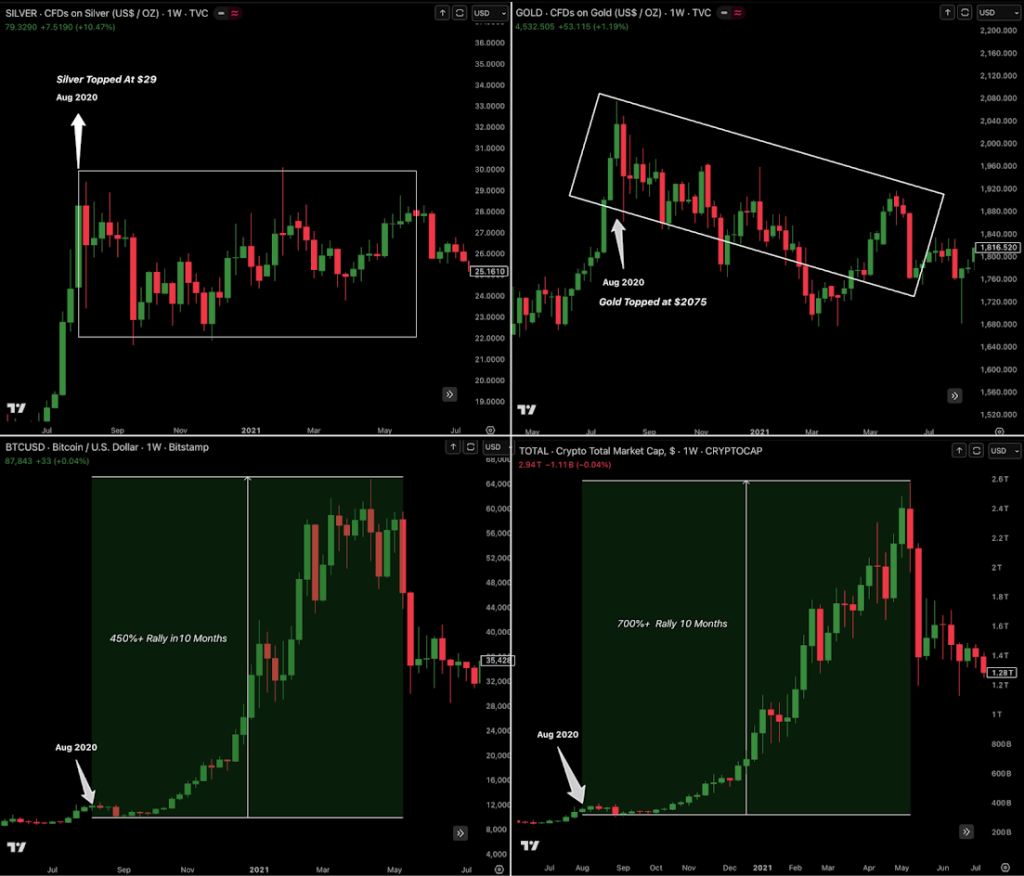
The current divergence follows the same pattern, suggesting this phase may be part of a normal market rotation rather than a sign of weakness in Bitcoin.
Why Silver Price Outperformed Gold and Bitcoin
Silver is surging due to a real supply shortage, not speculation. China, which controls most of the global silver supply, will restrict exports from January 2026 to only large, state-approved producers.
The market is already in a multi-year deficit, with demand far exceeding supply. Physical silver inventories on COMEX, London, and Shanghai have dropped sharply, pushing prices higher than paper market levels.
Growing industrial demand from solar panels, electric vehicles, and electronics has tightened supply even more, making silver one of the top-performing assets in major markets.
Bitcoin Consolidation Mirrors 2020 Price Action
Bitcoin is consolidating after a major liquidation in October, similar to the post-COVID selloff in 2020. Historically, bitcoin lags in the early stages of liquidity surges, while gold and silver absorb most of the initial capital.
This sideways trading is not a sign of weakness. It reflects investors waiting for confirmation before moving money into higher-risk assets like Bitcoin.
Bitcoin Price Analysis: Key Levels to Watch
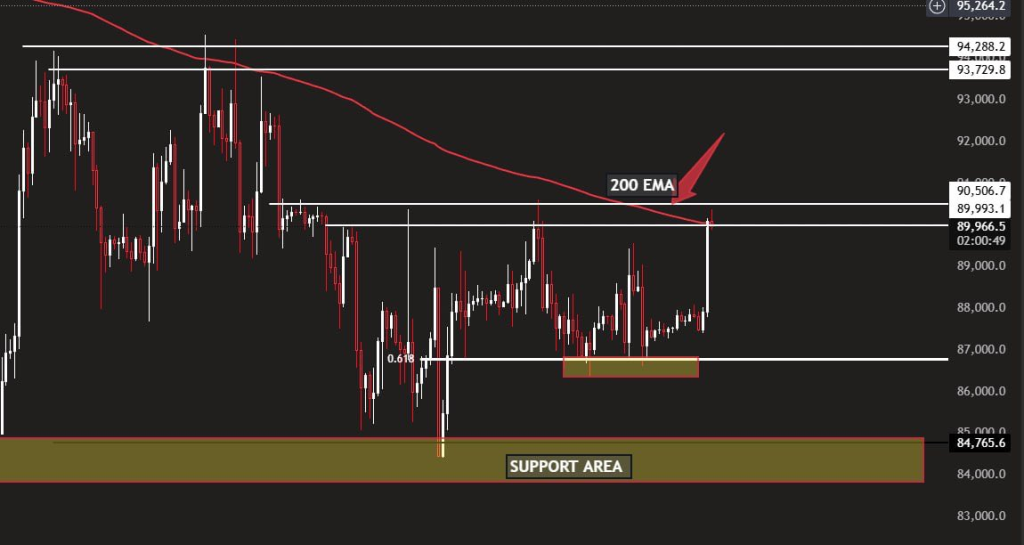
Bitcoin recently bounced from a strong demand zone, showing active buying interest. It is now approaching the 200-EMA, a key resistance level.
A clear break above the 200-EMA could push Bitcoin toward the $92,000–$94,000 range. If it fails to reclaim this level, Bitcoin may continue trading sideways in the short term.
Is Capital Rotating From Gold to Crypto?
Market signals are pointing to a potential rotation. The copper-to-gold ratio is recovering, a pattern that has historically signaled money moving from precious metals into risk assets during past crypto bull cycles.
Easing monetary conditions, clearer crypto regulations, and growing ETF access could allow Bitcoin to follow once metals stabilize. Historically, Gold and silver strength has been an early signal, not competition for crypto. If the pattern holds, Bitcoin’s current consolidation may be the calm before the next rally rather than the start of a decline.
