Vitalik Buterin Champions Individual Sovereignty on Ethereum as Bullish Momentum Builds

Ethereum co-founder Vitalik Buterin just dropped a manifesto for digital self-rule. His latest push for individual sovereignty on the blockchain isn't just philosophy—it's a direct challenge to the gatekeepers of traditional finance.
The Core Argument: Your Keys, Your Life
Buterin's vision cuts through the noise. He argues that Ethereum's real value proposition bypasses middlemen entirely—governments, banks, legacy institutions. The tech enables self-custody, decentralized identity, and uncensorable transactions. It's about building systems where users aren't just customers but sovereign entities.
Why This Matters Now
The timing is no accident. With institutional money flooding in and regulatory scrutiny intensifying, the battle for the network's soul heats up. Will it become a new walled garden for financial giants, or remain a foundational layer for individual autonomy? Buterin's advocacy stakes a clear claim for the latter.
The Bullish Backdrop
This philosophical stance lands amid roaring market optimism. Developers are shipping, major protocols are hitting new milestones, and the ecosystem's total value locked continues its climb. The narrative isn't just about price—it's about utility and adoption finally catching up to the hype.
So, while Wall Street tries to package decentralization into neat, fee-generating ETFs, the core builders are focused on something more radical: making you your own bank. Whether that's a utopian dream or the next inevitable financial layer depends on who you ask—and perhaps how much you've already invested.

Vitalik Buterin, a co-founder of ethereum (ETH), has reiterated the importance of individual sovereignty. The popular web3 developer argued that the Ethereum network was not created to make finance efficient or apps convenient but instead to set people free.
Buterin Urges Ethereum Developers to Build Trustless Products
In a bid to lead the Ethereum ecosystem towards a competitive future, Buterin has reiterated the importance of individual sovereignty. Buterin noted in an X post that the Ethereum ecosystem must focus on achieving resilience instead of convenience and efficiency.
He revisited the Trustless Manifesto to urge Ethereum developers to ensure individual privacy. Furthermore, Buterin led the Ethereum community in celebrating the breakthrough of achieving the blockchain trilemma through major network upgrades such as Fusaka in 2025 and the Merge.
“Resilience is the game where if you become politically unpopular and get deplatformed, or if the developers of your application go bankrupt or disappear, or if Cloudflare goes down, or if an internet cyberwar breaks out, your 2000ms latency continues to be 2000ms,” Buterin stated.
Institutions Bet on ETH Signals Bullish Outlook
Following the notable developments of the Ethereum network, more institutional investors are building on ETH. The clearer crypto regulatory framework in the United States, through the Genius Act and soon the Clarity Act, has helped the Ethereum ecosystem attract more institutions seeking to build stablecoins and other web3 projects.
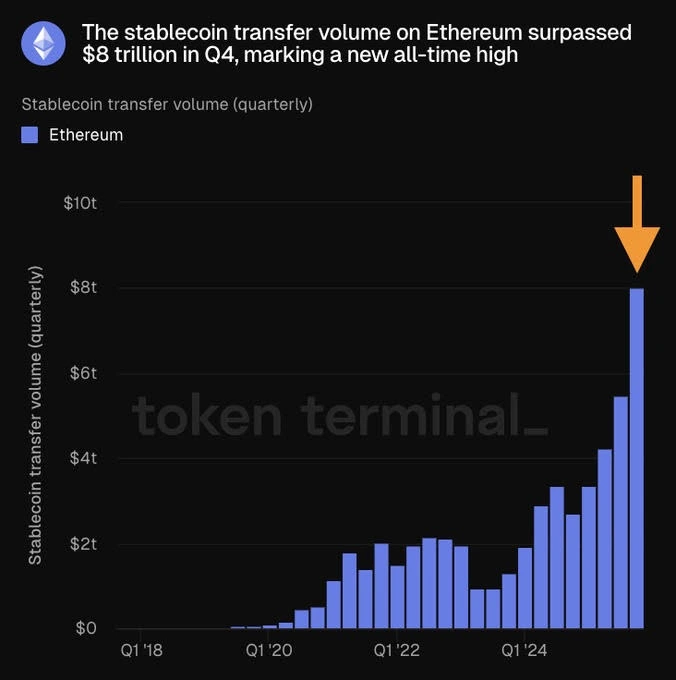
According to onchain data analysis from Token Terminal, Ethereum’s stablecoin transfer volume surpassed $4 trillion during the fourth quarter of 2025. Additionally, Ethereum’s real-world assets have edged higher in the past few months, according to Token Terminal.
What’s Next?
Following an impressive ETH price bullish rebound since the beginning of 2026, crypto analyst @Cryptorover on X believes that a bullish reversal towards $5,556 is imminent.
