Berkshire Faces New Era Without Its Iconic Leader: The Buffett Succession & What It Means for Traditional Finance

The Oracle of Omaha has left the building. Warren Buffett's departure marks more than a corporate transition—it's a symbolic passing of the torch for an entire investment philosophy. The market holds its breath.
A World Without Buffett's Gravitas
For decades, Buffett's annual letters were gospel. His folksy wisdom—‘be fearful when others are greedy’—anchored a generation of value investors. Now, the helm passes to a new team. The question isn't just about stock picks; it's about whether anyone can command the same cultural capital in a world of memes and algorithms.
The Institutional Machinery Grinds On
Berkshire's portfolio is a monument to 20th-century industrial might—insurance, railroads, candy. It's a bet on tangible assets in a rapidly dematerializing world. The new guard inherits a cash-hoarding behemoth, famously skeptical of tech bubbles and, until recently, entirely dismissive of digital assets. That stance is looking increasingly like a relic.
The Crypto Counter-Narrative
While Omaha debates succession, a parallel financial universe accelerates. Decentralized protocols operate 24/7, governed by code and community, not a single iconic leader. Here, ‘value’ is programmed, auditable, and often yields returns that would make even the most aggressive growth investor blush. The contrast couldn't be starker: one system waits on a single shareholder letter, the other updates in real-time on a blockchain.
Legacy vs. Lightning Pace
Buffett built an empire on patience and moats. Crypto builds on disruption and network effects. The succession at Berkshire highlights the fragility of personality-driven finance—a stark reminder that in traditional markets, you're often just betting on a manager's lifespan. Meanwhile, smart contracts don't retire.
The closing chapter for Buffett's Berkshire isn't just an end. It's a spotlight on the old world's vulnerabilities. The new era won't be defined by finding the next Oracle—it'll be built by systems that don't need one. After all, in the grand casino of finance, the house always wins... unless you rewrite the rules of the game entirely.
 Read us on Google News
In brief
- Warren Buffett officially leaves his CEO position at Berkshire Hathaway after more than 60 years of leadership.
- Greg Abel, his long-designated successor, takes over amid a financial climate marked by uncertainty.
- Berkshire Hathaway’s investment style, based on rigor and stability, should remain unchanged.
- His withdrawal symbolizes the end of a financial paradigm and raises questions about Berkshire’s future without him.
The end of an era : Warren Buffett officially passes the baton
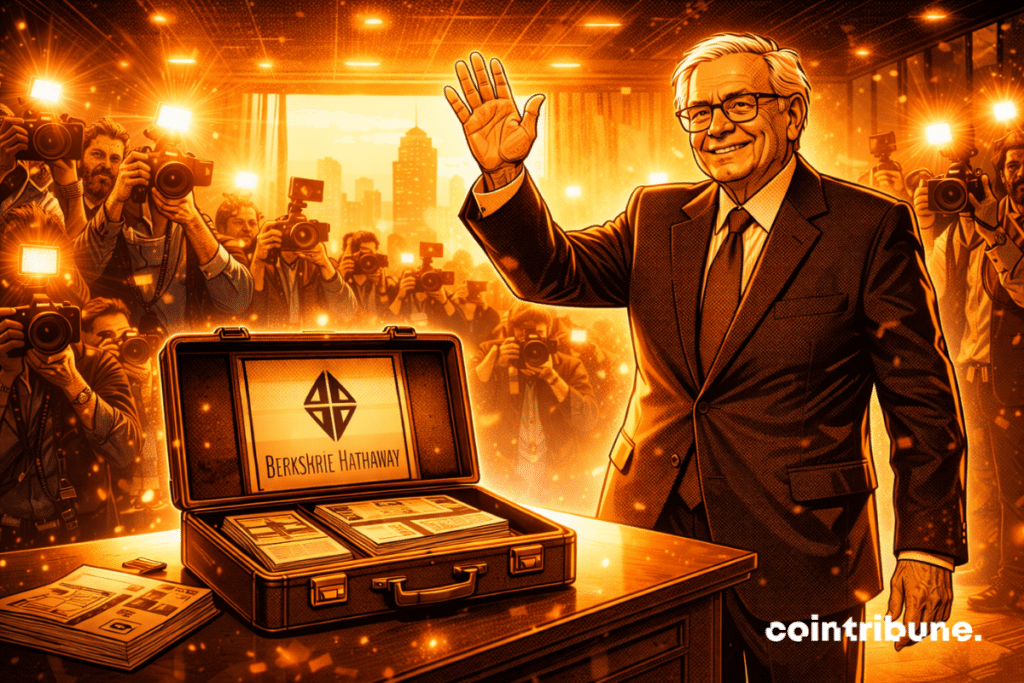
Warren Buffett leaves his CEO position at Berkshire Hathaway today, after more than 60 years at the helm of the conglomerate. This departure marks the end of a unique leadership in the modern history of finance. His long-designated successor, Greg Abel, officially takes office this Wednesday.
The group’s investment style, based on consistency, discipline, and ethics, should not change according to Howard Buffett, Warren’s son, who stated : “you do what you say you will do, and you do it when you say you will. You are honest about it. You make mistakes, and you take responsibility for those mistakes”.
A statement that summarizes the DNA of Berkshire Hathaway, a company that has become a symbol of stability in a stock market often volatile.
This transition comes as financial markets are in turmoil, notably under the influence of the rise of artificial intelligence. The Buffett Indicator, a market valuation barometer popularized by Buffett, has reached a historic level of 221.4 %, up 22 % since April 30.
This record, never observed since measures began in 1970, reflects a tense economic context. Buffett, faithful to his strategy, has maintained his stance despite the current euphoria. His portfolio remains focused on benchmark stocks in the technology sector. Among his key positions are :
- Apple, considered by Buffett as a strategic asset, held with rare consistency ;
- Amazon, despite a later exposure, now an integral part of the Berkshire portfolio ;
- Alphabet, Google’s parent company, illustrating his confidence in the tech giants ;
- And historically, the acquisition of Burlington Northern, a long-term industrial bet, far from speculative trends.
This prudent and rigorous management, even in a turbulent environment, confirms that the Buffett style will continue, at least initially, under Greg Abel’s leadership.
The challenge of continuity without the founding figure
While the traditional finance world salutes Buffett’s exit, an entire sector of the crypto universe remains unsatisfied.
In May 2024, in a public letter, Jai Hamid suggested he invest in Bitcoin before leaving, to, in his words, “close his legacy by opening it to the future”. This attempt, left unanswered, highlights a friction point between two worlds: on one side, a financial orthodoxy based on tangible fundamentals; on the other, a new, evolving ecosystem that Buffett consciously ignored.
However, Buffett has not been passive in the face of technological changes: his portfolio remains firmly anchored in traditional tech, with maintained positions in Apple, Amazon, and Alphabet. He has not publicly ridden the AI wave, but its impact is visible through the soaring Buffett Indicator.
This strategic discretion, faithful to his style, raises questions about the adaptation of the Berkshire model to the era of accelerated innovation. Greg Abel, though faithful to the Buffett doctrine, will have to navigate a less stable and more unpredictable environment than the one in which his predecessor built his legend.
Warren Buffett leaves the stage, but his legacy remains a guide. In a constantly changing financial world, 5 of his principles that you will do well to apply remain highly relevant: simplicity, discipline, patience, independent thinking, and integrity. More than just a departure, it is an invitation to rethink investment with clarity and rigor.
Maximize your Cointribune experience with our "Read to Earn" program! For every article you read, earn points and access exclusive rewards. Sign up now and start earning benefits.
