Trust Wallet’s Critical Update Hits Unexpected Delay—What Crypto Users Need to Know

Trust Wallet users are left waiting as a pivotal security and feature upgrade gets pushed back. The delay throws a wrench into the self-custody plans of millions—right as regulatory scrutiny tightens.
Timing is everything, and this isn't it. The postponed update, rumored to include enhanced multi-chain support and deeper DeFi integrations, arrives at a moment when users crave stability above all else. It’s a stark reminder that in crypto, your roadmap is only as good as your last deploy.
Behind the Scenes: More Than Code. These delays rarely happen in a vacuum. They often signal deeper integration challenges, last-minute security audits, or partner bottlenecks. For a wallet handling billions in assets, ‘move fast and break things’ isn’t a motto—it’s a liability.
The Self-Custody Trade-Off. This hiccup underscores the core tension of self-custody: total control comes with total responsibility. No customer support hotline to call, just community forums and hope that the devs post an update soon. It’s the ultimate ‘your keys, your coins, your problem’ scenario.
Looking Ahead: Trust Under Pressure. The wallet’s reputation hinges on navigating this smoothly. A clear communication plan and a flawless eventual rollout are non-negotiable. In the meantime? It never hurts to have a backup option ready—because in crypto, the only constant is unexpected change. Just ask anyone who’s watched a ‘sure thing’ token dive while the founders jet off to a non-extradition country.
 Read us on Google News
In brief
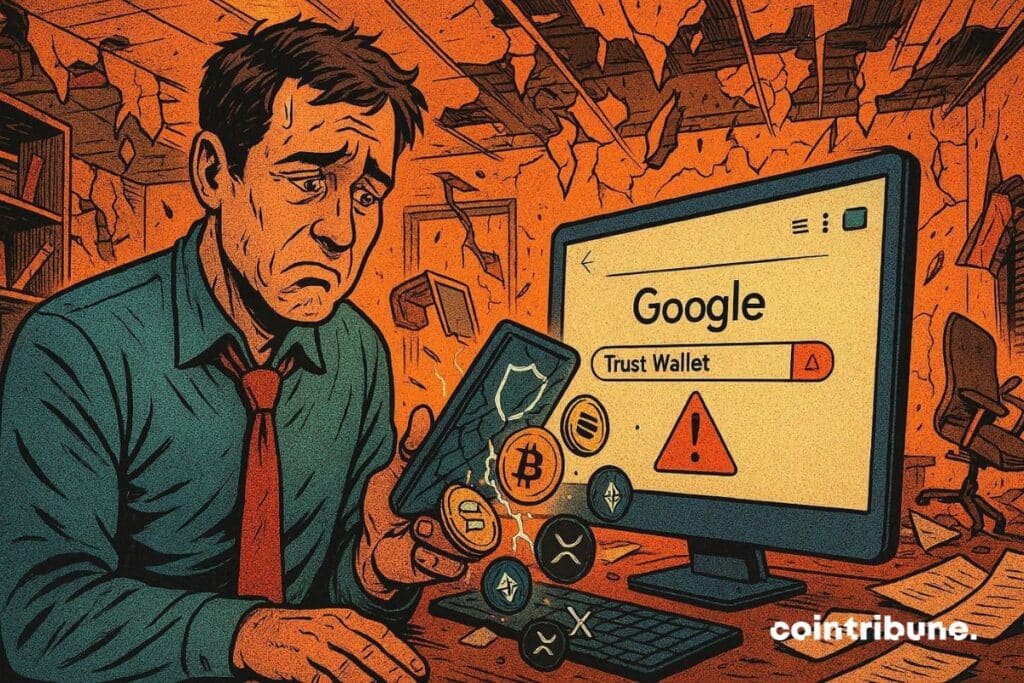
- Trust Wallet postpones crucial update to its Chrome extension after a hack stole $7 million from 2,596 users.
- The Trust Wallet hack exploits a stolen API key and a vulnerability related to the “Sha1-Hulud” incident.
- The year 2025, marked by repeated hacks, underlines the urgency of securing crypto tools to avoid further delays.
Trust Wallet, a delayed update, the crypto ecosystem on alert
On December 24, 2025, Trust Wallet was forced to temporarily withdraw its Chrome extension after discovering a corrupted version (2.68). Indeed, this malicious update allowed the theft of $7 million from 2,596 crypto wallets. Over 2,630 reimbursement claims were recorded, some of which are suspected to be fraudulent.
In this regard, Eowyn Chen, CEO of Trust Wallet, confirmed that the priority was to secure crypto users before deploying a new version (2.69). This situation highlighted vulnerabilities in browser extensions, often targeted by cybercriminals. As a result, Google is collaborating with Trust Wallet to resolve this flaw and prevent new incidents.
The incident reminds us of the importance of vigilance! Especially during periods of high activity such as the end-of-year holidays, when attacks multiply.
Trust Wallet: causes and consequences of a hack with major repercussions
The vulnerability exploited by crypto hackers originated from a stolen Chrome Web Store API key, allowing a malicious update to be published without internal checks. This attack is in line with the emph{“Sha1-Hulud”} incident, which compromised Trust Wallet development secrets on GitHub. The consequences are multiple:
- Loss of user trust;
- Increase in phishing attempts;
- Strengthening verification requirements for reimbursements.
Trust Wallet must now invest heavily in cybersecurity to restore its reputation, especially since the economic impact is significant. Moreover, the cost of reimbursements and security measures could affect the company’s profitability in the short term. Crypto users, for their part, are encouraged to carefully verify sources before any update.
2025, a year marked by crypto hacks
The year 2025 marked a turning point in cryptocurrency security, with billions of dollars stolen, according to Chainalysis. Among the major attacks, Bybit suffered a $1.5 billion hack mainly in ethereum in February, attributed to the North Korean group Lazarus. In November, Balancer lost $116 million through a vulnerability in its smart contracts.
These incidents highlight the urgency to strengthen security audits! But also to adopt solutions such as hardware wallets and two-factor authentication. Collaboration between crypto platforms becomes crucial to limit systemic risks.
The postponement of Trust Wallet’s update reminds us that security remains a major challenge for cryptocurrencies. However, crypto hacks are multiplying, and in 2025 alone, $3.4 billion were stolen. A crucial question arises: how to reconcile innovation and user protection in the ecosystem?
Maximize your Cointribune experience with our "Read to Earn" program! For every article you read, earn points and access exclusive rewards. Sign up now and start earning benefits.
