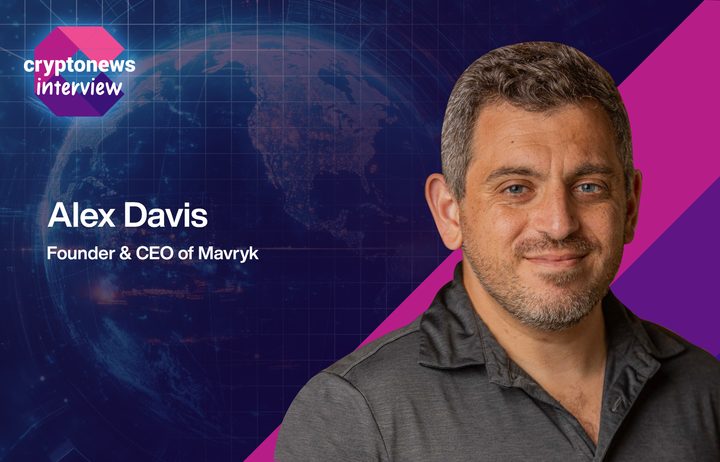
Mavryk CEO Alex Davis Reveals How Tokenizing Real-World Assets Unlocks Massive On-chain Yield

Forget waiting on Wall Street dividends. The real yield revolution is happening on-chain.
Alex Davis, CEO of Mavryk, is pulling back the curtain on a financial pivot that's turning everything from real estate to royalties into programmable, high-yield crypto assets. It's a move that cuts out the traditional middlemen—and their hefty fees.
From Paper to Protocol
The vision is stark: take the trillion-dollar world of illiquid, paper-based assets and digitize them. Tokenization isn't just about creating a digital twin; it's about injecting liquidity into markets that have been frozen for decades. Davis argues this process bypasses the slow, permissioned gates of legacy finance, unlocking value at a speed and scale that brokerages can't match.
Engineering Yield at Scale
Building sustainable on-chain yield is the core engineering challenge. It's not about speculative token pumps, but constructing reliable cash-flow engines from real-world revenue streams. The protocol's architecture is designed to aggregate these yields, offering investors a diversified product that—theoretically—moves independently of crypto's notorious volatility. A welcome change from watching charts all day.
Of course, skeptics in tailored suits will call it a fad. But when the alternative is a 0.5% savings account at a legacy bank that still charges you for the privilege of holding your money, the math starts speaking for itself. The race isn't just to tokenize the world's assets, but to prove that decentralized networks can manage them better than the incumbents ever did.
From Tezos to Tokenization Infrastructure
Before becoming CEO of Mavryk, Davis served as Head of Innovation for the Tezos blockchain’s MENA office. During that period, he co-founded a crypto investment company backed by a real-estate billionaire and helped launch the first venture-capital-backed DeFi application on Tezos.
That DeFi product was designed as a banking-style platform, allowing users to borrow against tokenized securities and use them as collateral. The vision was ambitious, but by late 2022, Davis and his team identified a key gap. While they had lending technology and deal FLOW from institutional investors, they lacked a blockchain infrastructure purpose-built for tokenized assets.
“We realized we didn’t have a chain that we believed WOULD be the future of RWAs,” Davis explains. The collapse of major crypto firms, including Terra, Celsius, and FTX, reinforced the need for a more institutional-grade foundation.
That realization led to a shift: instead of building solely on existing networks, the team decided to create its own infrastructure stack tailored specifically for tokenization and on-chain finance.
What Mavryk Actually Does
In its simplest form, Davis describes Mavryk as a company that digitizes investments using blockchain as the underlying technology. At a deeper level, Mavryk has built a full tokenization infrastructure that allows assets to be created, issued, distributed, and traded on both primary and secondary markets.
Why are we addicted to RWAs?
Because it feels like crypto growing up.
Not 100x promises. Not “maybe one day” roadmaps.
Just real assets, real yield, real ownership. Onchain.
RWAs are the moment where crypto stops guessing… and starts connecting to the real economy.
That’s… pic.twitter.com/R89DxYaEW8
Additionally, this infrastructure operates on Mavryk’s own network, allowing interoperability with lending, borrowing, and data oracles through its complementary platform, Maven. Tokenized equities, credit products, and other investments can be seamlessly integrated with on-chain yield, collateralization, and liquidity.
Davis likens the approach to Apple’s ecosystem. “When you use an iPhone, you know it works with your Mac, your AirPods, your Magic Mouse,” he says. “We’ve taken that same holistic view—making sure tokenization, lending, and data all work together.”
Mavryk is also moving toward institutional adoption. The firm is in the process of onboarding a bank in the UAE and has partnered with MultiBank, a major derivatives and CFD trading platform with roughly $35 billion in daily volume.
Why Now Is the Moment for RWAs
After years of pilots and proofs of concept, Davis believes the timing for tokenized real-world assets is finally right. Earlier attempts were hindered by fragmented infrastructure, limited regulatory clarity, and a lack of institutional understanding.
“Now it’s not just one thing clicking into place,” he says. “It’s multiple stars aligning—regulation, technology, and industry acceptance of blockchain as legitimate financial infrastructure.”
Geographically, Davis points to the UAE as the most forward-thinking jurisdiction for tokenized investments. Regulators there have moved beyond legacy securities frameworks toward modern investment laws designed for digital assets. By contrast, the United States is slower to adapt but could become a global catalyst once its regulatory shift fully materializes.
“When the U.S. moves, it moves like an aircraft carrier,” Davis notes. “But when it does, it hits like a hammer.”
Security, Scale, and the Road to 2026
Rather than competing directly with Ethereum-based RWA stacks, Davis sees Mavryk as complementing a growing industry. Adoption challenges, he argues, are less about blockchain rivalry and more about institutional risk tolerance.
Many institutions still operate with paper-based processes and view smart-contract vulnerabilities as unacceptable. To address this, Mavryk uses functional programming—often described as aerospace-grade code—to reduce attack surfaces and meet institutional security standards.
Looking ahead to 2026, Davis expects rapid expansion rather than immediate saturation. While estimates suggest the RWA market could grow to $16–30 trillion, he believes the real breakthrough will come from business-to-business-to-consumer (B2B2C) models that open private-equity access to a broader audience.
“Institutions don’t really need blockchain—retail does,” he says. Tokenization, in his view, should unlock institutional assets for retail investors and family offices that have historically been shut out. Mavryk is already backed by several family offices, including London-based Wentworth Hall.
Davis ties the rise of tokenization to deeper macro forces: unsustainable fiat money creation, growing demand for hard assets, and trillions of dollars locked in illiquid private equity. Tokenization, he argues, offers a release valve—bringing liquidity, access, and transparency to assets that have long remained closed.
“These forces are converging all at once,” he says. “That’s why RWAs aren’t just a trend—they’re becoming necessary.”
