Crypto-Friendly SEC Veteran Cicely LaMothe Retires After 24-Year Stint

Another pro-innovation voice exits the regulatory stage. Cicely LaMothe, a Securities and Exchange Commission official known for her nuanced understanding of digital assets, has stepped down after nearly a quarter-century at the agency.
Her departure leaves a vacuum in crypto expertise.
LaMothe's 24-year tenure spanned multiple market cycles, from the dot-com bust to the rise of decentralized finance. She built a reputation for engaging with blockchain projects on their own technical terms—a rare quality in a building often accused of regulatory stonewalling.
Insiders say her approach was pragmatic: dissecting whitepapers, parsing code, and asking how real-world applications actually functioned. This stood in stark contrast to the blanket skepticism that sometimes passes for due diligence in Washington.
The timing raises eyebrows.
Her retirement comes as the SEC faces mounting pressure to clarify its stance on everything from token classification to custody rules. The agency is juggling dozens of high-profile crypto enforcement actions while simultaneously trying to not stifle a multi-trillion-dollar industry. Losing institutional knowledge doesn't help.
Who fills the gap?
The finance world's revolving door will likely spin—another regulator trading their government badge for a lucrative private sector advisory role. It's the oldest play in the book: spend decades learning the rules, then get paid to help others navigate them. A cynic might call it a perfectly hedged career.
One thing's clear: the SEC's crypto learning curve just got steeper. And in a market that moves at blockchain speed, bureaucratic hesitation isn't just a delay—it's a strategic disadvantage.
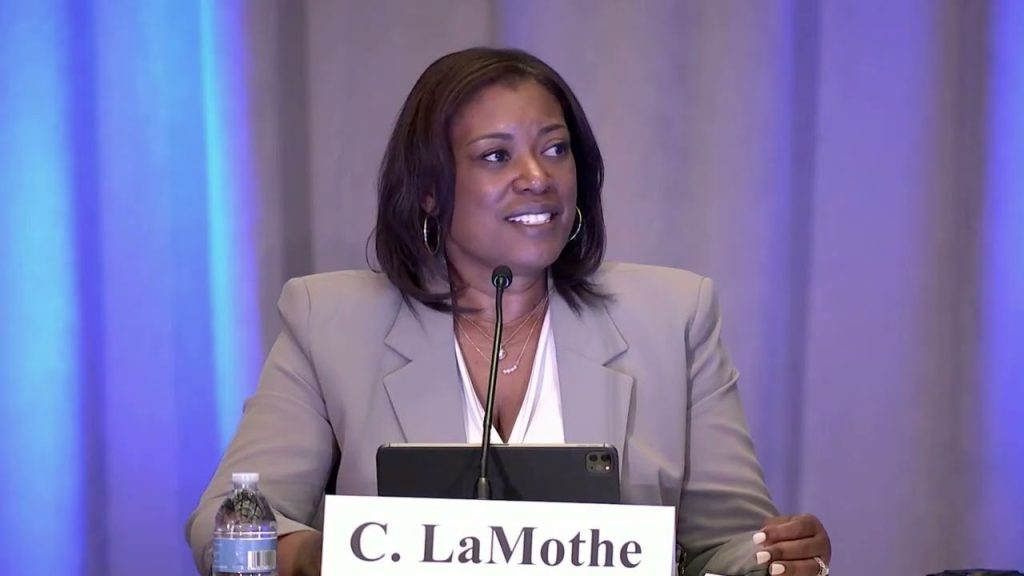 Source: PLI
Crypto Guidance Defined LaMothe’s Final Years at SEC
LaMothe oversaw the release of seven CF Staff Statements addressing rapidly evolving crypto matters, including liquid staking, stablecoins, mining activities, meme coins, and crypto exchange-traded products.
The guidance documents provided clarity on disclosure requirements as digital asset companies sought to navigate SEC registration processes.
“After more than two decades at the SEC, I depart with a DEEP sense of honor and gratitude for the opportunity to serve the American public,” LaMothe said in the agency’s announcement.
“The work has been incredibly challenging and rewarding, and I have learned immensely from the dedicated individuals who commit themselves daily to this critical mission.“
Beyond crypto policy, LaMothe expanded accommodations for companies submitting draft registration statements and drove recommendations on accelerating filings with mandatory arbitration provisions.
She issued over 25 new and updated Compliance and Disclosure Interpretations covering clawbacks, deSPACs, and Rule 10b5-1 plans.
LaMothe Faced Congressional Scrutiny Over Tron’s Nasdaq Debut
LaMothe’s role drew attention in September when Senator Jeff Merkley and Representative Sean Casten questioned her oversight of Tron’s reverse merger onto Nasdaq.
The lawmakers challenged the SEC’s February decision to pause enforcement proceedings against TRON founder Justin Sun, who later took the company public in July through a reverse merger.
Merkley and Casten suggested Sun’s investments in Trump family crypto ventures, including World Liberty Financial and the OFFICIAL TRUMP memecoin, may have influenced the case’s suspension.
They also raised national security concerns about Tron’s alleged ties to the Chinese government.
 SEC Chair Paul Atkins has addressed scrutiny over the TRUMP meme coin and Justin Sun’s $75M ties during a congressional hearing.#Crypto #SEChttps://t.co/dsWbJbB0s3
The lawmakers asked LaMothe and Chair Atkins whether tron met rigorous listing standards and how the SEC could protect investors through any Sun settlement.
During that time, their letter also highlighted broader questions about foreign crypto companies accessing US exchanges through similar merger structures.
Retirement Comes Amid Sweeping SEC Policy Shifts
LaMothe’s departure follows dramatic changes at the SEC under Atkins, who took over in April after Gary Gensler’s resignation.
The agency has dropped nearly 60 percent of crypto enforcement cases since Trump’s January inauguration, including high-profile actions against Coinbase, Kraken, and Binance.
 The @SECGov has sharply scaled back its enforcement actions against the cryptocurrency industry since @realDonaldTrump returned to office.#SEC #Trumphttps://t.co/NCTPm62pCR
In September, Atkins told Fox Business the SEC now issues warning notices before enforcement actions, rejecting Gensler’s lawsuit-first approach.
He said most tokens are not securities and support tokenized asset trading with the same legal rights as underlying instruments.
The agency also launched a Crypto Task Force and is developing an innovation exemption designed to support crypto firms experimenting with blockchain-based services.
Atkins said the measure could be finalized by year-end, despite many economic, seasonal, and democrats obstacles along the way.
Meanwhile, Senate leaders are racing to pass the Responsible Financial Innovation Act before 2026.
The bill WOULD clarify SEC and CFTC jurisdiction over digital assets, establish a joint advisory committee, and protect DeFi developers from securities laws if protocols remain decentralized.
LaMothe’s retirement also coincides with mass departures from the SEC.
Reuters data shows the agency lost up to 19 percent of full-time staff in key divisions during May, prompting Representative Maxine Waters to demand oversight hearings with Atkins.
 Representative Maxine Waters calls for SEC oversight hearing as agency drops crypto enforcement cases against Coinbase and Binance under Chairman Atkins.#SEC #Cryptohttps://t.co/jrgJqAVibK
Waters questioned whether the SEC maintains sufficient human capital to accomplish its mission following what she called “” under the Trump administration.
