Zcash as Corporate Treasury Play? Cypherpunk’s 2% Bet Sparks Debate

A major crypto fund just made a statement—loading up on nearly 2% of Zcash's total supply. Is this a speculative moonshot, or a calculated bet on privacy tech hitting the corporate mainstream?
The Privacy Premium
Corporate treasuries have flirted with Bitcoin for years, chasing its digital gold narrative. But the real game-changer might be assets that offer something Bitcoin doesn't: true transactional privacy. Zcash's shielded transactions let companies move value without broadcasting their strategy to the world—a feature that bypasses the prying eyes of competitors and, let's be honest, overzealous regulators.
Beyond the Speculative Frenzy
This isn't just about price charts. It's a wager on infrastructure. As blockchain analytics firms turn public ledgers into open books, the demand for optional privacy shifts from a niche cypherpunk ideal to a legitimate business necessity. The fund's massive accumulation signals a belief that the market still undervalues this utility.
The Regulatory Tightrope
Adoption won't be a straight line. Privacy coins make compliance officers sweat, offering a convenient scapegoat for finance bureaucrats who'd rather debate obscure rules than adapt to new technology. The path forward requires tools that balance auditability with confidentiality—a challenge Zcash's technology is built to address.
The move raises a provocative question: in an era of unprecedented financial surveillance, will corporations pay a premium for the right to keep their business private? One fund is betting nearly 2% of the entire supply on 'yes.' After all, in traditional finance, the most lucrative deals are always the ones nobody sees coming.
Cypherpunk Sets Its Sights on 5% of the Zcash Network
Chief investment officer Will McEvoy said the company is working toward a long-term goal of holding 5% of the Zcash network.
He framed the strategy around the growing relevance of financial privacy while also pointing to plans to expand into other privacy-focused technologies.
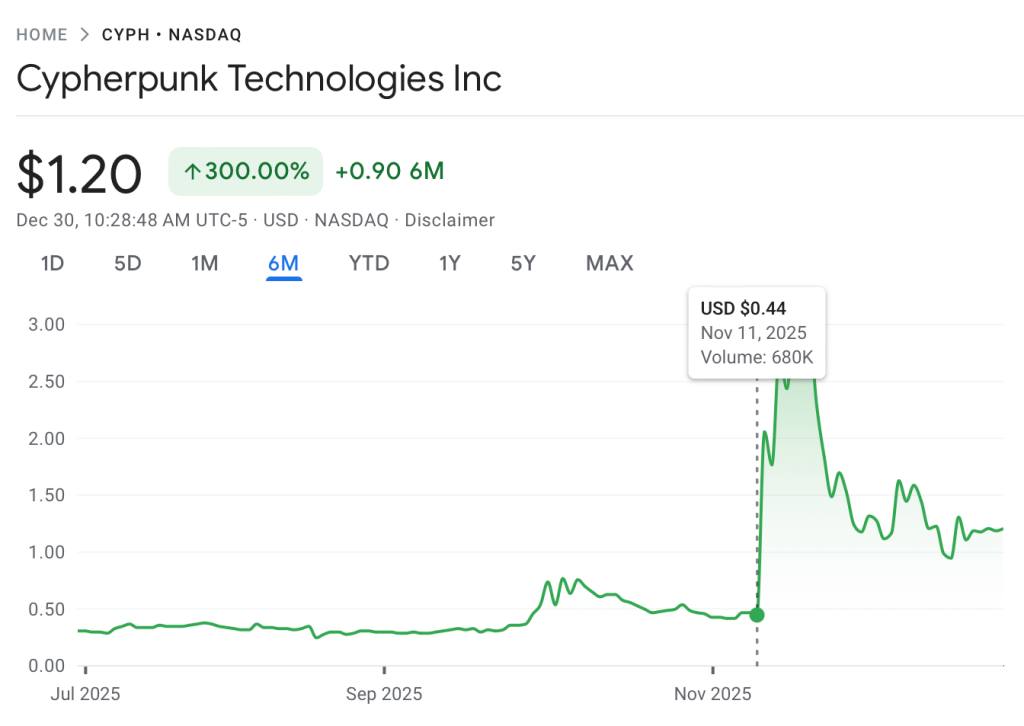
The MOVE comes after a sharp corporate pivot, as the firm was formerly known as Leap Therapeutics before rebranding in November as Cypherpunk Technologies and has now repositioned itself as a Zcash-focused digital asset company.
Its stock has been increasing almost 170% since the rebrand, up to approximately $1.18 compared to approximately $0.44, as per Google Finance.
Zcash, in its turn, has been registering among the most robust performances in the crypto market this year. The token has increased over 800% in the last 12 months and currently trades at roughly $530, based on CoinGecko.

Bitcoin, by comparison, is down by approximately 5% over the same period, though ZEC was up almost 27% in the past 7 days alone.
Notably, Zcash daily trade volume dropped by approximately half to approximately 499 million dollars in the last 24 hours, showing that activity slowed following the recent explosion.
As Bitcoin Dominates Treasuries, Zcash Offers a Privacy Alternative
Zcash is a fork of Bitcoin, which was released in 2016 and has many structural features in common with BTC, such as a limit of 21 million coins and a proof-of-work blockchain.
The difference lies in the privacy, in which Zcash employs zero-knowledge, known as zk-SNARKs, proofs that users can use to conceal the transaction information like sender, recipient, and value, yet still provide optional transparency and auditability by using viewing keys.
Those features have shaped how ZEC is being discussed as a treasury asset. Bitcoin’s appeal to corporations has rested on verifiable scarcity, deep liquidity, and growing regulatory clarity, reinforced by the approval of U.S. spot bitcoin ETFs earlier this year.
Companies holding BTC typically treat it as a long-term store of value or macro hedge, with potential returns tied to price appreciation rather than operating income.
Zcash, by comparison, is often described by companies adopting it as a hedge centered on privacy.
Cypherpunk and a small number of other firms, including Reliance Global Group, have cited the need to protect sensitive financial activity as a reason to hold ZEC.
Like Bitcoin, Zcash does not generate cash flow, and any treasury “revenue” WOULD come from unrealized or realized gains if prices rise.
Market participants are divided on near-term price direction, with Former BitMEX CEO Arthur Hayes saying ZEC could be setting up for a move toward $1,000, pointing to potential liquidity shifts that may favor privacy-focused assets.
The tears of the bears shall be my sustenance. $ZEC first stop $1k pic.twitter.com/FPCZbNxMTj
— Arthur Hayes (@CryptoHayes) December 29, 2025However, others are more cautious, as analyst Eric Van Tassel has warned a pullback toward $400 is possible, while macro investor Raoul Pal recently described Zcash’s rally as looking more like capital rotation than a confirmed long-term trend.
Even after its recent surge, Zcash remains more than 80% below its all-time high of $3,191.93.
