6 RWA Predictions for 2026: From Pilots to Standard On-Chain Products

Forget pilots—real-world assets are going mainstream. By 2026, tokenization won't be an experiment; it'll be the new plumbing of global finance.
Prediction 1: The Treasury Tidal Wave
Corporate treasuries flood on-chain. Why? Instant settlement and 24/7 markets slice through the old-world friction of wire transfers and business hours. Six major firms already signal the move.
Prediction 2: Private Credit's Digital Makeover
Illiquid private debt gets a liquidity injection. Fractional ownership opens the asset class to a new tier of investors, bypassing traditional gatekeepers and their hefty fees.
Prediction 3: The Green Bond Revolution
Climate finance gets transparent. Every solar panel or carbon credit tied to a bond becomes trackable on a public ledger—cutting greenwashing and boosting investor trust.
Prediction 4: Real Estate's Liquidity Moment
Commercial property ownership fragments. Tokenization turns skyscrapers into tradable pieces, unlocking capital for owners and creating a secondary market that doesn't exist today.
Prediction 5: Supply Chains Settle On-Chain
Trade finance ditches paper trails. Smart contracts auto-execute payments upon delivery verification, slashing disputes and freeing up working capital trapped in logistics.
Prediction 6: The Regulatory Green Light
Watch for a major jurisdiction to launch a comprehensive RWA framework. It won't be a sandbox—it'll be a highway, providing the legal certainty big money demands.
The shift is structural, not speculative. While traditional finance debates committee structures, blockchain is rebuilding the foundation. The real prediction? By 2026, the term 'RWA' might just disappear—because it'll all just be 'assets.'
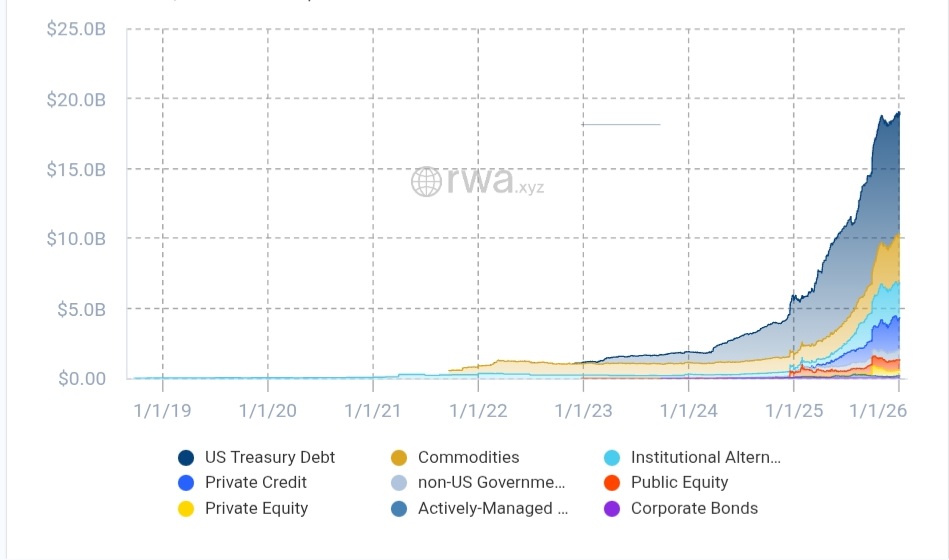 Tl otarWA value. Source: rwa.xyz
A Focus on Transparency, Faster Settlement
Grigorov, the Real Finance cofounder and CEO, said that in 2026, institutions will demand systems in which on-chain assets remain auditable, with risk grades, metadata, accountability and penalties.
“But sensitive information [such as] counterparties, positions, identity details, documents) is disclosed only to authorized parties, i.e, regulators, auditors and permitted market participants,” he detailed.
“This usually evolves via patterns like permissioned data access layers, selective disclosure/attestations, and privacy-preserving proofs – so compliance can be proven without exposing everything publicly.”
Cryptonews spoke to five other crypto industry executives about their expectations for real-world asset tokenization in 2026, including the sector’s relationship with traditional finance. Here’s what they had to say.
, expects tokenization to focus on assets where benefits show up fast: short-duration treasuries, money-market funds, commodities, invoices, and private credit.
“Faster settlement matters here,” he said. “So does transparency that auditors can actually verify and compliance checks that run automatically without locking users out.”
“Stablecoins will handle settlement at scale, keeping liquidity available around the clock and connecting on-chain assets to existing payment systems. Banks and payment firms will run blockchain infrastructure without changing what customers see.”
said the integration of RWAs and traditional finance will be the big story for 2026, driven by the efficiency, transparency, and 24/7 liquidity offered by blockchain‑based structures.’
“Real‑world assets will become a Core part of institutional portfolios,” Mata told Cryptonews, adding:
“TradFi liquidity will FLOW on‑chain, and DeFi will serve as the proving ground for testing new financial primitives, together laying the groundwork for a more open, interoperable global financial system.”

RWAs as Collateral
spoke about how the RWA conversation will MOVE away from “whether assets can be tokenized and toward what they can do once they are on-chain.”
“The next phase is about collateral usability,” Tolkachev said. “Institutions don’t just want tokenized assets sitting in isolation.”
“They want assets that can unlock liquidity, be pledged and reused as collateral, and fit into portfolio-level risk and liquidity frameworks, with yield emerging as a consequence of that usage.”
The tech entrepreneur added, “That means accepting a wider range of high-quality collateral and building engines that allow both crypto and real-world assets to plug into the same liquidity and yield infrastructure.”
RWAs will essentially become “functional building blocks” rather than standalone products. Regulation-wise, Tolkachev said institutions are not looking for anonymity and are not trying to avoid oversight.
“What they want is clarity and predictability – clear rules around issuance, transfer, custody, and redemption,” he noted. “Compliance needs to be designed into the structure from the start, not added later.”
said real-world asset tokenization will make “ownership uncomfortable” in 2026.
“As assets move on-chain,” Beni said, “long-hidden inefficiencies in who owns what (and why) will become visible in real time.”
“Ownership will shift from a passive claim to an active responsibility, forcing holders to engage with governance, constraints, and long-term obligations rather than simply speculate.”
According to Beni, the real break from expectations is that “liquidity won’t be the goal.” He said markets will start rewarding RWAs that “deliberately limit transferability to preserve stability, compliance, and durability.”
“Regulation won’t chase real-world assets so much as embed itself into them, reshaping how ownership behaves. RWAs will shift focus away from democratizing access alone, to be about disciplining ownership, and many will find that far more disruptive than tokenization itself.”
Challenges Remain for RWA Tokenization
said while the outlook for real-world asset tokenization looks positive, there remain obstacles to mainstream adoption.
“Market infrastructure is fragmented, with liquidity often siloed and secondary markets reliant on issuer-led redemption,” Wu told Cryptonews. “Interoperability, security, and privacy issues also persist, especially as institutional stakes increase.”
There are also questions around the legal enforceability of on-chain contracts as well as establishing investor protection frameworks.
Wu says real-world assets are ready for “full-scale implementation and growth” in 2026. Major institutions like BlackRock, JPMorgan, and Franklin Templeton are expected to move from “pilots to large-scale, production-ready products,” he said.
“Early use cases such as tokenized Treasuries and private credit [will] offer predictable yields and regulatory familiarity, while groundwork across Asia, Europe, and emerging markets supports broader adoption,” Wu added.
