Ripple’s $40B Valuation Stuns Wall Street—But Still No IPO in Sight

Ripple just dropped a bombshell on the traditional finance playbook. Despite a staggering $40 billion valuation and mounting pressure from Wall Street's heaviest hitters, the blockchain giant is slamming the door on an initial public offering. For now.
Why Skip the Street?
Going public is the dream exit for most startups—a golden ticket to liquidity and legitimacy. Ripple's leadership, however, is playing a different game. They're betting that private capital and the explosive growth of the crypto-native ecosystem offer more strategic firepower than a traditional IPO. It's a move that bypasses quarterly earnings theatrics and shareholder short-termism.
The Valuation That Turns Heads
Let's talk numbers. That $40 billion figure isn't just paper wealth; it's a signal that institutional money sees real, long-term value in blockchain infrastructure—even with the regulatory fog. It puts Ripple in a league with some of tech's biggest names, all while staying defiantly private. A bold statement in a market obsessed with public listings.
The Finance World's Mixed Reaction
Bankers are scratching their heads. On one hand, they're salivating over the potential fees from a blockbuster IPO. On the other, they're forced to acknowledge that the old gatekeepers are losing their grip. It's a deliciously cynical twist: Wall Street wants a piece of the action, but the company building the future of money doesn't need Wall Street's stamp of approval.
Ripple's stance is a provocation. It challenges the very notion of what success looks like. In a world where 'IPO' is synonymous with 'arrival,' choosing to stay private is a power move. It says the real growth—and the real revolution—is happening outside the bell-ringing ceremonies and the analyst downgrades. The game has changed, and the players are writing their own rules.
 Source: Bloomberg
Wall Street Backing Replaces Public Market Need
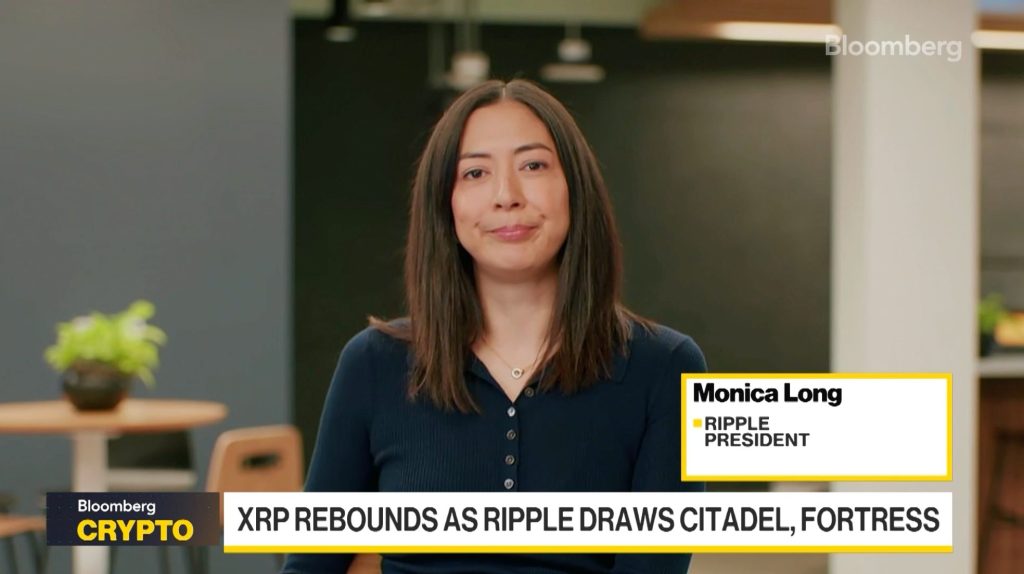
Long explained that traditional IPO drivers no longer apply to Ripple’s position.
“Currently we still plan to remain private,” she stated, noting that “between the strength of our balance sheet stand alone” and “interest from strategics like Citadel and Fortress,” the company is “in a really healthy position to continue to fund and invest in our company’s growth without going public.“
Ripple completed a $1 billion tender offer earlier in 2025 at the same $40 billion valuation, which shows sustained institutional demand for equity exposure.
The company has repurchased over 25% of its outstanding shares in recent years, providing liquidity to shareholders while strategically onboarding new partners.
During that time, CEO Brad Garlinghouse said, “This investment reflects both Ripple’s incredible momentum and further validation of the market opportunity we’re aggressively pursuing,” noting the expansion from the original 2012 payments focus into “custody, stablecoins, prime brokerage, and corporate treasury, leveraging digital assets like XRP.“
Over two years, Ripple executed six acquisitions, including two valued at over $1 billion each.
The company acquired Rail and integrated it into Ripple Payments, combining RLUSD and XRP. Ripple Payments volumes have surpassed $95 billion with 75 regulatory licenses globally.
Stablecoin Growth Drives Strategic Direction
Ripple’s RLUSD stablecoin surpassed $1 billion in market capitalization within seven months of launch, though it remains behind Circle’s $75.8 billion USDC and Tether’s $183.5 billion USDT.
The October acquisition of GTreasury extends treasury capabilities as institutions adopt stablecoins for payments and settlement following regulatory clarity from the GENIUS Act.
This came as Garlinghouse projects the stablecoin market could expand from $250 billion to $2 trillion as institutional adoption accelerates.
 @Ripple CEO @bgarlinghouse believes the stablecoin sector could balloon to $2 trillion in the NEAR future. #Ripple #XRPhttps://t.co/9XMruoepP6
For Ripple, BNY Mellon serves as the RLUSD custodian and is pursuing a banking license and a Federal Reserve Master Account.
Back in November, Chief Legal Officer Stu Alderoty welcomed Governor Christopher Waller’s proposal for crypto firms to access “” Fed accounts, stating, “I think it’s an attractive idea, and I think it should give traditional banks some comfort.“
Waller’s suggestion that stablecoin issuers could leverage central bank payment rails directly signals a shift in regulatory attitudes.
“I wanted to send a message that this is a new era for the Federal Reserve in payments, the DeFi industry is not viewed with suspicion or scorn,” Waller stated, adding his view for the Fed is to “embrace the disruption — don’t avoid it.”
While primarily theoretical, the proposal could materialize if Waller succeeds Jerome Powell as Fed chairman, with shortlist candidates demonstrating pro-crypto leanings.
Institutional Products Expand Beyond Payments
Ripple Prime has doubled client collateral since integration, while processing over 60 million daily transactions and tripling platform size. The prime brokerage offers collateralized XRP lending to institutions.
However, despite Ripple’s cross-vertical growth, XRP reached $3.65 in July 2025, but the token is currently trading over 30% below its January 2018 all-time high of $3.84.

Notably, Ripple contributed $50 million to the National Crypto Association for public education, as adoption data shows that 39% of crypto holders use digital assets to purchase goods and services.
While Ripple opts to stay private, the broader crypto industry embraces public markets. Circle’s June NYSE debut at $31 per share surged to $88 on opening day, now trading around $149 with a $34 billion market cap.
Kraken also raised $500 million at a $15 billion valuation ahead of its anticipated IPO, while Gemini raised $425 million on its September debut.
BitGo became the first dedicated crypto custodian pursuing a US exchange listing, and Figure Technology raised $787.5 million in its IPO at a $5.3 billion valuation.
