XRP Goes Institutional: Spot Trading Now Live on Hyperliquid—Top DEX Welcomes Wall Street

XRP just landed on Hyperliquid—and the game changed overnight. Institutional spot trading is now live on the leading decentralized exchange, marking a watershed moment for digital asset infrastructure. Forget the retail frenzy; this is about moving serious capital.
The Plumbing Gets an Upgrade
Hyperliquid's integration isn't just another listing. It's a direct pipeline for institutions to trade XRP spot without the traditional gatekeepers. The platform's high-throughput order book and deep liquidity pools are built for scale, offering the speed and reliability that fund managers demand. This bypasses the clunky, permissioned corridors of old finance—cutting settlement times from days to milliseconds.
Why This Isn't Just Another CEX Listing
Centralized exchanges have dominated institutional flows, but they come with baggage: custody risks, opaque operations, and regulatory overhang. A top-tier DEX like Hyperliquid flips the script. It offers non-custodial trading, transparent on-chain settlement, and a compliance-friendly framework that traditional finance can actually stomach. It’s the institutional-grade DeFi stack that was always promised.
The Ripple Effect on Liquidity and Legitimacy
Expect a surge in XRP's available liquidity depth. Institutional participation typically brings tighter spreads and more stable pricing—a welcome shift from the volatility-driven retail markets. More importantly, it signals a maturing asset class. When major players use a DEX for core trading, it legitimizes the entire decentralized infrastructure. Suddenly, the "unregulated wild west" narrative starts to crumble.
A Cynical Footnote for the Finance Bros
Let's be real—this move also lets institutions have their cake and eat it too. They get to tout their "innovative crypto exposure" to clients while using infrastructure that, ironically, eliminates many of the middlemen they've been charging fees to be for decades. The efficiency is genuine; the irony, delicious.
The bottom line? XRP on Hyperliquid isn't just a new trading pair. It's a direct challenge to the legacy system. It proves that decentralized markets can handle institutional heft, offering a faster, cheaper, and more transparent alternative. The walls between TradFi and DeFi just got a lot thinner.
FXRP Listing Brings XRP to Hyperliquid Spot Markets
The listing makes XRP spot exposure available on Hyperliquid’s high-performance trading infrastructure, an environment better known for its dominance in decentralized perpetuals.
FXRP is a bridged representation of XRP issued through Flare’s FAssets system and deployed using LayerZero’s Omnichain Fungible Token standard.
This setup allows XRP to MOVE from the XRP Ledger onto Flare, move seamlessly across chains, trade on Hyperliquid, and return to the XRP Ledger as its canonical settlement layer.
The structure preserves XRP custody while extending its usability across decentralized finance environments that were previously inaccessible to the asset.
Flare said the launch is designed to position XRP as a programmable, multichain asset without altering the role of the XRP Ledger as the primary trust and settlement layer.
Hugo Philion, co-founder of Flare, said the listing brings XRP into one of the most liquid and performant on-chain trading environments available, expanding XRP’s reach across DeFi while maintaining its existing settlement architecture.
Hyperliquid’s spot markets differ from the automated market Maker pools that dominate most decentralized exchanges.
Its orderbook-based design is built to handle higher trading volumes with improved price discovery and execution quality, particularly during periods of volatility.
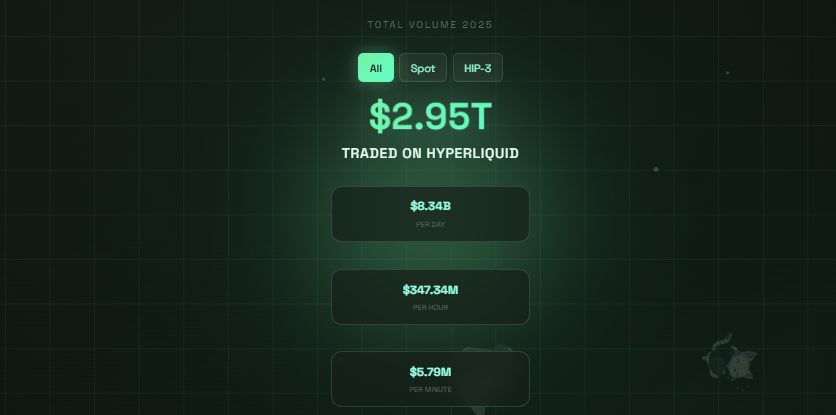
This has helped Hyperliquid capture a large share of decentralized derivatives activity, with the platform surpassing $2.9 trillion in total trading volume in 2025 and maintaining a dominant share of on-chain perpetuals throughout the year.
The platform added more than 609,000 users over the year and recorded $3.8 billion in net inflows, showing rising demand from both retail and institutional traders for decentralized derivatives.

Daily volumes frequently reached into the billions during peak periods, supported by its custom LAYER 1 architecture and fully on-chain orderbooks.
While derivatives remain Hyperliquid’s Core product, its spot markets have grown steadily.
 @CMEGroup beats @binance in $BTC futures with massive $16.5B open interest while @HyperliquidX explodes to $5B daily volume and dominates 80% DeFi perpetual market share.#Binance #Hyperliquidhttps://t.co/7nlCHHrrFY
Recent data shows Hyperliquid reporting over $169 million in 24-hour trading volume, with spot pairs contributing a meaningful share alongside its native HYPE token and major assets such as BTC, ETH, SOL, and USDC.
The addition of FXRP introduces XRP exposure into this environment for the first time, allowing traders to manage spot positions, hedge alongside perpetuals, and deploy more advanced trading strategies without leaving the chain.
FXRP Volume Jumps, Showing Rising Demand for On-Chain XRP Trading
Market activity around FXRP has increased following the launch. CoinGecko data shows that the token is trading around $2.29, with a circulating supply of roughly 86 million tokens and a market capitalization NEAR $197 million.
Over the past week, FXRP has gained more than 20%, while 24-hour trading volume has climbed above $14 million, showing rising participation as liquidity migrates across venues.
For Flare, the integration strengthens its broader XRP-focused DeFi strategy. The network currently holds nearly $220 million in total value locked, with decentralized exchange volume rising sharply over the past week.
Seven-day DEX trading volume on Flare exceeded $84 million, more than doubling week over week, while stablecoin market capitalization on the network has also increased.
Following execution on Hyperliquid, FXRP can be bridged back to Flare to access lending, staking, and other XRPFi applications, or returned to the XRP Ledger through upcoming tooling designed to simplify one-click withdrawals.
This trading lifecycle allows users to bridge once, trade at scale, and settle back on XRPL without relinquishing custody at any point.
