South Korea to Allow Spot Bitcoin ETFs in 2026 Growth Plan

Seoul throws open the gates—institutional crypto access just got a major upgrade.
The Regulatory Green Light
South Korea's financial watchdogs are drafting the rulebook for spot Bitcoin ETFs, a move that slices through years of regulatory red tape. The 2026 growth plan doesn't just suggest change; it mandates it. Expect fund managers to scramble for approvals the second the ink dries.
Market Mechanics Unleashed
This isn't about enabling retail speculation—it's about building direct, regulated pipelines for institutional capital. The plan bypasses convoluted derivatives and synthetic products, linking pension funds and asset managers straight to the underlying asset. Volatility won't disappear, but the playing field gets a massive, liquidity-boosting upgrade.
The Global Ripple Effect
Watch Asia's financial hubs take notes. South Korea's pivot pressures holdouts in the region to draft their own frameworks or risk capital flight. It's a classic case of regulatory arbitrage—where there's money to be made, rules tend to follow, often with the urgency of a trader chasing a rally.
A cynical observer might note that traditional finance always manages to find a fee-generating wrapper for the assets it once dismissed. The 2026 plan isn't just growth; it's formal adoption on a spreadsheet, which, in finance, is the highest form of flattery.
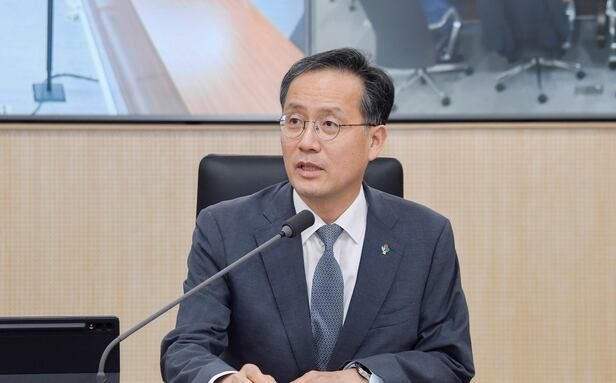 Deputy Minister of Economy and Finance Lee Hyung-il. | Source: ChosunBiz
Spot ETF Push Meet Stalled Stablecoin Framework
The spot ETF announcement follows Korea Exchange Chairman Jeong Eun-bo’s January pledge to launch crypto products, yet broader digital asset legislation remains gridlocked over stablecoin governance disputes between the Financial Services Commission and Bank of Korea.
The central bank insists stablecoins should be issued only by bank-led consortia with lenders holding at least a 51% ownership stake, while the FSC warns that fixed thresholds could sideline technology firms and slow payment innovation.
Regulators also disagree on whether a new licensing committee is needed for stablecoin oversight.
Korea Exchange announces crypto ETF plans and 24/7 trading as regulators remain deadlocked over stablecoin governance and digital asset legislation.#SouthKorea #Bitcoin #ETFshttps://t.co/uLCsnlUsri
— Cryptonews.com (@cryptonews) January 2, 2026Despite the impasse, the FSC’s phase-two bill is expected to include provisions for issuer authorization with capital requirements, reserve asset management, maintaining at least 100% of issued amounts, and redeemability claims.
Cross-border stablecoin transfer regulations will be established in conjunction with the legislation, according to the government strategy document obtained by News1.
Separately, authorities plan to allocate a quarter of national treasury funds to digital currency deposit tokens by 2030, requiring revisions to the Bank of Korea Act and the National Treasury Management Act to establish a legal basis for blockchain-based payments and settlements.
The regulatory uncertainty creates tension between the Korea Exchange’s readiness to launch products and persistent delays that have stretched back years, with the FSC’s June 2025 roadmap proposing spot crypto ETFs never materializing as planned.
During that time, the Democratic Party also introduced legislation to amend the Capital Markets Act, expanding the definition of underlying assets to include Bitcoin and other digital currencies.
Enforcement Actions Intensify Amid Policy Uncertainty
Enforcement activity has accelerated even as legislative debates continue, with the Financial Intelligence Unit imposing a ₩27.3 billion fine on Korbit in late December following approximately 22,000 anti-money laundering violations.
The penalty followed earlier sanctions against Upbit operator Dunamu, which received a three-month suspension on new customer accounts in February and a ₩35.2 billion fine in November, with Bithumb, Coinone, and GOPAX remaining under review as authorities work through cases in inspection order.
 South Korea’s Financial Intelligence Unit fines crypto exchange Korbit $1.89M over violations.#Crypto #Regulation https://t.co/fqGj3jWHWF
Authorities are simultaneously expanding transaction monitoring requirements, with a task force reviewing whether to extend the travel rule to cover crypto transfers below 1 million won.
The proposed changes WOULD require exchanges to collect sender and recipient information for all virtual asset transfers, regardless of size.
Broader Market Reforms Target MSCI Upgrade
The spot ETF plan supports President Lee Jae-myung’s policy drive to eliminate the “” and boost domestic market valuations, which helped the KOSPI benchmark rise 76% in 2025, its strongest performance since 1999.
MSCI maintained South Korea’s emerging market status in June 2025, citing limited foreign-exchange reforms and the restricted availability of investment instruments as impediments, despite recent measures that lifted short-selling bans and extended won trading hours.
According to Bloomberg, Vice Finance Minister Lee Hyoung-il told reporters the government expects 2% economic growth this year, above the Bank of Korea’s 1.8% estimate, driven by firmer domestic consumption and stronger semiconductor-led exports.
The government forecasts a current account surplus of $135 billion for 2026, up from an estimated $118 billion last year, as chip prices recover and energy costs ease.
The roadmap also positions artificial intelligence, semiconductors, and advanced manufacturing as key growth engines while pursuing inclusion in the FTSE World Government Bond Index and eventual MSCI developed market reclassification.
