South Korean Crypto Exodus: $110 Billion Flees to Overseas Exchanges in 2025

Capital floods out as traders seek friendlier shores.
### The Great Digital Asset Migration
South Korea's cryptocurrency market bled over one hundred and ten billion dollars last year. The massive outflow wasn't a market crash—it was a calculated escape. Savvy traders routed their funds to international platforms, bypassing domestic constraints in a stunning display of financial arbitrage.
### Dodging the Regulatory Gauntlet
Local exchanges faced a perfect storm. Stringent know-your-customer rules, real-name trading mandates, and speculative trading curbs created friction that global competitors simply didn't have. When your own financial watchdog treats crypto like a suspicious package at the airport, you find a new airport.
The money moved where the rules didn't strangle opportunity—where leverage was available and asset listings weren't bottlenecked by committee approvals. It's the oldest story in finance, just with a blockchain twist: capital flows to the path of least resistance and highest potential return. After all, why pay for the full regulatory theater experience when you can watch the show from a balcony seat abroad?
### A Warning Shot to Domestic Hubs
This isn't just capital flight—it's a referendum. The exodus signals that overly restrictive frameworks don't protect markets; they simply export them. While bureaucrats draft another round of guidance papers, the actual market has already voted with its wallet, finding liquidity and innovation wherever it's welcomed. The lesson for 2026? Build a better harbor, or watch the ships sail to someone else's port.
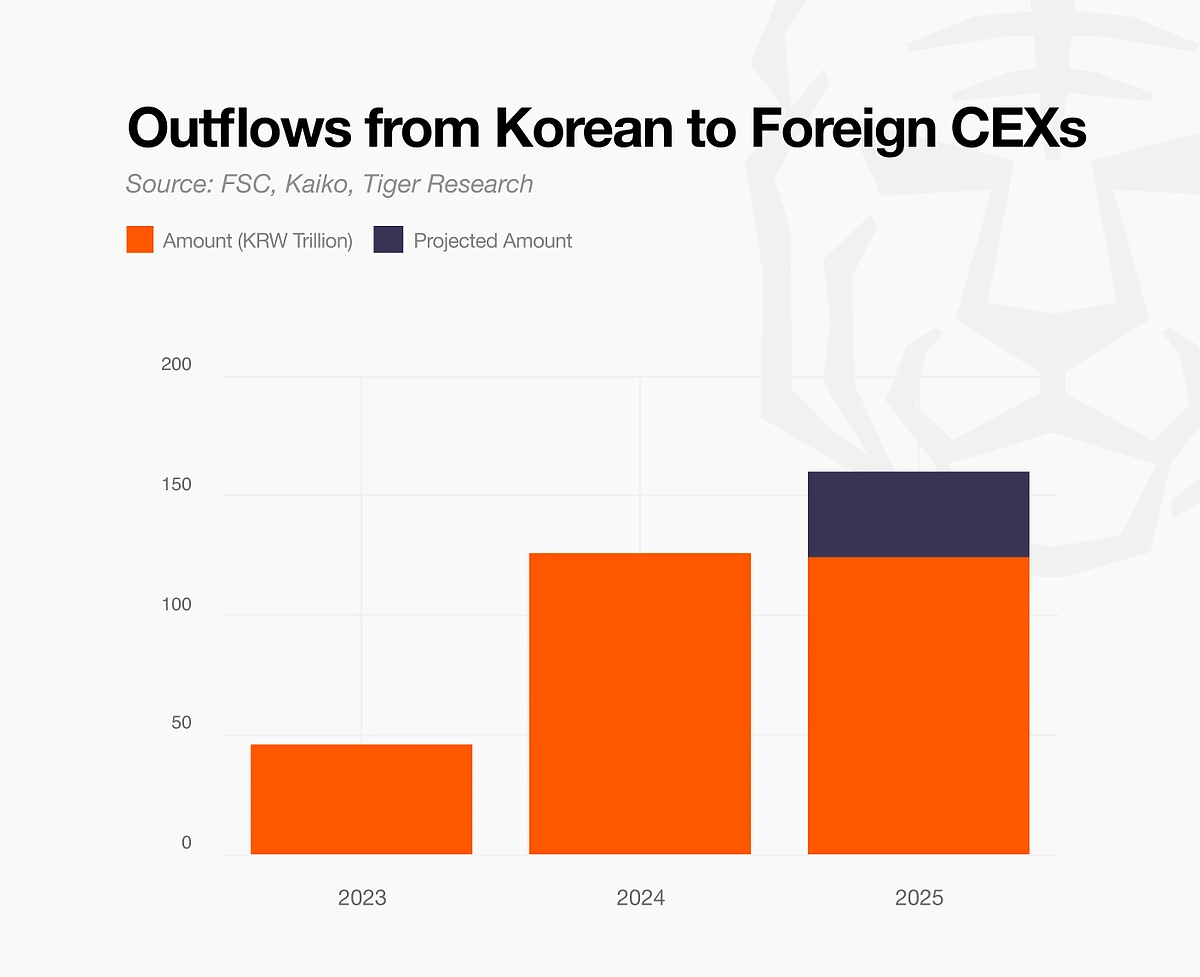 Source: Kaiko
Between January and September 2025, around ₩124 trillion flowed out of Korean exchanges to overseas ones, nearly three times the outflows seen in 2023. According to the report, total outflows for the year were estimated at ₩160 trillion.
“The main reason Korean investors move funds to foreign CEXs is the gap in investment opportunities. Domestic CEXs face strict regulations that limit them to spot trading. Foreign CEXs fill this gap with diverse options including Leveraged derivatives,” said the report.
Moreover, the estimated 2025 fee income tied to Korean users reached about ₩2.73 trillion at Binance, ₩1.12 trillion at Bybit, ₩580 billion at OKX, ₩270 billion at Bitget, and ₩70 billion at Huobi, cumulatively making ₩4.77 trillion, or $3.36 billion, from Korean traders.
That sum equals 2.7 times the combined operating revenue of Upbit, Bithumb, Coinone, Korbit, and Gopax last year, which is ₩1.78 trillion, according to the report.
South Korean regulators have been increasing pressure on crypto markets
Regardless of the government’s restrictions, South Koreans moved ₩2.7 trillion from exchanges to personal wallets like MetaMask in the first half of 2025.
CoinGecko said:-
“Decentralized perpetual futures exchanges (Perp DEXs) have grown rapidly with record trading volumes. Platforms now offer competitive execution speed, user experience, and liquidity. Korean investors increasingly choose Perp DEXs. Even if Korea blocks unlicensed foreign CEXs, capital will likely scatter into the unregulated decentralized space rather than return home.”
The report claims that its researchers combined exchange trading records with Arkham Intelligence and Dune, using both top-down and bottom-up methods. One approach allegedly relied on a benchmark showing Korean traders made up 13 percent of Binance volume in 2023, mostly in futures.
With Binance’s 2025 futures volume at $27.5 trillion, an average fee of 0.035 percent, and an exchange rate of ₩1,420, estimated annual fees ranged from ₩2.05 trillion under conservative assumptions to ₩3.417 trillion under aggressive ones.
The second method tracked real fund flows. About 57.7 percent of the ₩160 trillion outflow went to Binance, around ₩92.3 trillion. Korean investors held about ₩98.9 trillion in assets and traded roughly twice their holdings each month, or 24 times a year.
Futures trades on Binance occurred 2.3 times more often than spot trades and were 1.5 times larger, lifting volume by 3.52 times. Applying these figures produced an annual fee estimate of ₩2.73 trillion, according to CoinGecko.
The crypto market in South Korea has long leaned toward altcoins, which make up for 70% to 80% of domestic trading volume, far above the global average near 50%. Traders once made money buying small, volatile tokens early, even after their token generation events.
Sign up to Bybit and start trading with $30,050 in welcome gifts
