Electric Vehicle Showdown: Rivian vs. Tesla - Which Stock Charges Ahead in 2025?

The EV battlefield just got hotter as legacy automakers scramble to catch up while two pioneers race toward dominance.
Rivian's Rocky Road to Production
Rivian burns through cash like a Hummer EV burns through batteries—delivery targets keep shifting while factory bottlenecks threaten to stall their ambitious growth plans. The startup's promise of electric adventure vehicles captures imaginations but faces the brutal reality of scaling manufacturing.
Tesla's Manufacturing Mojo
Tesla slashes production costs while expanding gigafactories globally. Their vertical integration strategy bypasses traditional supply chain headaches, though Elon Musk's attention splits between electric cars, rockets, and social media dramas.
The Valuation Question
Both stocks trade at premiums that make traditional auto executives laugh all the way to the bank—until they remember their own companies are worth less than Tesla's quarterly revenue growth. Rivian's market cap assumes flawless execution for the next decade, while Tesla's already prices in world domination.
Choose your fighter: the established disruptor facing growing pains or the ambitious newcomer fighting for survival. Either way, buckle up for volatility.
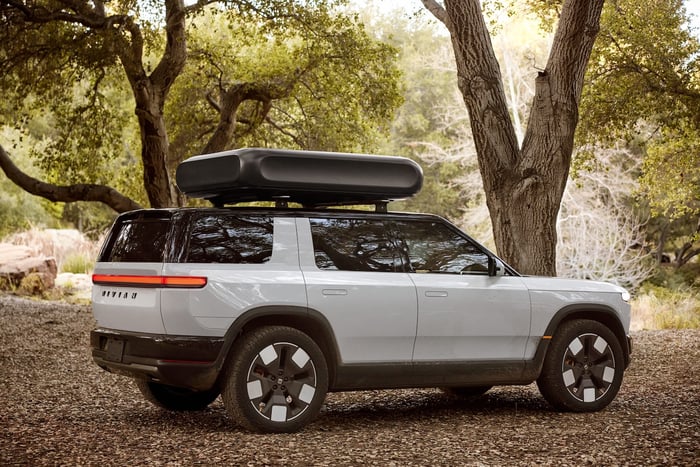
Image source: Rivian.
Rivian's potential is coming into view
Rivian proved its potential earlier this year with two straight quarters of gross profit, meeting a goal management had set. The company slipped back to a loss recently as tariff costs weighed on results, but investors still got a glimpse of how Rivian can achieve its financial targets while keeping profitability in focus.
What's more, Rivian is on the verge of launching new vehicles that should appeal to a wider customer base. The company's smaller SUV, the R2, is slated to go on sale in early 2026 at a price tag of around $45,000. That's far cheaper than its cheapest models and significantly lower than the average EV price of about $57,000. The R2 will be the first of a handful of cheaper vehicles in Rivian's pipeline, with a smaller R3 and R3X also eventually on the way, with an estimated starting price of about $37,000.
Investors will have to wait to see how customers respond to Rivian's new vehicles, but they're certainly a step in the right direction for expanding Rivian's customer base and spreading the cost of production across multiple vehicles. Production efficiency has been a goal of the company lately, with Rivian reengineering portions of its manufacturing process last year -- saving 35% in material costs.
Another check mark in the pro column for Rivian is the fact that it's building strong partnerships and developing solid sources of funding. The most recent is a partnership with, in which Rivian supplies some of its technology to the automaker in return for $2 billion in funding. Rivian could receive up to $5.8 billion if the company continues meeting agreed-upon goals.
Tesla has a rough road ahead
Tesla was once a dominant force in the EV industry, but its fortunes have taken a turn as of late. For one, the company's operating income plunged 42% in the most recent quarter to $923 million, and its free cash flow fell 89% to just $146 million. Tesla said the decline came, in part, because of dwindling regulatory credit sales, lower vehicle deliveries, and higher operating expenses.
Tesla's net income tumbled 16% in the quarter to $1.1 billion, and operating margin fell to 4.1%, down from 6.2% in the year-ago quarter. Rising competition, higher costs, and a bruised brand thanks to CEO Elon Musk's political involvement are all putting pressure on the company.
Some investors are hopeful for a turnaround. Tesla's stock recently got a bump after Musk purchased $1 billion worth of shares. The purchase was likely a way for Musk to signal to Tesla's board that he's committed to the company as he seeks a pay package that's worth up to an eye-popping $975 billion, if certain goals are met.
But Tesla faces serious challenges. Declining profits and shrinking cash reserves limit its ability to reinvest just as Musk is pushing the company to expand into new growth areas, including robotics and autonomous vehicles (AVs). Without the profits and cash to do so, it's a big question whether the company will be able to pivot to these new industries -- or even if it should.
Rivian is the better EV stock, but success isn't guaranteed
I'm optimistic about Rivian because I think the company is building a strong EV lineup, and I've been impressed with how management has adapted to an increasingly difficult EV environment.
While Rivian's success is nowhere NEAR guaranteed -- especially given the difficult EV environment -- I think it's the better EV stock right now. Tesla's falling profits and shrinking cash availability put it in a tough spot as it tries to transition to robotics and AVs. Investors will still need to be patient with Rivian, though, as the company navigates a challenging period for the EV industry.
