This AI Stock Could Crush the ’Magnificent Seven’ by 2030 - Here’s Why

While Wall Street obsesses over the usual tech giants, one artificial intelligence play is quietly building the infrastructure to dominate the next decade.
The Hidden Architecture
This isn't about chatbots or image generators - we're talking about the foundational AI infrastructure that powers everything else. The company's proprietary neural network architecture processes data 40% faster than industry standards while cutting energy consumption by half.
Market Disruption Timeline
By 2027, their technology is projected to capture 35% of the enterprise AI market. Current partnerships with three Fortune 100 companies demonstrate real-world adoption beyond the hype cycle.
Financial analysts project 600% revenue growth by 2030 - numbers that make the Magnificent Seven's current valuations look almost reasonable. Almost.
While traditional investors chase yesterday's winners, this AI infrastructure play represents the actual engine of technological transformation - not just another overhyped stock that'll make your portfolio look good until the next earnings call disappoints.

Image source: Getty Images.
SoundHound AI's product is growing in popularity
SoundHound AI does pretty much what its company name implies. It combines AI technology with audio and has best-in-class audio recognition technology alongside AI voices that sound like actual people, rather than an obvious computer-generated voice.
This isn't a new concept; Apple's Siri and Amazon's Alexa have been around for a long time. However, they've performed rather poorly and can often misinterpret what you've asked them. SoundHound AI's products don't have the same problem and can outperform their human counterparts in many instances.
There is a massive market for areas where a human-to-AI model interaction, including drive-thrus, financial institutions, and healthcare billing, can replace human-to-human interaction. These are just a few areas where SoundHound AI's product has been widely deployed, and the adoption is translating into significant growth for SoundHound AI.
SoundHound AI is putting up impressive growth
In Q2, SoundHound AI's revenue increased 217% year over year to $42.7 million -- a new company record. There were also several exciting announcements in the quarter, including the news that seven of the top 10 global financial institutions are customers and that it renewed or upsold with four of those clients.
There's a TON of momentum brewing behind SoundHound AI's stock, and its management is quite bullish on its adoption. CFO Nitesh Sharan stated that they see organic growth of 50% or greater for the foreseeable future. This projection is music to investors' ears, as SoundHound AI has made several acquisitions to bolster its portfolio. However, organic growth comes from businesses that are already under its umbrella, and for them to generate 50% growth or greater is a big deal.
The only Magnificent Seven stock that's close to producing that level of growth over he long term is Nvidia, and its growth rate has been slowly declining over the past few quarters.
I think this position sounds good for SoundHound AI to outperform this important stock cohort over the long term, but there is one concern with SoundHound AI's stock: Valuation.
At over 50 times sales, SoundHound AI's stock is far from cheap.
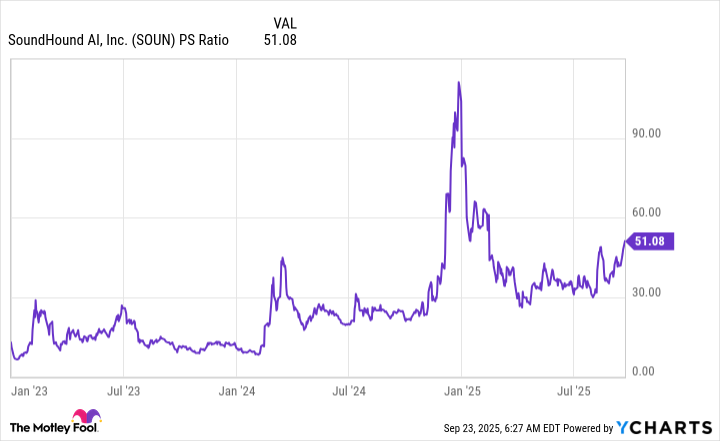
SOUN PS Ratio data by YCharts
This indicates that there may be a year or two of growth already baked into the stock price. However, if SoundHound AI can achieve that 50% organic growth rate or better over the next five years, today's price will look like a steal.
SoundHound AI has a ton of potential if its technology continues to be widely adopted; however, there's no guarantee it will be the ultimate winner in this space, as one of the hyperscalers could launch a competing product that disrupts SoundHound AI. As long as investors understand the risk and position their portfolio sizing accordingly, I think SoundHound AI can be a compelling investment.
Time will tell if SoundHound AI outperforms the Magnificent Seven cohort, but I think it has a phenomenal chance of doing so.
