Costco’s Bold Policy Shift Sparks Fury and Fortune - And Management’s Loving Every Minute
Costco drops bombshell policy change that's dividing customers and sending shockwaves through retail
The Backlash Backfire
Members are screaming - but the cash registers are singing a different tune. Costco's controversial new approach is generating exactly the kind of attention management hoped for, proving once again that in retail, sometimes the best way to win is to piss people off first.Numbers Don't Lie
While traditional retailers play it safe, Costco's gamble is paying off in cold, hard numbers. The membership-based giant is proving that calculated controversy can be more profitable than universal approval - a lesson Wall Street analysts somehow still haven't figured out despite decades of data.The New Retail Reality
Love it or hate it, Costco's move demonstrates that in today's market, playing nice doesn't always pay the bills. Sometimes you've got to break a few eggs - or in this case, a few customer expectations - to make an omelet. Another quarter, another reminder that when it comes to retail success, being popular is optional - but being profitable isn't.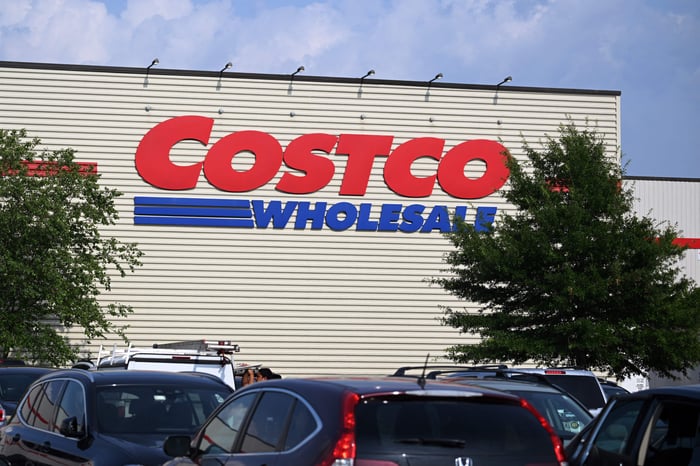
Image source: Costco Wholesale.
Though all three of these retail goliaths possesses well-defined competitive advantages, their operating approach is anything but static. The ability to change and adapt to meet the needs of consumers is a necessity of the retail landscape -- and arguably no company knows this better than warehouse club Costco.
Costco's value approach has won over shoppers
In some instances, size isn't everything in corporate America. But for retailers, size tends to provide a meaningful competitive edge. In Costco's case, it's used its size and DEEP pockets to deliver deals that drive members into its stores.
Being able to buy products in bulk can lower the per-unit cost for each item, which in turns allows Costco to consistently undercut local stores and even national grocery chains on price. Though the margins on basic need goods (e.g., produce and toiletries) are often razor-thin, Costco's management team understands that these necessity items are what drive traffic into its stores on a regular basis.
This value proposition can also be found in Costco's food court. The cost of the company's famous hot dog combo has been pinned at $1.50 for more than four decades due to the cult-like attraction of this deal. In 2009, the company transitioned to its in-house Kirkland Signature brand to supply hot dogs for its combo deal in an effort to keep costs down and its members happy.
But the biggest edge of all for Costco is its membership-driven operating model. Depending on the tier, members are paying $65 or $130 each year to shop in its warehouses. This is high-margin revenue that flows almost directly to Costco's bottom line, and it also provides an added margin buffer when the company is undercutting its rivals on price.
If consumers are spending $65 or $130 annually for the right to shop at a warehouse, you can rest assured they're going to be making most or all of their big-dollar purchases there to get as much out of their membership as possible.
However, changes have been commonplace for Costco Wholesale in its more than four decades of operation -- and they're not always well-received by its members.

Image source: Getty Images.
A controversial new policy has some members in an uproar and management thrilled
Over the last year or so, Costco has made a handful of meaningful changes. It increased annual membership fees for Gold Star/Business and Executive cardholders from $60 to $65 and $120 to $130, respectively, as well as required members to scan their card or a QR code when entering its stores. Seeing as how this was the first membership fee increase in seven years, cardholders didn't put up much of a fuss.
But changes made to Costco's shopping hours, which affords special treatment to Executive members, has definitely created an uproar.
In June, the company announced plans to introduce special early shopping hours for Executive cardholders seven days a week. On weekdays and Sundays, Costco would open its doors for Executive members from 9 a.m. to 10 a.m. On Saturdays, a 30-minute window of 9 a.m. to 9:30 a.m. exists for these top-tier cardholders to shop.
Though Costco doesn't offer a U.S. breakdown of its Gold Star/Business vs. Executive memberships, it does do so globally. It closed out its fiscal year (Aug. 31, 2025) with 81 million paying members, 38.7 million of which were Executive cardholders. This means tens of millions of Gold Star members can't shop in the company's U.S. warehouses during these special hours.
What's more, Costco introduced a $10 monthly credit on qualifyingorders of $150 or more for its top class of cardholders. This is in addition to the 2% back they can receive each year (up to $1,250) on purchases.
While some Gold Star/Business members aren't happy with these new perks (specifically the special shopping hours) for Executive cardholders, Costco's management team and Wall Street are all smiles.
During the company's fiscal fourth-quarter conference call with Wall Street analysts, CEO RON Vachris directly addressed this controversial new policy, as well as the decision to extend hours for all members on Saturday evenings in U.S. warehouses:
To increase value and convenience for our members, on June 30, we added Executive Member exclusive operating hours in the morning and an additional hour on Saturday evenings for all members in our U.S. warehouses. We estimate these incremental hours have added about 1% to weekly U.S. sales since implementation.
A 1% bump in sales might not sound like much, until you realize that a 1% boost in sales can generate close to $3 billion in added annual revenue for the company. That's not chump change!
Furthermore, even though Executive cardholders account for "just" 47.8% of worldwide memberships, they were responsible for 74.2% of net sales during the fiscal fourth quarter. It's in Costco's financial interest to keep its highest tier of cardholders happy, even if newly implemented policies annoy entry-level members.
With management seeing evidence of membership upgrades a little over a month after firmly implementing its special shopping hours policy, there's little question that this controversial policy change is here to stay.
