The Nuclear Energy Play That Could Power Your Portfolio in 2025

Forget meme stocks—this nuclear contender is splitting atoms and investor skepticism.
Why uranium's dark horse is heating up
While Wall Street obsesses over AI and crypto, the quiet resurgence of nuclear energy stocks slips under the radar. No hype, just old-school megawatt economics—the kind that keeps lights on during crypto-mining blackouts.
The regulatory dominoes fall
Three countries flipped from nuclear phase-outs to extensions this year. Germany finally admitted its Energiewende looked better on PowerPoint than in winter. Meanwhile, SMR approvals hit critical mass.
Cash flow meets fission
One under-the-radar player locked in 12-year uranium contracts at pre-surge prices. Their secret? Buying when everyone else was busy shorting Tesla.
Nuclear's not dead—it's the contrarian bet that could melt shorts faster than a Chernobyl core. Just don't tell the ESG funds.
The world needs more (clean) power
First, worldwide demand for power is projected to soar in coming years -- as much as 18% by 2050, according to McKinsey -- due to the emergence of power-hungry data centers and artificial intelligence projects, as well as the adoption of electric vehicles and the ongoing electrification of emerging market countries, among other factors.
estimates power consumption from AI data centers alone will rise 50% by 2027 and 165% by the end of this decade. Recall's 2024 deal to power data centers by restarting one of the reactors at Three Mile Island that was shut down for economic reasons in 2019 (I'll get to the owner of that plant in just a moment).
In addition, countries are scrambling for power sources that don't worsen global warming, and nuclear energy is among the lowest carbon-emitting energy sources available.
Finally, nuclear has undergone a technological revolution in recent years with the emergence of so-called small modular reactors that are more easily and rapidly constructed and transported. They're also much less financially risky to build.
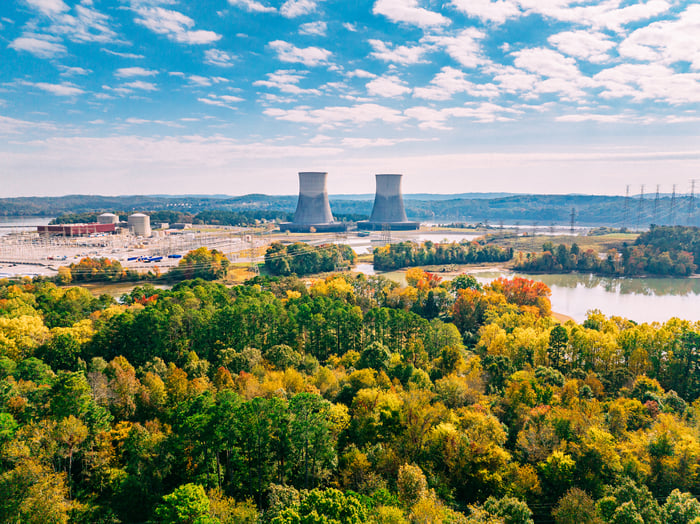
Image source: Getty Images.
For all of those reasons, opposition to nuclear has mostly evaporated among important gatekeepers like the World Bank and the European Union that were once, well, lukewarm to the prospect of more plants. And some countries are going all in. This past May, President Trump announced four executive orders designed to reinvigorate America's nuclear energy industry.
The real proof of nuclear's rebirth, however, is in the rush to build new plants. There are roughly 70 nuclear facilities under construction across the world, according to the World Nuclear Association. And world nuclear capacity is projected to increase by 2.5 times by 2050, says the International Atomic Energy Agency.
Constellation is signing agreements
The biggest nuclear provider in the U.S. -- by a long shot -- is(CEG -0.71%), a Baltimore-based power utility. The company generates power through hydro, wind, natural gas and solar facilities, but its biggest source is nuclear, which accounts for about 86% of its output. It currently operates 21 nuclear reactors at 16 facilities (there are 54 total commercial nuclear plants in the U.S. at present). Constellation is projected to produce 95% of its energy carbon free by 2030 and 100% a decade later.
Constellation owns the Pennsylvania nuclear plant formerly known as Three Mile Island -- the one that will power Microsoft data centers and is now called Crane Clean Energy Center. A bit of context and history: The 20-year agreement with Microsoft paved the way to restart Three Mile Island Unit 1, which "operated at industry-leading levels of safety and reliability for decades before being shut down for economic reasons" in 2019, according to Constellation. In 1979, there was a partial nuclear meltdown of the Unit 2 reactor at the Three Mile Island facility. "This was the most serious accident in U.S. commercial nuclear power plant operating history, although its small radioactive releases had no detectable health effects on plant workers or the public," according to the U.S. Nuclear Regulatory Commission. Unit 2 is permanently shut down.
Constellation also recently agreed to provide 20 years of power from an Illinois nuclear plant to support the data centers of Facebook parent.
The stock is worth a look
Constellation reported second-quarter results last week and both earnings and revenue beat Wall Street's expectations. Earnings of $1.91 per share were 13% higher than a year ago. Revenue jumped 11.4% to $6.1 billion. The power company also announced a 94% capacity rate for its reactors -- the amount of time they operate at maximum power output -- which is among the highest in the industry.
And management is determined to support the stock. It just repurchased $400 million worth of shares. The stock is up 46% year to date as of market close on Thursday and 75% over the past 52 weeks. Constellation's market cap is about $106 billion and its price-to-earnings ratio is around 34.
Yes, that P/E ratio is a bit high for a power utility. But consider what you're getting as an investor: a power company that has basically transcended its category. Constellation is increasingly viewed not as a boring utility, but instead as an AI-adjacent stock because of its deals to provide clean nuclear energy to AI-centric companies like those in the "Magnificent Seven."
Nuclear energy is hotter than ever, and now is the time to own a piece of it. Constellation Energy is worth a look.
