Ripple’s Singapore License Gets Major MAS Upgrade - A Game-Changer for Crypto Regulation

Ripple just landed regulatory jet fuel in Asia's financial hub. The Monetary Authority of Singapore (MAS) didn't just renew their license—they supercharged it.
What This Means for Cross-Border Payments
The enhanced Major Payment Institution license removes previous transaction limits. Ripple can now process unlimited-value digital payment token services for institutions across Singapore. It’s a green light for enterprise-scale settlement.
Why Singapore Matters More Than Ever
While other regulators play whack-a-mole with crypto firms, MAS is building a framework that actually works. They’re betting that clear rules attract serious players—and push the speculative junk to the sidelines. A welcome change from the regulatory theater elsewhere.
Ripple’s Regulatory Chess Move
This isn't about retail speculation. It’s about positioning XRP as the plumbing for institutional transfers—the boring, profitable infrastructure that survives market cycles. Singapore becomes their Asian command center for battling SWIFT’s legacy systems.
The Bottom Line
One regulator finally figured out that treating crypto like a dangerous toy gets you toy results. Singapore’s move validates a path forward: regulate the service, not just the asset. Now watch every other major financial center scramble to catch up—or risk getting bypassed completely. The future of finance isn't just digital; it's jurisdiction-shopping.
MAS Hands Ripple A Major Boost
The company framed the approval as validation of its long-running “regulation-first” posture. President Monica Long directly credited Singapore’s approach to digital asset oversight as a differentiator, saying: “MAS has set a leading standard for regulatory clarity in digital assets, and we deeply value Singapore’s forward-thinking approach. Ripple has always taken a regulation-first approach and Singapore is proof that innovation thrives when rules are clear. This expanded license strengthens our ability to continue investing in Singapore and to build the infrastructure financial institutions need to move money efficiently, quickly, and safely.”
Under the new scope, Ripple can deploy a wider suite of services via Ripple Payments, its enterprise payments platform that uses digital payment tokens and a global payout network to support cross-border transfers and fiat on/off ramps. The product is pitched squarely at banks, crypto firms and fintechs that want access to token-based settlement without having to build their own infrastructure stack or manage the operational complexity of blockchain in-house.
Ripple Payments uses digital payment tokens (DPTs), “such as RLUSD and XRP,” to settle transactions within minutes, while the company itself handles collection, holding, swapping and payout through a single integration. The company emphasizes that clients can choose whether or not to hold DPTs directly, with Ripple’s infrastructure designed to eliminate the need for separate banking relationships, specialized infrastructure or direct digital asset management.
With MAS’ expanded approval, those capabilities can now be delivered from Singapore as fully regulated payment services, rather than as a patchwork of individual components. That gives institutional clients a clearer compliance profile when using token-based settlement rails, with both the digital asset and fiat legs sitting inside a single supervisory framework.
Fiona Murray, Ripple’s vice president and managing director for Asia Pacific, anchored the announcement in regional fundamentals, citing robust on-chain growth as the main demand driver.
“The Asia Pacific region leads the world in real digital asset usage, with on-chain activity up roughly 70% year-over-year. Singapore sits at the center of that growth,” she said. “With this expanded scope of payment activities, we can better support the institutions driving that growth by offering a broad suite of regulated payment services, bringing faster, more efficient payments to our customers.”
Singapore has been central to Ripple’s strategy since it established its APAC headquarters there in 2017. The company is now highlighting its status as one of the relatively few “blockchain-enabled institutions” globally to operate with an MPI license, using that status as a signal of both regulatory maturity and institutional readiness.
Beyond Ripple Payments, the firm continues to position itself as a broader crypto infrastructure provider. It offers custody for digital asset storage and management, and Ripple Prime as a multi-asset prime brokerage for institutional clients, with its stablecoin RLUSD and the XRP cryptocurrency integrated across these services to make “traditional finance more efficient and enable new ways to utilize digital assets.”
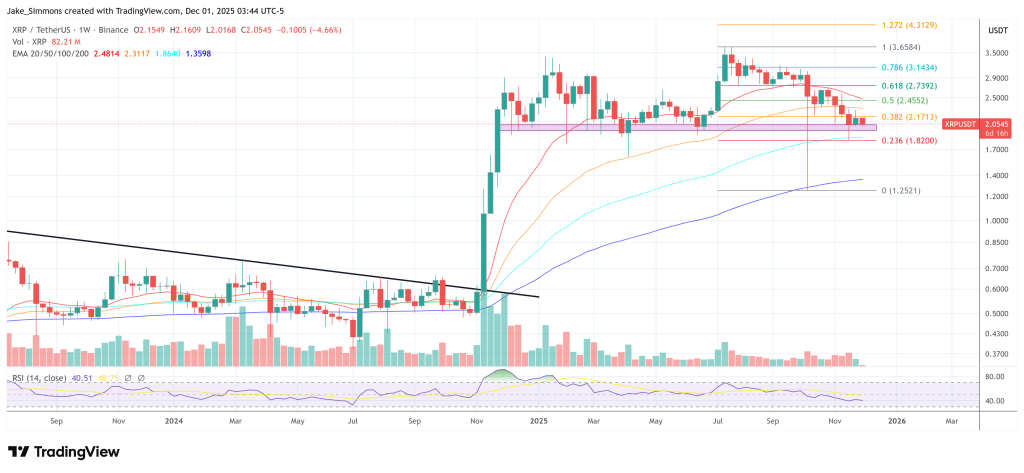
At press time, XRP traded at $2.05.