Bitcoin Hashrate Plunge Puts Miner Squeeze Back Under Microscope: Analysts Sound Alarm

Bitcoin's security backbone just took a hit. The network's hashrate—the total computing power securing the blockchain—has dropped sharply, and analysts are warning the pressure on miners is about to get real.
The Squeeze Is On
When hashrate falls, mining difficulty eventually follows. That's the protocol's built-in adjustment. But the lag between the two creates a window where miners operating on thin margins get crushed. Their machines suddenly cost more to run than the Bitcoin they produce, forcing a brutal calculus: shut down or bleed cash.
Survival of the Fittest (and Most Funded)
This isn't a new story, just the latest chapter. The industry has been here before. The shakeout typically follows a familiar pattern: smaller, less efficient operations get unplugged first. Their exit then eases the difficulty for the remaining giants—the ones with access to cheap power, newer hardware, and deep venture capital pockets. It's a Darwinian reset that centralizes power while the rest of the market watches, a process Wall Street would probably call 'efficient consolidation' while collecting advisory fees.
Beyond the Headline Fear
Don't mistake this for a network failure. Bitcoin's security model is designed to withstand these fluctuations. The real story isn't the temporary drop in hashrate; it's the financial fault lines it exposes in the mining sector. Every dip tests the resilience of the multi-billion dollar infrastructure built around proof-of-work. When the music stops, the players with the biggest balance sheets get the chairs.
The clock is ticking for the inefficient. The next difficulty adjustment will tell us who's built to last and who was just riding the hype cycle—a cycle that, much like traditional finance, has a nasty habit of separating the optimistic from their capital.
Hashrate Compression Can Signal Recoveries
Reports have disclosed that longer windows look better for bulls. When hashrate contracted and stayed low, the odds of a recovery improved over wider horizons. Negative 90-day hashrate growth was followed by positive 180-day Bitcoin returns 77% of the time, with an average gain of 72%.
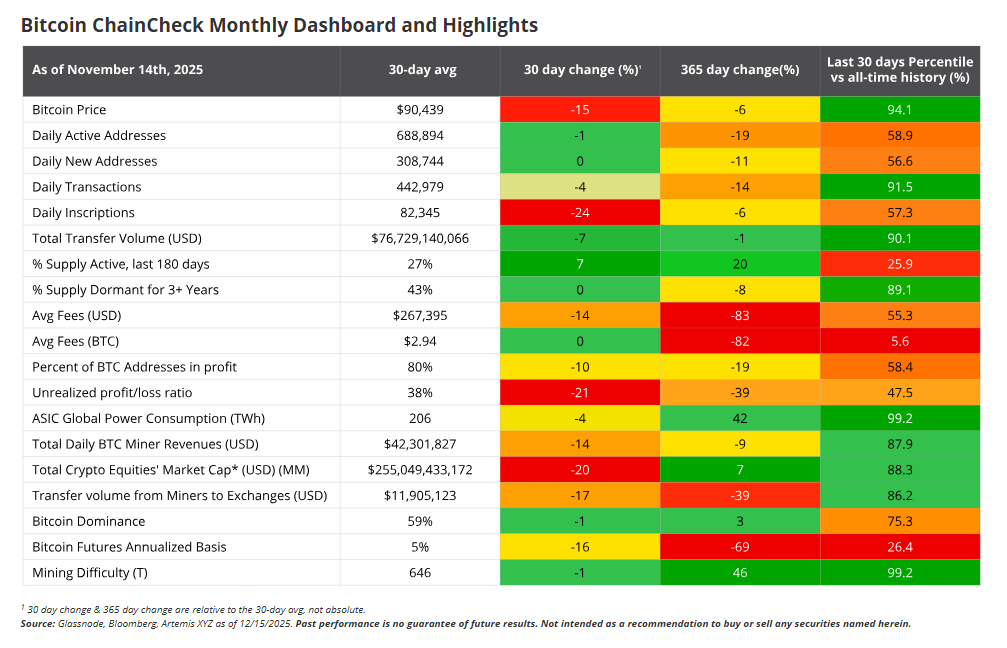
The math is clear and the pattern is consistent enough to make investors take notice. Miner economics add to the story: the break-even electricity price on a 2022-era Bitmain S19 XP dropped nearly 36% from $0.12 per kilowatt-hour in Dec. 2024 to $0.077/kWh by mid-December. That shift squeezes margins and forces marginal operators to rethink their rigs.
Miners Exit, Markets Watch
Some capacity has left the network. VanEck tied the recent 4% decline to a shutdown of roughly 1.3 gigawatts of mining power in China. Analysts also warn that rising demand for AI compute could pull capacity away from Bitcoin, a trend they estimate might erase 10% of the network’s hashrate.
That WOULD redistribute mining activity and could concentrate operations where power and policy align. At the same time, support for mining has not disappeared worldwide. Based on reports, up to 13 countries are backing mining activities, including Russia, Japan, France, El Salvador, Bhutan, Iran, UAE, Oman, Ethiopia, Argentina, and Kenya.
Price And Market ContextBitcoin is trading NEAR $88,600, down nearly 30% from its Oct. 6 all-time high of $126,080. Markets have been quiet around year-end and thin liquidity can hide real momentum.
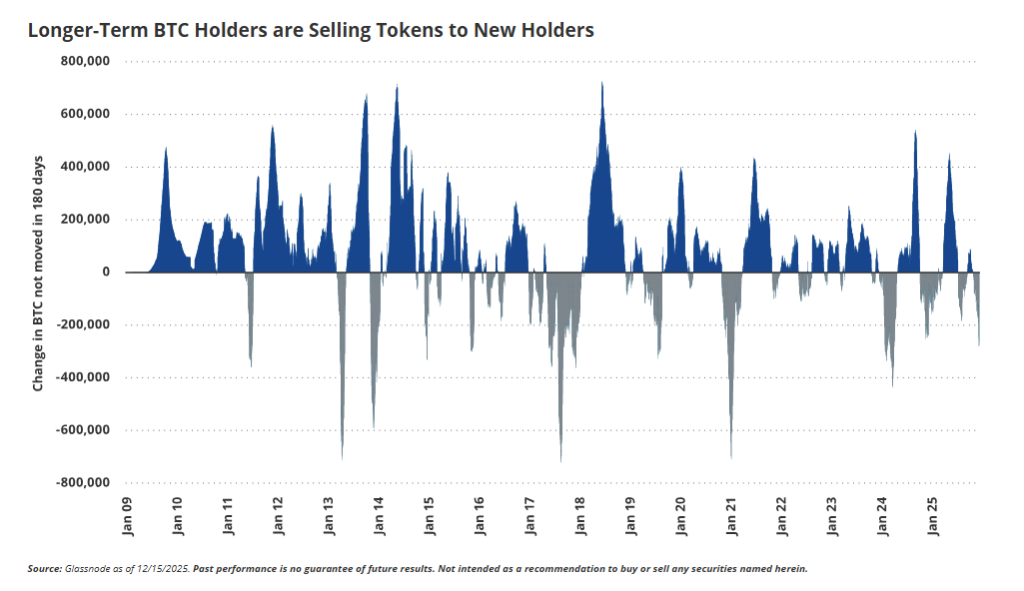
BTC was monitored as steady near $89K in recent coverage and remained range-bound as traders weighed supply and demand signals. Other cross-asset moves matter too. Gold climbed above $4,400/oz while silver reached $69.44/oz, moves that some investors see as part of a broader safe-haven bid.
The data points suggest a cautious optimism. Miner capitulation has worked as a contrarian signal historically — weaker miners exit, difficulty adjusts, and surviving operators face less near-term selling pressure. That sequence can set the stage for price stabilization and gains over months.
Featured image from Pixabay, chart from TradingView
