Bitcoin’s Coin Days Destroyed Crashes Following Massive Coinbase Transfer

Bitcoin's long-dormant coins just woke up—and the market's age-old metric just took a nosedive.
The Big Move
A colossal transfer from a major exchange sent Bitcoin's Coin Days Destroyed (CDD) metric plunging. This isn't just wallet shuffling; it's a fundamental reset of the network's accumulated 'HODL' time. When old coins move, history gets erased on-chain.
Why CDD Matters
Think of CDD as Bitcoin's memory. It tracks the age and quantity of coins every time they're spent. A sharp drop signals that a huge chunk of historically inactive supply—coins sitting idle for months or years—just re-entered circulation. It's the on-chain equivalent of a veteran soldier mustering out.
The Exchange Factor
The epicenter was a single, massive outflow from Coinbase. Moves from institutional custodians like this don't happen on a whim. It points to decisive action: perhaps preparation for OTC deals, collateralization, or a strategic reallocation. Either way, it's a vote of confidence with cold, hard Satoshis.
Reading the Tea Leaves
A plummeting CDD can be a bullish precursor. It often precedes periods of increased volatility and new price discovery as 'old money' seeks new opportunities. It signals conviction from historically patient hands—arguably the smartest money in the crypto space. Or, in traditional finance terms, it's like a boardroom finally selling its vintage company shares to fund something that isn't a quarterly stock buyback.
The ledger doesn't lie. When Bitcoin's oldest and largest stakeholders make a move, the entire network feels the tremor.
Major Coinbase Transfer Triggers Bitcoin CCD Drop
While ongoing volatility has increased within the broader cryptocurrency sector, the Bitcoin market appears to be entering a pivotal phase. This new phase, which goes beyond routine volatility or short-term price noise, is largely driven by the BTC Coin Days Destroyed, an indicator that simply measures the number of holding days of a UTXO before it is spent, after undergoing a notable drop.
Beneath the surface, key structural indicators point to a significant shift occurring, characterized by evolving on-chain patterns, shifting liquidity dynamics, and altered investor behavior. This is a crucial turning point in the current cycle since it has the potential to redefine the market’s next major direction.
In the report shared on X by Darkfost, a market expert and author at CryptoQuant, it shows that the drop in the BTC CDD metric emerged following a large BTC MOVE from Coinbase over a month ago. As a result, all leverage data are now slowly returning to normal levels.
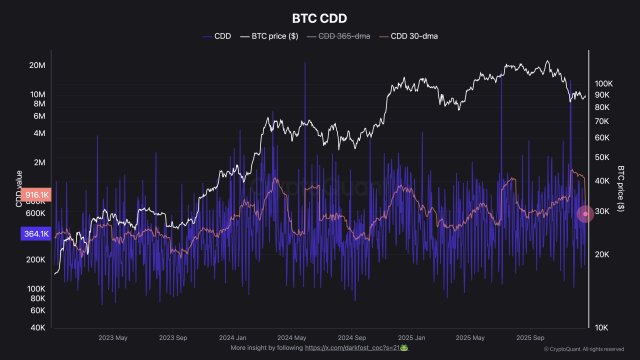
According to the expert, the most interesting aspect of the development is that this decline has reached a level well below the previous spike. In addition to the Coinbase-related action, this implies a sign of slowdown in Bitcoin long-term holders’ activity. It is worth noting that when BTC held in the long term begins to move, it is usually in preparation for a sell-off.
Although it may sound bad, this drop in CDD is a positive signal. This is because long-term holders continue to be the biggest possible source of selling pressure as they account for the largest share of the total supply. However, a decrease in long-term holder selling pressure aids in relieving the market and may add to the formation of a bottom if this trend persists.
When Is The Time To Buy The Crypto Asset?
After weeks of waning price action, Joao Wedson, the founder of Alphractal, has offered insights into when to purchase bitcoin using the Financial Stress Index (FSI). Historically, this key metric has acted as a reliable signal for when to buy BTC, making it one of the most closely watched indicators.
Presently, the FSI metric has flipped into a positive territory. Wedson highlighted that each time this happens, good opportunities to acquire more BTC have emerged. However, this trend has not yet unfolded.
The indicator, which uses a wide range of factors, including volatility, spreads, and risk premiums, to gauge systemic stress in international financial markets, was created by the Office of Financial Research. Wedson stated that these kinds of metrics are uncommon in the macroeconomic environment, which is characterized by substantial data delays and sluggish decision-making.
