Dragonfly’s Hadick Unveils Bullish 2026 Crypto Outlook: ‘Constructive’ Market Surge Ahead

Crypto's sleeping giant wakes hungry. Dragonfly Capital's Tom Hadick just dropped a bombshell prediction for 2026—and institutional money's already circling.
The 2026 Catalyst Playbook
Regulatory shackles loosen as Bitcoin ETFs hit critical mass. DeFi 3.0 protocols eat traditional finance's lunch—with 100x faster settlements at 1/100th the cost. Meme coins? Still pumping, but now with AI-generated 'utility' whitepapers.
The Institutional Stampede
BlackRock's crypto AUM crosses $50B as pension funds panic-buy exposure. CBDCs flop harder than Meta's Diem—turns out nobody wants surveilled digital dollars. Meanwhile, Ethereum's zk-rollups finally deliver scalable transactions (only three years behind schedule).
The Punchline
Hadick's 'constructive' outlook reads like a Goldman Sachs memo—if Goldman admitted their 2% Treasury returns were financial malpractice. The real prediction? Wall Street will rebrand its crypto skepticism just in time to take credit for the rally they missed.
2026 Crypto Predictions
Pressed on what “a good 2026” means in practice for the crypto market, Hadick tied his outlook to macro conditions and what he sees as compounding real-world usage. “For the token prices themselves—bitcoin, ethereum—there’s likely to be continued momentum,” he said. “I think from a macroeconomic perspective… we’ll have better monetary policy. And then we’re going to have more and more adoption of tokenized assets.”
One data point he said: “McKinsey just said that they think 3% of all cross-border payments is happening in stablecoins right now. That’s up from basically 0% a year ago,” Hadick said, adding that he expects “another tenfold increase.”
Hadick described Dragonfly as deliberately non-ideological across chains and sectors, positioning the firm less as a “bitcoin vs. ethereum” shop and more as a bet on market-structure innovation. “We invest in everybody that’s doing anything that’s interesting in tokenized digital assets,” he said. “We’re not what I WOULD say ideological about crypto. What we are is investing in the future of innovation in financial markets.”
When the conversation turned from majors to categories, Hadick leaned into two themes: stablecoins and prediction markets. “Stablecoins I think are here to stay. I think it’s going to grow tenfold,” he said. “I think prediction markets are here to stay. I think they’re going to grow tenfold.”
On prediction markets specifically, Hadick argued the addressable market extends well beyond sports betting, despite the current overlap. He pointed to Polymarket’s growth as evidence of expanding use cases. “If you look at Polymarket volume today, they’ve gone from $50 million a month in early ’24… they’re now going to do probably about $4 billion of volume this month,” he said, adding that “only about 35% of that is sports,” putting Polymarket in contrast with Kalshi, which he characterized as “more of a sports platform because they’re infrastructure for Robinhood.”
Hadick also invoked Intercontinental Exchange CEO Jeff Sprecher’s long-running tokenization thesis to argue prediction markets may converge with broader financial infrastructure rather than remain a niche wagering product. “If you talk to Jeff Sprecher over at ICE… he’ll tell you he believes in the tokenization of all markets,” Hadick said. “I talked to him before he made the investment in Polymarket… his perspective is that this is going to be as big as ICE itself. Probably.”
He suggested the functional framing is less “bets” and more programmable risk transfer. “I talked to an insurance company maybe a month ago that was thinking about how they can hedge out risk in weather related activities,” Hadick said. “That’s just one use case… every single thing and every single market and outcome that can be put [into] a market—or really just a binary option, which is what it is.”
Ethereum Vs. Solana
Asked to pick sides in the Ethereum–Solana debate, Hadick refused the “MySpace vs. Facebook” framing. “No, they’re both Facebook,” he said, arguing the market will require multiple settlement environments if tokenization becomes mainstream. In his view, Ethereum’s advantage is where value and stablecoin liquidity already sit, while Solana’s edge is high-throughput, low-cost flow.
“Most stablecoins today are on Ethereum,” Hadick said. “Ethereum is where a large amount of… economic activity exists… but if you look at the trading volume, it’s happening more on Solana, which is more optimized for that type of transaction FLOW and for low cost transactions.”
Still, Hadick conceded the platform layer is not frozen. He said Dragonfly is invested in a newer chain, Monad, describing it as “trying to be a solana killer,” and cited figures he said reflected early-stage market positioning: a roughly $2 billion valuation and a token price around $0.002.
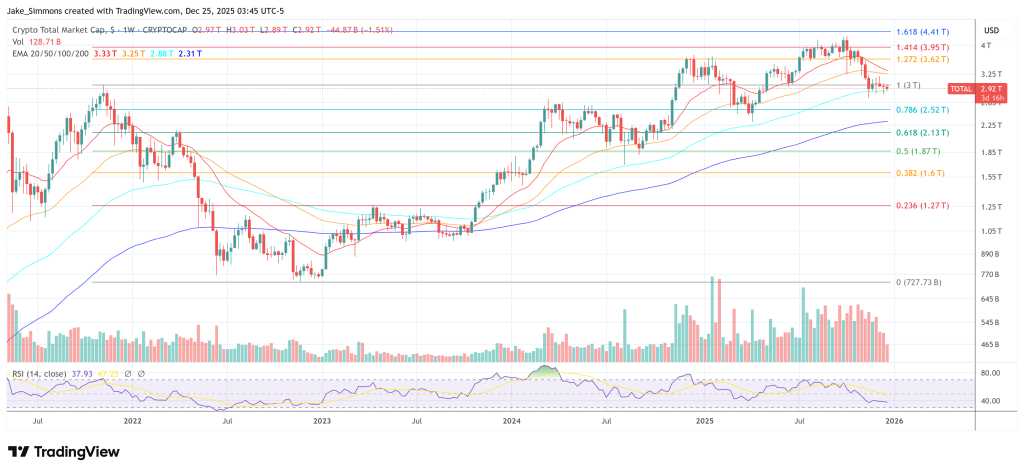
At press time, the total crypto market cap stood at $2.92 trillion.