CZ Breaks Silence as Bitcoin Plunges to $24,000 on Binance: What’s Next for Crypto?

Bitcoin's sudden nosedive on the world's largest exchange sent shockwaves through digital asset markets this week. The flagship cryptocurrency briefly touched $24,000 on Binance, triggering a cascade of liquidations and frantic social media speculation.
The CEO Steps Into the Fray
Changpeng Zhao, Binance's founder, moved swiftly to address the market panic. His public statement aimed to calm nerves, framing the volatility as a temporary market anomaly rather than a fundamental breakdown. The response highlighted the delicate dance exchange leaders perform during price crises—balancing transparency with damage control.
Anatomy of a Flash Crash
These events typically follow a predictable, brutal pattern. A large sell order hits a thin order book, automated trading algorithms amplify the move, and leverage gets vaporized in minutes. It's the financial equivalent of a crowd stampede—once it starts, everyone runs for the same exit.
Volatility as a Feature, Not a Bug
For seasoned crypto participants, these dramatic swings are part of the landscape. The market's 24/7 nature, combined with global liquidity pools and sometimes comical leverage ratios, creates perfect conditions for periodic air pockets. Traditional finance veterans might clutch their pearls, but crypto natives just check their liquidation prices and brew another coffee.
The Regulatory Shadowboxing Continues
Every sharp move brings renewed scrutiny from regulators watching from the sidelines. They'll likely use this episode as another data point in their ongoing assessment of crypto market stability—or lack thereof. Expect more speeches about investor protection, with the usual suspects calling for tighter controls on the wild west of finance.
Where Do We Go From Here?
History suggests these events often create buying opportunities for those with steady hands. The market's resilience will be tested in the coming days as traders assess whether this was a healthy correction or something more sinister. One cynical take? Wall Street probably sees this as a buying opportunity—they love acquiring assets at a discount during other people's panic attacks.
The crypto ecosystem absorbs another stress test. It bends, sometimes dramatically, but so far hasn't broken. The real question isn't whether volatility will return—it's when, and who will be prepared when it does.
Did Bitcoin Really Crash To $24,000?
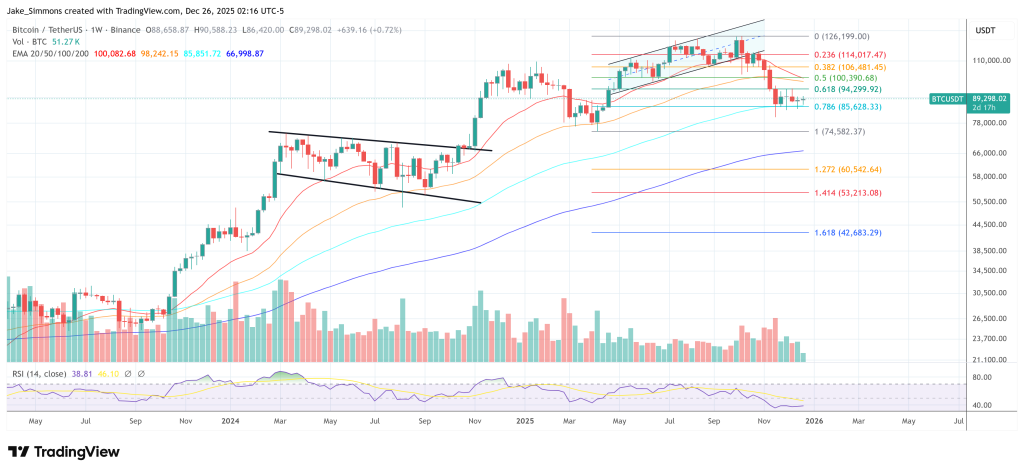
The sharp wick appeared isolated to BTC/USD1, a market quoted in USD1, a stablecoin launched by Trump family-backed World Liberty Financial. Within seconds, the pair snapped back toward prevailing bitcoin prices above $87,000, according to exchange data cited by traders sharing the screenshot.
CZ’s explanation was straightforward: on an illiquid order book, a single aggressive order can print an extreme price before arbitrage closes the gap. “This actually shows the exchange is NOT involved in trades. Low liquidity on new pairs means one large market order can spike prices, but arbitrageurs quickly corrected it. No liquidations occurred, as this pair isn’t included in any index.”
The Binance founder shared a breakdown from Head of Business Development of Solv Protocol Catherine Chan who said the MOVE was “a liquidity event,” not a bitcoin collapse. She tied the dislocation to a Binance-and-USD1 promotion offering a 20% fixed APY deposit deal that, she claimed, pushed users to swap USDT into USD1 and briefly drove USD1 to a premium.
“Many users swapped USDT → USD1, pushing USD1 to a 0.39% premium: huge for a stablecoin. Smart money borrowed USD1 on @lista_dao against SolvBTC or SolvBTC-BTCB smart lending markets (~0.5% APY). They either deposited USD1 directly or sold it slowly on spot to meet demand. Then someone thought: ‘Why not just sell via BTC/USD1?’ They used a market order. Problem: BTC/USD1 has very thin liquidity. That market order wiped out most buy orders, briefly causing a very low price,” Catherine explained.
“Arbitrage bots instantly bought it back,” she wrote. “No fundamentals changed. No mass liquidations.”
The episode also picked up a familiar edge of crypto paranoia. One user, Bera (@doomsdart), framed it as a coordinated signal: “Cz and Trump family are telling us what they’re gonna do to our coins. Get ready.” CZ’s reply, by contrast, suggested the opposite — that the speed of arbitrage, and the absence of cascading liquidations, is evidence the venue wasn’t “printing” a market-wide price at all.
For traders, the takeaway is less dramatic than the screenshot implied, but still relevant: new quote-asset pairs can be structurally fragile, and promotions that rapidly concentrate FLOW into a single stablecoin can leave unusually thin order books in their wake. In that kind of market, a single market order can create a headline before it creates a trend.
At press time, Bitcoin traded at $89,298.