Bitcoin Market Stress Isn’t Over: Short-Term Holders Still Underwater - Here’s Why It Matters in 2026

Bitcoin's latest volatility isn't just a blip—it's exposing a critical fault line in the market structure. Short-term holders are still swimming in red ink, and their pain could dictate the next major price move.
The Psychology of Paper Hands
When prices dip below recent entry points, human nature kicks in. Fear trumps conviction. These investors didn't sign up for a marathon; they wanted a sprint to profits. Now, they're stuck watching their screens, calculating losses instead of gains. This creates a massive overhang of potential sell orders—a sword of Damocles hanging over any rally attempt.
Liquidity Versus Conviction
The market's health hinges on who holds the coins. Long-term believers stash them away, reducing liquid supply. Short-term traders provide the daily churn that defines price discovery. When that churn is fueled by panic, not strategy, the entire ecosystem feels the tremors. It's the financial equivalent of building on sand during a storm.
The Domino Effect on Sentiment
Negative momentum feeds itself. Each stop-loss triggered becomes a data point for the next fearful headline. Social media amplifies the anxiety, turning individual doubts into a collective narrative. Before you know it, a technical correction morphs into a full-blown sentiment crisis—because in crypto, perception often is reality, at least until the next trend reverses.
Why This Isn't 2022 All Over Again
Context matters. The macroeconomic backdrop, institutional adoption curve, and regulatory clarity (or lack thereof) in 2026 are worlds apart from previous cycles. The players have changed, the stakes are higher, and the tools for analysis are more sophisticated. Yet, the core human emotions—greed and fear—remain stubbornly, reliably primitive.
So, while the charts show stress, history shows opportunity. These pressure points have a way of separating the tourists from the natives. The tourists eventually go home; the natives rebuild. Just remember, in traditional finance they call this 'risk management'—in crypto, we often just call it Tuesday.
Short-Term Holder Stress Persists
Adler’s latest analysis of Short-Term Holder (STH) Realized Price highlights why Bitcoin remains locked in a stress regime despite recent attempts to stabilize. The chart compares BTC price with the STH Realized Price—the average cost basis of coins held for less than 155 days—alongside stress indicators and weekly changes in that cost basis.

In this framework, the black line represents Bitcoin’s market price, while the orange line tracks the STH Realized Price. Additional overlays, including the STH Stress Score and weekly percentage changes, help contextualize shifts in short-term positioning.
According to Adler, Bitcoin has traded consistently below the STH Realized Price since October 17, confirming that stress mode remains active. The weekly change in STH Realized Price has stayed in negative territory and recently reached local lows, signaling that short-term holders continue to redistribute coins at lower prices rather than accumulate at higher levels. This behavior reflects weak incoming demand and reinforces overhead pressure.
Price performance across timeframes remains mixed. While Bitcoin has shown modest stabilization over shorter horizons—up roughly 0.9% on the week and 2.3% on the month—the broader picture remains fragile.
The 90-day performance is deeply negative at −26.7%, indicating that stress dominates across all major timeframes. Adler’s forecast model points to continued downside pressure, with an expected weekly decline of around 3% if current conditions persist.
Crucially, the declining STH Realized Price lowers the resistance “ceiling,” reducing the distance required to return to healthier conditions. However, it also underscores persistent weakness in new demand. A meaningful improvement WOULD require the STH Realized Price to stabilize and turn higher while Bitcoin holds current price levels.
Bitcoin Holds Structure But Remains Capped Below Resistance
The weekly Bitcoin chart highlights a market caught between long-term structural support and persistent overhead resistance. BTC is trading NEAR the $88,000–$89,000 zone, a level that has acted as a pivot since late November. While price has managed to reclaim this area, it has repeatedly failed to sustain a breakout above $90,000, signaling hesitation rather than renewed bullish momentum.
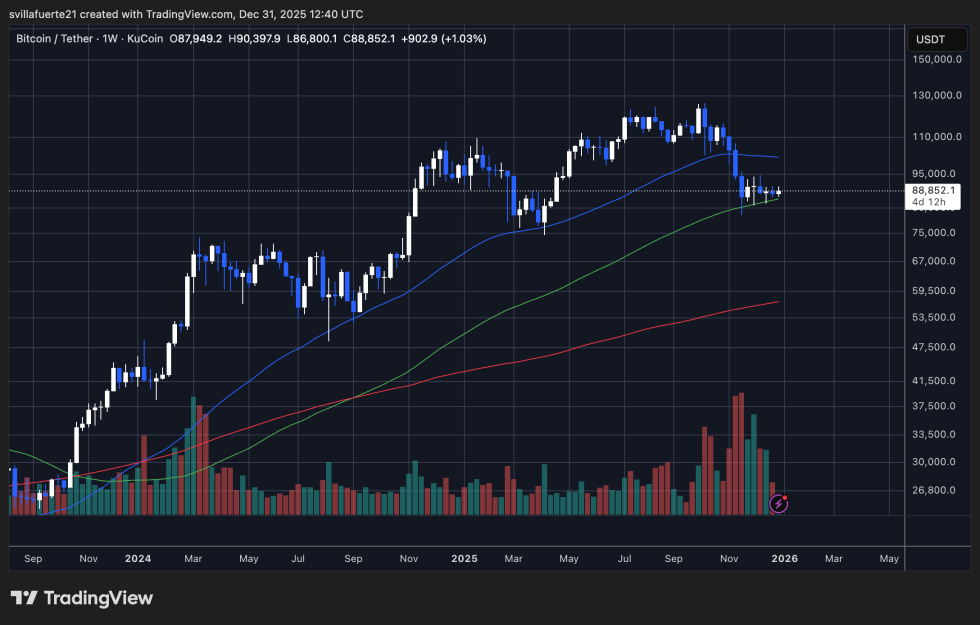
From a trend perspective, Bitcoin remains above its 200-week moving average, which continues to slope upward and currently sits well below price, preserving the broader bullish market structure. The 100-week moving average is also rising and has provided dynamic support during recent pullbacks, reinforcing the idea that long-term buyers are still defending key levels. However, the 50-week moving average has flattened and now acts as immediate resistance, aligning with the broader supply zone between $90,000 and $95,000.
After a surge in activity during the sharp correction from October highs, recent weeks show declining volume, suggesting reduced participation and growing apathy among market participants. This environment often precedes a directional MOVE but does not yet favor a clear upside resolution.
Technically, as long as Bitcoin holds above the rising 100-week moving average, downside risk appears structurally contained. However, failure to reclaim the 50-week average keeps the market vulnerable to extended consolidation or a deeper corrective phase before any sustainable recovery can develop.
Featured image from ChatGPT, chart from TradingView.com
