Bitcoin Warning Signal Flashes: Whale Deposits Surge as Accumulation Slows—What’s Next?

Bitcoin's calm waters just got choppy. A classic warning signal is flashing on the charts, and it's got the market's attention.
The Whale Watch
Large holders are moving coins. Not buying—depositing. Exchange-bound transactions from deep-pocketed addresses are ticking up, a historical precursor that often precedes increased selling pressure. It's the digital equivalent of seeing the smart money quietly edging toward the exit at a crowded party.
The Retail Retreat
Meanwhile, the steady drumbeat of accumulation from smaller wallets is losing its rhythm. The buy-the-dip fervor that characterized previous dips has softened to a murmur. When the big players start distributing and the little guys stop hoarding, the supply-demand equation shifts—fast.
Reading the Tea Leaves
This isn't a crash prediction; it's a momentum check. Bull markets climb a wall of worry, and this signal is a fresh brick in that wall. It suggests a potential consolidation phase or a healthy pullback is on the menu. For traders, it's a cue to tighten risk management. For hodlers, it's a reminder that volatility is the price of admission.
Remember, in crypto, a 'warning signal' is just a fancy term for 'opportunity wearing a scary mask.' The traditional finance crowd will call it reckless—but then again, they still think a 2% yield is a win.
Bitcoin Whale Flows Signal Rising Supply Risk
The report points to a meaningful shift in how large bitcoin holders are interacting with exchanges, and the change is not neutral. Data tracking the average size of deposits into Binance shows a sharp jump over recent months. Transactions flowing into the exchange are no longer clustered around smaller sizes; instead, they increasingly reflect much larger transfers.

This pattern is typically associated with whales positioning liquidity, a behavior that often precedes distribution rather than long-term holding. When large amounts of BTC are moved onto exchanges, it raises the probability that supply will soon be available to the market.
At the same time, the opposite side of the equation looks notably weak. Average withdrawal sizes have failed to recover meaningfully since their decline in October. While there has been a modest rebound, outflows remain far below previous levels, suggesting that large investors are not aggressively moving coins into cold storage. This lack of follow-through on withdrawals implies muted conviction in longer-term accumulation.

Taken together, these two trends FORM an uncomfortable divergence. Selling capacity appears to be growing, while evidence of strategic accumulation remains limited. This does not guarantee immediate downside, but it does tilt the risk profile against sustained upside momentum. As long as large inflows dominate and outflows stay suppressed, Bitcoin may struggle to build a durable rally without a clear improvement in underlying demand.
Price Stabilizes, But Structural Resistance Persists
Bitcoin’s weekly chart shows a market attempting to stabilize after a sharp correction, but still facing important structural hurdles. Price has reclaimed the $92,000 area, which places BTC back above a key horizontal level that previously acted as support during mid-2025. This recovery has eased immediate downside pressure and suggests buyers are defending the range rather than capitulating.
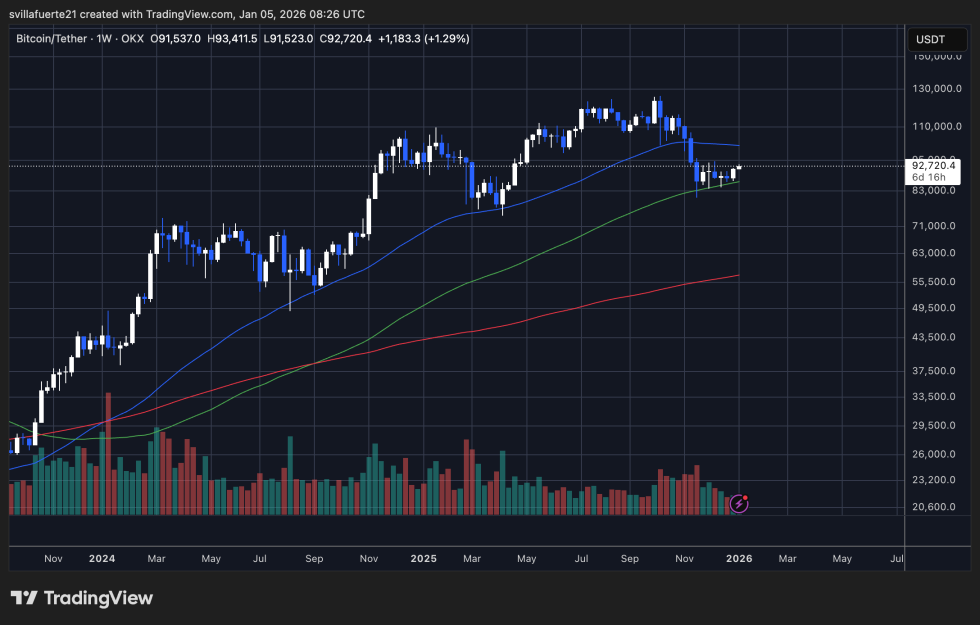
However, the broader trend remains mixed. Bitcoin is still trading below the declining short-term moving average, which has capped upside attempts since the November breakdown. This indicates that, despite the bounce, momentum has not fully shifted back in favor of bulls. The recovery so far resembles consolidation after a drawdown rather than a confirmed trend reversal.
From a structural perspective, the rising longer-term moving averages remain intact and well below the price. This signals that the macro uptrend from 2023 has not been invalidated. As long as BTC holds above the green moving average, the larger bullish structure remains technically preserved. That said, the distance between price and these longer-term supports has narrowed, reflecting reduced trend strength.
Volume has remained relatively muted during the rebound, suggesting that buying interest is cautious rather than aggressive. For Bitcoin to reassert bullish control, it would need to reclaim and hold above the short-term moving average with expanding volume. Until then, price action points to a fragile recovery within a broader consolidation phase.
Featured image from ChatGPT, chart from TradingView.com
