Vitalik Buterin Declares Ethereum Has Cracked The Blockchain Trilemma - Here’s How

For years, the blockchain trilemma haunted developers: the seemingly impossible choice between scalability, security, and decentralization. Pick two, the dogma went, and sacrifice the third. Ethereum co-founder Vitalik Buterin now claims that era is over.
The Three-Headed Beast, Tamed
Ethereum's roadmap—a multi-year pivot to proof-of-stake and a layered rollup-centric architecture—purportedly delivers on all three fronts simultaneously. The Beacon Chain anchors security, rollup networks like Arbitrum and Optimism drive transaction throughput, and a globally distributed validator set maintains decentralization. It’s a technical trifecta that defies old axioms.
Beyond the Theoretical
The real test isn't in whitepapers but in adoption. Developers are voting with their code, building everything from decentralized social media to high-frequency trading engines on this new foundation. Network activity metrics and total value locked suggest the theory is holding under real-world load—a stress test no academic model can replicate.
The Finance Angle (With a Dash of Cynicism)
Of course, Wall Street will find a way to repackage this breakthrough into a convoluted ETF or a derivative product that somehow still requires a 2% management fee. Innovation in the back office, rent-seeking in the front—some things never change.
Buterin’s declaration isn't just a technical milestone; it's a gauntlet thrown. If Ethereum truly solved the trilemma, it redefines what's possible for global, open-source infrastructure. The next generation of applications won't be built on compromises. They'll be built on a stack that finally delivers it all.
Ethereum Will Solve The Blockchain Trilemma
The claim, in Buterin’s telling, is that Ethereum is entering a third category. “Now, Ethereum with PeerDAS (2025) and ZK-EVMs (expect small portions of the network using it in 2026), we get: decentralized, consensus and high bandwidth,” he said. “The trilemma has been solved — not on paper, but with live running code, of which one half (data availability sampling) is on mainnet today, and the other half (ZK-EVMs) is production-quality on performance today — safety is what remains.”
Buterin cast this as the culmination of a multi-year roadmap rather than a sudden breakthrough. He described it as a “10-year journey,” pointing back to early data availability sampling research and noting that ZK-EVM efforts began around 2020. The arc of his argument is that data availability sampling changes what a decentralized network can safely publish and verify at scale, while ZK-EVMs change how nodes can validate execution, shifting validation toward proof-based verification as the technology matures.
Looking ahead, Buterin laid out an approximate timeline for how he expects the vision to roll out over the next four years. In 2026, he expects “large non-ZKEVM-dependent gas limit increases” tied to BALs and ePBS, alongside what he described as the first opportunities to run a ZK-EVM node.
From 2026 through 2028, he anticipates a sequence of changes, gas repricings, adjustments to state structure, moving execution payloads into blobs, and other steps, aimed at making higher gas limits safe. Between 2027 and 2030, he expects “large further gas limit increases,” with ZK-EVMs becoming “the primary way to validate blocks on the network.”
He also flagged what he called a “third piece” of the puzzle: distributed block building. The long-term goal, he wrote, is a world where “the full block is never constituted in one single place,” though he stressed it “will not be necessary for a long time.” The nearer-term focus is distributing “meaningful authority in block building,” either through in-protocol mechanisms—he floated expanding FOCIL as a primary transaction channel—or through out-of-protocol systems such as distributed builder marketplaces.
For Buterin, distributing block building is not just an engineering preference but a risk and fairness question: he argued it WOULD reduce the chance of “centralized interference with real-time transaction inclusion,” while creating “a better environment for geographical fairness.”
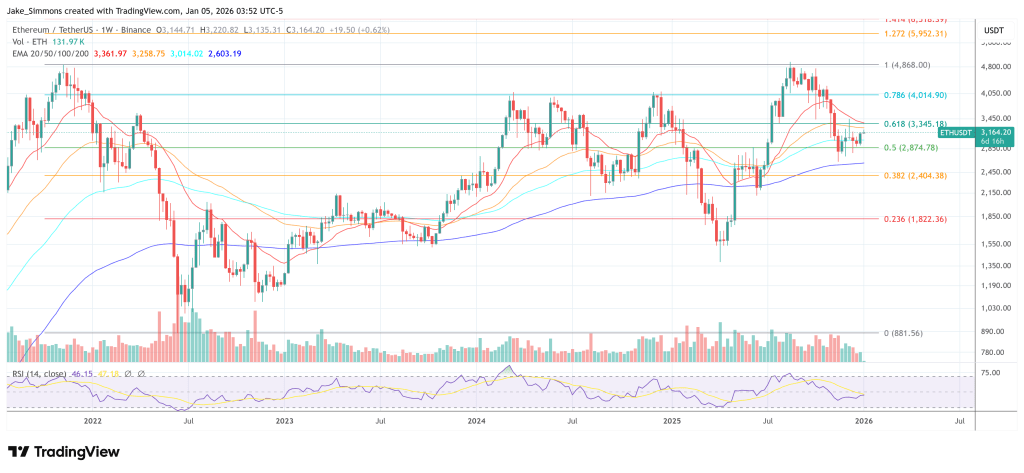
At press time, ETH traded at $3,164.