Ethereum Shatters Records: How Massive Stablecoin Flows Cement Its Dominance in On-Chain Finance

Ethereum isn't just leading the on-chain finance race—it's lapping the competition. Record-breaking stablecoin volumes are flooding the network, painting a clear picture of where the real financial action lives in the digital asset world.
The Plumbing of Digital Finance
Forget the speculative froth. The real story is in the pipes—the billions in stable value moving to settle trades, provide liquidity, and execute complex financial strategies entirely on-chain. This isn't gambling; it's utility at a staggering scale, and Ethereum's infrastructure is handling the load.
Why Volume Trumps Hype
High transaction volumes signal one thing: entrenched adoption. Developers build where the users are, and capital flows where the infrastructure is proven. The network effect becomes a moat, making Ethereum the default settlement layer for a new financial system—one that operates 24/7, bypassing traditional banking hours and gatekeepers.
A Reality Check for the Field
Let's be cynical for a second. While other chains tout lower fees or faster speeds, they're often chasing ghosts—building elaborate palaces for speculative tokens that come and go with the market's mood. Ethereum, meanwhile, is processing the kind of boring, essential monetary plumbing that would make a central banker nod in grim recognition. The numbers don't lie, and right now, they're all pointing to one network. The age of on-chain finance is here, and its capital highway has a very clear on-ramp.
Stablecoin Liquidity Floods Ethereum Network
Ethereum continues to remain at the forefront of on-chain finance following recent stablecoin flows on the blockchain. Presently, stablecoin activity on the Ethereum network has surged sharply, reaching historical levels, reflecting a significant change in the dynamics of on-chain liquidity.
In the midst of a growing stablecoin market, Joseph Young, a market expert and ETH narrator, revealed that stablecoin transfer volume on the Ethereum network just hit a new all-time high. This rise in stablecoin flows to new heights suggests increasing demand for settlement, trading, and Decentralized Finance (DeFi) activity.
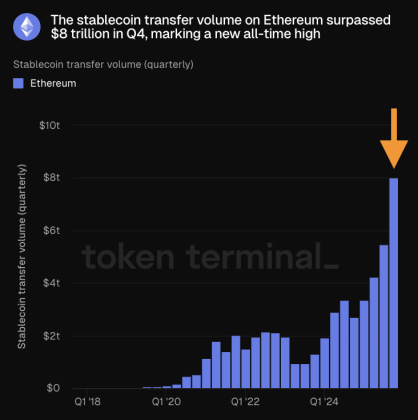
Data from the chart shared by Young shows that over $8 trillion in stablecoins were settled in the fourth quarter (Q4) of 2025, or in just 3 months. This is actual money being moved, settled, and cleared on the blockchain.
With this growth, Ethereum is reinforcing its central role as the primary financial LAYER for stablecoin transactions. According to Young, this amount of stablecoin transfers settled on ETH is larger than that of Visa, whose average payment volume is at $4 trillion per quarter.
Stablecoins have subtly emerged as one of the most popular cryptocurrency goods; the key chain for that activity is Ethereum. As a result, Young believes that ETH is becoming the trusted settlement layer of money, and no other chain rivals its financial reach.
ETH Is Highly Undervalued In The Crypto Space
Despite several milestones and remarkable network growth over the years, Ethereum is increasingly viewed through a different lens. Many analysts continue to argue that the ETH network may be the most undervalued blockchain in the entire cryptocurrency landscape today.
In the X post, BMNR Bullz, a financial expert and investor, highlighted that ETH only makes up over 14% of all crypto market value. Meanwhile, the network secures about 59% of all capital in the DeFi sector. This widening gap between usage and price is strengthening the argument that Ethereum’s true value may not yet be completely reflected.
This growth implies that the majority of the real money, applications, and settlements are actively taking place on the leading blockchain. “When price doesn’t reflect where capital actually lives, it’s usually the price that’s wrong,” BMNT Bullz added.
At the time of writing, the price of ETH was trading at $3,233 after experiencing a more than 2% rise in the last 24 hours. At the same time, its trading volume has flipped sharply bullish, increasing by over 42% in the past day.
