The Bitcoin Signal Most Investors Overlook: Hash Ribbons Reveal What’s Really Happening

Hash Ribbons just flashed a signal most traders missed—here's what it means for Bitcoin's next move.
Forget the noise on crypto Twitter. While retail investors chase price pumps and celebrity endorsements, a quieter metric cuts through the hype. It's called the Hash Ribbon indicator, and it's whispering something the charts aren't screaming yet.
Mining Tells the True Story
Hash Ribbons track miner capitulation—the moment when inefficient miners get squeezed out and shut down their rigs. It's a brutal, Darwinian process within Bitcoin's ecosystem. When the hash rate recovers after this shakeout, history shows it often marks a major bottom. It's a signal built on economic survival, not sentiment.
Why Wall Street Analysts Hate This Metric
You won't find Hash Ribbons in a traditional financier's toolkit. It bypasses discounted cash flow models and ignores P/E ratios. It measures raw, operational stress in a decentralized network—a concept that gives legacy analysts heartburn. Their spreadsheets can't quantify miner electricity bills, but the blockchain does.
The Cynical Take
Of course, the big funds would rather you focus on their quarterly reports and carefully curated narratives. A transparent, on-chain signal like this? It undermines their gatekeeper status—and their fees.
So, while the headlines debate ETFs and regulation, the network's own heartbeat is telling a different story. The miners who survived the last squeeze are still hashing. And that might be the most bullish signal of all.
Miner Pressure Eases as Difficulty Adjusts Lower
Today, Bitcoin’s mining difficulty is beginning to adjust, offering early signs of relief for a sector that has been under sustained pressure. The latest adjustment shows a decline of approximately 2.6%, and current projections suggest the next difficulty change could also MOVE lower by around 1.88%. While these figures may appear modest, they carry meaningful implications for miner behavior and broader market dynamics.

A downward difficulty adjustment reduces the computational effort required to mine new blocks, effectively lowering operational stress for miners. As a result, profitability conditions improve at the margin, even if Bitcoin’s price remains range-bound.
This easing of pressure helps stabilize mining activity and, critically, reduces the urgency for miners to sell BTC simply to cover operating costs. Historically, periods when miner stress begins to unwind have often coincided with declining sell-side pressure from this cohort.
These dynamics are implicitly captured by the Hash Ribbons indicator, which tracks short- and long-term moving averages of the network hashrate to identify miner capitulation and recovery phases. Darkfost notes that Hash Ribbons is still flashing a buy signal, indicating that the market remains in a post-capitulation environment where miner selling pressure has largely been absorbed.
However, this signal is now starting to fade. As difficulty adjusts downward and conditions normalize, miners are likely to gradually return to full operational capacity. As machines come back online, the hashrate should trend higher, marking the transition out of the stress phase and signaling that the window of miner-driven relief may be narrowing.
Price Action Remains Range-Bound Below Key Averages
Bitcoin continues to trade in a broad consolidation range after the sharp sell-off from the October highs, with price currently hovering around the $90,000–$92,000 zone. The chart shows BTC attempting to stabilize after reclaiming the red long-term moving average, but upside momentum remains limited as price is still capped below the blue and green mid-term moving averages, which are now acting as dynamic resistance.
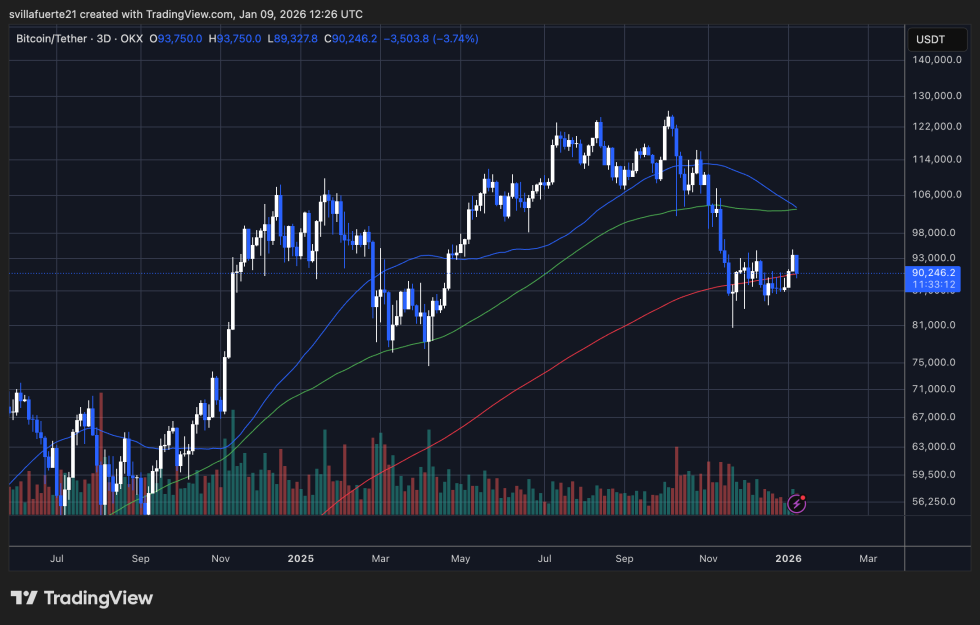
The recent bounce from the $85,000–$87,000 area suggests that buyers are defending this demand zone, which has repeatedly attracted bids since late November. However, the structure remains corrective rather than impulsive. Each recovery attempt has produced lower highs, signaling that sellers continue to distribute into strength. Volume also remains relatively muted compared to the sell-off phase, reinforcing the idea that this move is a consolidation rather than a trend reversal.
From a structural perspective, Bitcoin remains trapped between strong resistance near $95,000–$98,000 and key support around $85,000. A decisive reclaim of the 100-day and 200-day moving averages WOULD be required to confirm a bullish regime shift. Until that happens, price action favors continued sideways movement or another test of lower support.
Overall, the chart reflects a market in balance: sellers are no longer in full control, but buyers lack the conviction needed to push Bitcoin back into a sustained uptrend.
Featured image from ChatGPT, chart from TradingView.com
