Ethereum Foundation Co-Director Urges Turbocharged Teamwork to Meet Fusaka Upgrade Deadline

Ethereum’s Fusaka upgrade timeline hangs in the balance—and the Foundation’s co-director isn’t mincing words.
The Coordination Crunch
With the clock ticking, internal alignment is now the make-or-break factor for Ethereum’s next evolution. No new technical hurdles—just the age-old crypto Achilles’ heel: human synchronization.
Devs vs. The Calendar
Fusaka’s feature set promises scalability leaps, but delivery delays could let competitors eat Ethereum’s lunch (again). Meanwhile, traders are already pricing in the classic ‘crypto time dilation’—where 1 dev month equals 3 exchange quarters.
One thing’s certain: the upgrade will land right on schedule… in crypto-standard ‘eventually’ time.
Ethereum’s Fusaka Upgrade Scheduled For Q4 2025
In a post on X published today, Stańczak shared his views on the smart contract platform’s Fusaka upgrade, emphasizing the need for Ethereum developers to prioritize this upgrade over the upcoming Glamsterdam hard fork, which is expected to launch in Q1 or Q2 of 2026.
Stańczak mentioned that he had advised project coordinators to temporarily pause discussions around the Glamsterdam upgrade and focus exclusively on ensuring the timely delivery of Fusaka. He stated:
As I have said many times, no amount of talking about Ethereum’s roadmap and vision matters if we cannot achieve coordination levels that consistently meet goals on schedule. I know that some extremely talented people are now working on resolving the issues that caused teams to suggest moving the dates. I WOULD love to see a broad agreement that the timelines matter a lot. A lot.
For those unfamiliar, the Fusaka upgrade will introduce a range of technical enhancements to Ethereum. It builds on the Pectra upgrade, which went live in May 2025 and brought improvements to validators and account abstraction.
What Does Fusaka Upgrade Offer?
The Fusaka upgrade combines two major upgrades – Fulu (consensus layer) and Osaka (execution layer). It will introduce 11 new Ethereum Improvement Proposals (EIPs), Peer-to-Peer Data Availability Sampling (PeerDAS), and Verkle Trees.
One of the key EIPs, EIP-7825, aims to enhance the Ethereum network’s resilience to attacks by introducing a transaction gas limit cap of 16,777,216 units. This will help mitigate spam and safeguard nodes from targeted attacks.
PeerDAS enables network participants to efficiently verify shard data availability without downloading the entire data set, significantly improving scalability. This mechanism helps keep the network’s sharded blockchain secure and decentralized by preventing data withholding attacks while reducing the resource demands on individual nodes.
Meanwhile, Verkle Trees are an advanced type of cryptographic data structure that improve the efficiency of storing and verifying large amounts of data compared to traditional Merkle trees. They will enable ETH nodes to prove and verify state data with much smaller proofs, reducing storage requirements and speeding up sync times.
Ethereum’s continuous technological upgrades have fueled a growing trend among corporations to incorporate ETH into their treasury strategies. Recently, ETH exchange-traded fund (ETF) inflows surpassed those of Bitcoin (BTC) products.

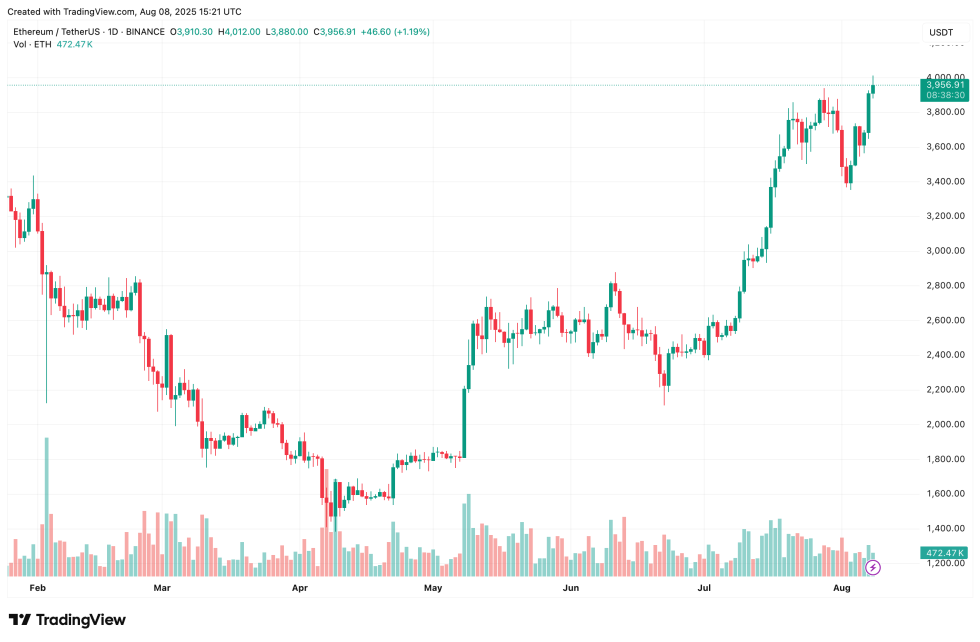
Additionally, a recent VanEck report suggested that ETH, rather than BTC, may become the future’s preferred store of value. At press time, ETH trades at $3,956, up 3.4% in the past 24 hours.