Armstrong’s Masterstroke: How Coinbase’s Bank Partnerships Are Fueling Crypto’s Mainstream Surge

Coinbase just pulled off the ultimate institutional heist—partnering with traditional US banks to bring crypto to the masses. This isn't just another integration; it's a direct pipeline from legacy finance into the digital asset ecosystem.
The Bridge to Billions
Forget clunky on-ramps. These partnerships let users buy crypto directly from their existing bank accounts, slashing friction and opening the floodgates for mainstream capital. It's a seamless pivot from fiat to crypto, wrapped in the familiar comfort of your neighborhood bank's interface—because nothing says "adoption" like making volatility accessible from your checking account dashboard.
Regulatory Chess, Not Checkers
Armstrong isn't just building products; he's playing a long game with regulators. By embedding crypto services within regulated banking frameworks, Coinbase is constructing a de facto regulatory blueprint. Each partnership normalizes digital assets, turning skeptical bankers into unlikely evangelists for the very system that was supposed to displace them. A neat trick, getting the old guard to fund the revolution.
The Domino Effect
Watch for the ripple. One major bank's move pressures the entire sector to follow or risk being left with obsolete offerings. This creates a network effect where crypto accessibility becomes a baseline expectation for financial services—transforming a niche advantage into a market necessity overnight.
This strategic weave through the banking system does more than boost user numbers. It systematically dismantles the last barriers to entry, proving that the fastest way to disrupt traditional finance is to partner with it first—and maybe charge a tidy facilitation fee along the way. After all, what's a financial revolution without a profitable middleman?
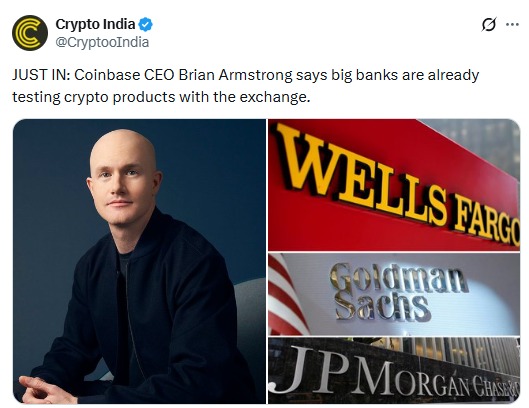
Source: X (formely Twitter)
These efforts follow earlier partnerships with PNC, J.P. Morgan, and Citi, as regulations ease and Wall Street shows growing interest in tokenization and Bitcoin.
Major Banks Begin Testing Crypto Services
According to Armstrong, some of the world’s largest banks are already using Coinbase’s systems to build these digital currency tools. While many institutions are moving forward, others are still trying to slow down crypto through lobbying. Armstrong warned that these financial institutions risk falling behind if they continue to resist change.
This partnership is not just for testing, but for building real financial products for customers. Armstrong explained that stablecoins could force them to offer better interest rates and lower fees. He also said financial institutions fear losing profits more than they fear crypto itself.
He predicted that soon, many financial institutions will ask regulators for permission to offer interest and rewards on stablecoins.
BlackRock’s Larry Fink Admits He Was Wrong on Bitcoin
One of the biggest moments at the summit came from BlackRock CEO Larry Fink. Once a strong critic of digital currency, Fink now sees Bitcoin as an important financial asset. He even called it an “asset of fear,” meaning people turn to it during uncertain times.
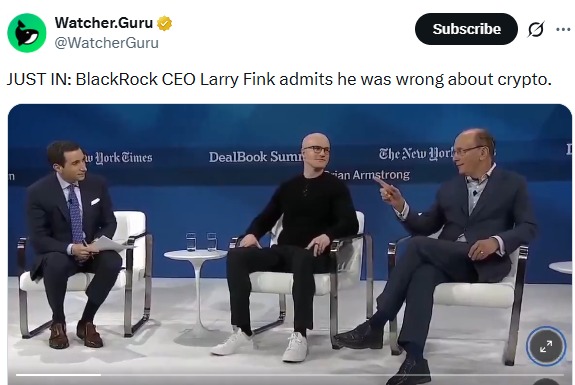
Source: X (formerly Twitter)
Blackrock CEO compared crypto tokenization to the early days of the internet. He believes that in the future, stocks, bonds, and even real-world assets could MOVE on-chain. It also signals that traditional finance is preparing for that future.
Fink also warned that the U.S. is moving too slowly on stablecoins. He pointed out that countries like India and Brazil are already using digital payments at a massive scale.
New Laws Are Helping Banks Move Faster
Digital assets growth is also being supported by new U.S. laws. Armstrong praised the GENIUS Act passed in July 2025, which created a legal framework for stablecoins. He said this year WOULD be remembered as the time when crypto moved out of legal uncertainty.
Coinbase Partners with US Banks with more confidence now because rules are becoming clearer. Armstrong also said the upcoming CLARITY Act could further strengthen the U.S. crypto market.
Vanguard and Bank of America Join the Crypto Shift
The momentum does not stop with Coinbase and BlackRock. Vanguard recently allowed its customers to invest in Bitcoin and ethereum ETFs through third-party funds. This move came after strong performance from digital currency investment products and growing investor demand.
At the same time, Bank of America advised its wealth clients to hold up to 4% of their portfolio in digital asset. The bank will also begin covering four bitcoin ETFs starting January.
Coinbase Partners with US Banks at a time when more financial giants are opening doors to digital assets.
What This Means for the Future of Banking
The message from Wall Street is now clear. Cryptocurrency is no longer on the edges of finance. With Coinbase building the rails, BlackRock backing Bitcoin, and major financial institutions entering the space, the old financial system is changing from within.
