India’s Crypto Crackdown: ED Raids 21 Locations Across 3 States in Major Scam Probe

The Enforcement Directorate just turned up the heat on India's crypto underworld.
Agents hit 21 locations across three states in a coordinated sweep targeting alleged digital asset scams. The raids signal a new phase of regulatory scrutiny—one that cuts through the hype and goes straight for the wallets.
Not Your Average Shakedown
This isn't about chasing retail traders. The ED is hunting organized operations—schemes that promise moon-shot returns but deliver empty wallets. The scale—21 locations—suggests a network, not a lone scammer.
The Regulatory Reckoning
India's stance on crypto has been a rollercoaster. The government debates frameworks while regulators like the ED take direct action. These raids bypass the political chatter and enforce existing financial laws. It's a clear message: play fast and loose with investors' funds, and the state will come knocking.
For every legitimate builder in Web3, there's a grifter selling vaporware—and finally, the authorities are starting to tell the difference. The timing is perfect, just as traditional finance starts dabbling in digital assets and needs a clean playground. Nothing says 'market maturity' like a few high-profile perp walks.
So, while the crypto faithful preach decentralization, remember: in the real world, your exit scam still has a physical address. And someone just wrote it down.
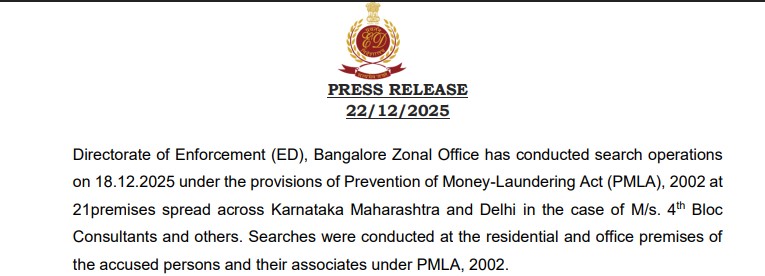
The searches covered 21 residential and office premises across Karnataka, Maharashtra, and Delhi, following information shared by the Karnataka State Police. Authorities allege the accused operated large-scale cryptocurrency fraud schemes, targeting both foreign nationals and Indian citizens, by collecting funds disguised as high-return investments.
With thousands of investors, from first-time crypto investors to seasoned traders, affected across India and abroad, are crypto scams in India entering a more dangerous and sophisticated phase?
Latest on Scam News: How the Fraud Network Operated
Investigators uncovered a well-planned and long-running method of operation used since 2015, highlighting how crypto scams in India have evolved beyond basic scams.
Creation of fake cryptocurrency investment platforms that closely looks like legitimate crypto-websites

Promises of high and guaranteed returns to attract investors, where initial payouts had been made to early investors to build trust.
Unauthorized use of photos of reputed market experts and public figures for promotions
Aggressive marketing through Facebook, Instagram, WhatsApp, Telegram, and referral bonuses
Laundering of funds via hawala channels (illegal money transfer system operates outside the banking network), accommodation entries, and P2P crypto-transfers
The search operations uncovered several digital wallet addresses linked to the accused persons. They moved the stolen money across multiple crypto wallets to hide its trail. These funds were later converted, transferred overseas, and used to buy properties and other assets, allowing the group to manage and conceal the capital without immediate detection.
How Crypto Scams In India Surging: Most Affected States
Estimated cryptocurrency crime cases in 2025 show clear regional concentration across the country. Where the high investor interest, rapid technology adoption, and limited knowledge, become the reason for surging cases in the major states.
Maharashtra: 650 cases
Karnataka: 550 cases
Delhi: 450 cases
Telangana: 300 cases
Uttar Pradesh: 250 cases
Here, Maharashtra and Karnataka lead due to high virtual asset use in cities like Mumbai and Bengaluru, while Delhi and Telangana see rising cases from high internet access and low awareness. Uttar Pradesh and Gujarat are emerging targets as scams reach rural areas as technology and smart networks.
This highlights how the regulatory gaps and social media reach rapidly expanding the cryptocurrency fraud networks, leaving no one, urban–rural.
Where Indian Regulations Stand: Crypto Laws
India currently does not recognise cryptocurrencies as legal tender. While digital asset trading soars here, it operates under regulatory uncertainty. But, as the Indian crypto market is growing fast, currently ranked #1 Globally in digital product's trading, authorities are taking steps to regulate it.
Cryptocurrencies are treated as VIRTUAL Digital Assets (VDAs), with taxes and KYC rules to protect investors. Proposed legislation such as the “Cryptocurrency and Regulation of Official Digital Currency Bill” and “Coins Act 2025”, are also adding hopes.
In developments, Madras High Court recognising cryptocurrencies as property and the RBI’s continued expansion of the Digital Rupee (e₹), showing growth. Although the country is moving slowly, it aims to create a safer, regulated environment.
So, with this the expectations of a clear future for digital product’s trading in the crypto-leading country becomes strong and pave the way for a more secured region.
