Ethereum 2026 Upgrades: Glamsterdam & Heze-Bogota Set to Radically Transform the Network

Ethereum's roadmap for 2026 isn't just an update—it's a full-scale metamorphosis. Two major upgrades, codenamed Glamsterdam and Heze-Bogota, are poised to fundamentally reshape the network's capabilities and economics.
The Core Engine Overhaul
Glamsterdam targets the protocol's deep architecture. Expect significant tweaks to the consensus mechanism and state management—cuts to finality times, bypasses for historical data bottlenecks. It's about making the base layer leaner, meaner, and ready for the next billion users.
Scaling the Execution Frontier
Heze-Bogota picks up where earlier upgrades left off, supercharging the execution layer. The focus? Turbocharging transaction throughput and slashing costs for complex smart contracts and decentralized applications. This isn't incremental; it's a performance leap designed to leave competitors scrambling.
The upgrades represent a calculated, aggressive push to solidify Ethereum's dominance. While the usual crypto hype cycle will inevitably inflate expectations—and a few trader portfolios along the way—the underlying tech narrative is one of relentless, pragmatic evolution. The network isn't just upgrading; it's preparing to eat the rest of the market's lunch.
Source: X (formerly Twitter)
Glamsterdam Upgrade: Increasing Speed and Efficiency
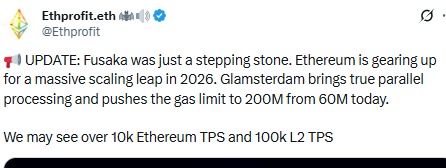
The Glamsterdam upgrade, which is expected to be seen in mid-2026, is all about speed and scalability. One of the most prominent features of the Glamsterdam upgrade is parallel processing.
This means that the blockchain would be able to process multiple transactions in parallel and not one at a time. This would make the network faster and able to handle a lot of traffic without slowing down.
Furthermore, the gas limit will be increased from 60 million to 200 million. Gas limit sets the threshold for the amount of data being processed in a block, so this increase will make the network more efficient for its users, processing more transactions in a block.
The next interesting addition would be the ZK validator proof system that would enable it to handle 10,000 TPS on the gateway and 100,000 TPS of transaction capacity via Layer 2 systems.
Source: X (formerly Twitter)
This WOULD make Ethereum blockchain systems the fastest of their kind and an enticing platform for developers.
Enhancing the Decentralization
It has always prided itself on being a decentralized network, and Glamsterdam is set to enhance its security further.
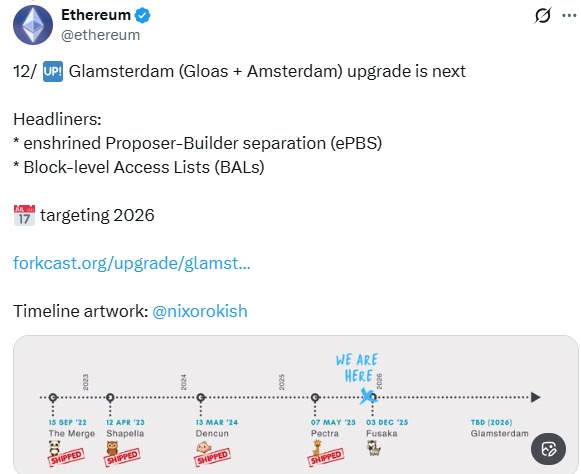
It brings forth Proposer-Builder Separation (ePBS), which guarantees that it is not possible for an individual to have control over which transactions go into the blockchain.
It works to eliminate Maximal Extractable Value (MEV) exploitation in which validators exploit the transaction order for their personal gain.
However, with ePBS, two different components are involved: block builders and proposers. Block builders build blocks, and proposers identify the block with the highest reward.
Block-Level Access Lists: Improving Efficiency
The Block-level Access Lists feature (EIP-7928) will increase the efficiency of the networks. It will enable the Ethereum system to understand in advance which accounts it will be dealing with, which will lead to a reduction in calculations. This will eventually reduce the cost of gases and also improve the performance of the Ethereum networks.
Heze-Bogota Upgrade: Privacy and Censorship
The second major upgrade, code-named Heze-Bogota, is planned for the end of 2026. Censorship resistance and privacy will be the major themes.
A critical aspect of this is the implementation of “Fork-Choice Inclusion Lists” (FOCIL), whereby validators would be able to validate the same set of operations, even when the network is not fully trustworthy.
Heze-Bogota will also enable the network to become trustless. As such, Heze-Bogota will ensure that the network depends less on centralized systems. This is crucial for keeping the network decentralized. Heze-Bogota also aims to help the network become censorship-resistant.
Currently, it is trading at $2,978.25, marking a 1.35% increase in the last 24 hours. With such developments on the horizon, it is expected that the price will increase.
Conclusion
The Ethereum 2026 upgrades is about to see some revolutionary updates on the platform. The Glamsterdam update and the Heze-Bogota update will make the platform faster, more secure, and more private. This would help Ethereum be among the most popular platforms for decentralized apps and services. Such developments would also help increase the price.
This article is for informational purposes only and not a financial advice, kindly do your own research before investing in crypto markets.
