Michael Saylor’s Unwavering Bitcoin Strategy: The Billion-Dollar Accumulation Playbook

Bitcoin's most vocal evangelist isn't just talking—he's buying. Relentlessly.
The Saylor Blueprint: Convert Everything to Satoshis
Forget dollar-cost averaging. This is corporate treasury transformation on a scale Wall Street still struggles to comprehend. While traditional finance debates inflation hedges, one CEO executes with the precision of a military campaign.
Why Accumulation Beats Speculation
The strategy bypasses short-term noise entirely. No chart-watching, no leveraged trades—just systematic conversion of fiat balance sheets into digital property. It treats Bitcoin not as an asset class, but as the upgrade to corporate cash reserves.
The Institutional Domino Effect
Every purchase sends a signal clearer than any earnings call: monetary technology has changed forever. Other CFOs now face the uncomfortable question—why hold depreciating dollars when a superior treasury asset exists?
The Cynical Take
Meanwhile, traditional fund managers charge 2% annually to underperform an asset they called a 'fraud' five years ago. Some things never change—except the money flowing from their clients to the Bitcoin network.
The accumulation continues. The market watches. And the old financial playbook gathers dust.

Between December 22–28, 2025, the company purchased 1,229 BTC for $108.8 million at an average price of $88,568 per coin, bringing its total holdings to 672,497 BTC, worth roughly $59 billion at year-end prices.
Saylor, who has long treated the asset as the company’s primary treasury asset, emphasized on his purchasing pattern by saying: “Our accumulation strategy continues, BTC remains the ultimate store of value.”
How Active Was MicroStrategy in December?
December 2025 was one of the most active months in the firm's purchasing history:
Dec 8: +10,624 BTCs (~$962.7M, avg. $90,615) → holdings 660,624
Dec 15: +10,645 BTCs (~$980.3M, avg. $92,098) → holdings 671,268
Dec 22–28: +1,229 BTCs (~$108.8M, avg. $88,568) → holdings 672,497 coins
Saylor regularly signals his confidence in the golden asset and explains why property rights and Bitcoin matter, reinforcing the philosophical basis for the acquiring tactics.
But the question that arises – is the company working on profits or loss as the currency is currently facing major volatility which are now months long.
Is MicroStrategy Profitable Despite Recent Value Dips?
Even though Bitcoin's prices dipped to around $87,000–$88,000, Strategy’s portfolio remains profitable.The cost basis is $50.44 billion, and with the present value of BTC standing close to $59 billion, the organization has an unrealized gain of approximately $8–9 billion or roughly 17–18% in total.
But, how does it remain profitable? The answer to this lies in the average buying price of the coin. The company has been accumulating Bitcoin since 2020 at much cheaper rates, and the overall average price of the strategy’s acquisition is $74,997 per coin. Even considering the current dip in December purchases, when the buying price was $88,000 to $92,000, most of the Bitcoin purchases had occurred at a price lower than the current market price.
BTC Yield Metric Reflects Shareholder Value
The technology giant has reported a BTC Yield of 23.2% YTD for the year 2025, which measures the growth of Bitcoin per diluted share. Such a measure illustrates the power of accumulation that enhances shareholder value, with the firm’s disciplined, long-term approach.
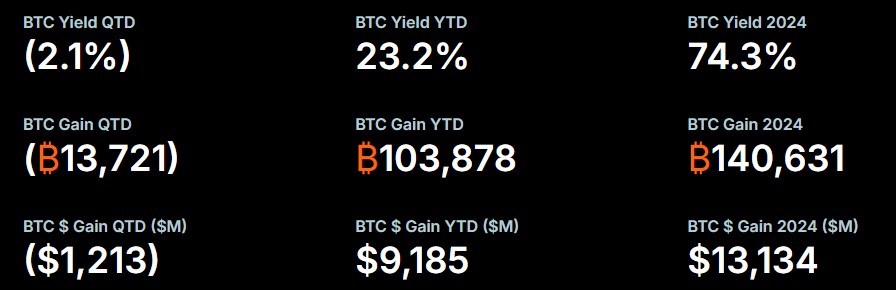
Even if recent purchasesshow short term losses, the overall portfolio grows steadily, highlighting resilience against frequent volatilities. On the other side, the company’s stock (MSTR) is also trading below net BTC value, reflecting broader market concerns.
Looking Ahead
While Michael Saylor’s Strategy remains confident in the golden asset, risks persist if the token prices continue to fall. The company holds 672,497 BTCs at an average cost of $74,997 per coin, currently valued around $87,000–$88,000.
If the asset's prices fall below the average cost (~$74,997), the unrealized gains could turn into paper losses, where recent smaller dips already reduced the value of December purchases.
Saylor, however, frames such volatility as opportunity rather than threat. He cleared the market pressure on his choice by stating in his recent December posts: “Challenges make Bitcoin” and “It grows stronger,” signaling a long-term approach focused on accumulation rather than short-term price swings.
