Silver Market Manipulation Rocks Investors with $600B Plunge

Forget subtle shifts—this was a financial earthquake. A $600 billion crater just opened in the silver market, and the tremors are rattling portfolios from Wall Street to Main Street. The culprit? Allegations of outright market manipulation that have left traditional investors reeling and questioning the very foundations of 'safe-haven' assets.
The Old Guard's Paper Castle
This isn't about normal volatility. The sheer scale of the drop points to structural cracks. It exposes the fragile, paper-driven mechanisms of legacy commodity markets—where complex derivatives and opaque trading desks can create artificial realities that collapse under their own weight. While regulators scramble to issue statements, the damage is already done. Trust, that most precious of metals, has been tarnished.
A Digital Counter-Narrative
Contrast this shock with the evolving architecture of digital asset markets. Blockchain's core proposition is radical transparency: an immutable, public ledger that makes clandestine manipulation exponentially harder. Every transaction is timestamped, verified, and open to audit. It’s a system designed to prevent exactly the kind of shadowy activity now suspected in silver. This event doesn't just highlight a failure; it underscores a foundational difference in market integrity.
The Real 'Safe Haven' Test
True stability isn't the absence of price movement—it's the presence of verifiable fairness. A $600 billion loss based on potential manipulation is the ultimate indictment of an opaque system. It forces a brutal question: where is your capital actually safer? In a market where the rules can be bent behind closed doors, or in one built on open-source code and cryptographic proof?
One cynical take for the finance traditionalists: maybe the only thing being 'mined' in the silver market was investor confidence—and that vein just ran dry. The future of finance isn't about hiding the ledger; it's about publishing it for the world to see.
What Happened Before the Crash?
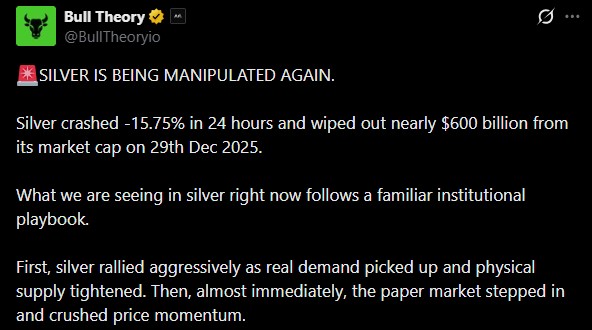
Before the price drop, silver’s value was rising quickly. Demand for physical-silver was increasing, and supply was getting tighter. Normally, this should support higher values.
But soon after the rally, rates were pushed down sharply. This did not happen because demand disappeared. It happened because of how the metal traded.
Paper vs Physical Silver: A Growing Price Gap
The WHITE metal trades in two very different markets. The first is the paper-silver market, mainly on futures exchanges like COMEX, where contracts are traded without moving real-silver.
The second is the physical-silver markets, where real metal is bought and sold.
On COMEX, it's priced around $70–$73 per ounce, but physical prices are much higher:
Japan: ~$130
UAE: ~$115
India: ~$110
Shanghai: $80–85
These premiums of $10 to $60 per ounce suggest strong physical demand and limited supply, a gap that normally should not exist in a balanced marketplace.
This gap exists because the paper market is highly leveraged. For every one ounce of real metal, there are 400 or more ounces of paper contracts. When prices rise too fast, selling in the paper-market can push values down quickly. Recently, margin rules were tightened, forcing many traders to sell, which caused the crash.
History Repeating in the Market?
This pattern is not new. Between 2008 and 2016, JP Morgan traders were found guilty in court of manipulating gold and silver futures using spoofing, a practice involving fake orders to MOVE price.
In 2020, the bank paid $920 million in fines for precious metals marketplace manipulation. While there is no confirmed proof that the same institutions are doing this again today, key risks remain.
What For Now
Paper leverage is now even higher, physical asset inventories are lower, and large banks still hold massive paper positions.
History shows that nearly every major rally follows the same sequence: real demand pushes prices up, paper pressure forces liquidation, and prices are suppressed. The current marketplace behavior closely matches that pattern.
