MetaMask 2FA Phishing Scam Exposes Critical Security Gaps—Are Your Crypto Assets Really Safe?

A sophisticated phishing campaign targeting MetaMask users has security experts sounding alarms—and questioning whether two-factor authentication provides any real protection in today's threat landscape.
The Bait-and-Switch That's Draining Wallets
Attackers are deploying fake authentication pages that mirror legitimate MetaMask interfaces, tricking users into surrendering both passwords and 2FA codes. Once obtained, bad actors bypass security measures within minutes—sometimes seconds. The scam doesn't just steal credentials; it exploits the very verification systems designed to prevent theft.
Why Your Security Theater Might Be Just That
Traditional 2FA relies on the assumption that possession of a physical device equals legitimate access. These phishing operations shatter that assumption by intercepting codes in real-time. Security layers become meaningless when users voluntarily hand over the keys—all while believing they're following proper protocol.
The Human Firewall Failure
No amount of technical security can compensate for psychological manipulation. These campaigns use urgency, fake system alerts, and professional-looking interfaces to trigger compliance. Users report receiving what appear to be legitimate MetaMask notifications—complete with correct branding and plausible error messages.
What's Next for Crypto Security?
The industry faces a reckoning. Hardware wallets offer partial solutions, but widespread adoption remains low. Some protocols are experimenting with biometric verification and decentralized identity systems, but these remain in early stages. Meanwhile, the old advice—"never share your seed phrase"—proves insufficient against attacks that don't require it.
As one security researcher noted: "We've built digital Fort Knoxes, then taught users to open the door for anyone wearing a convincing uniform." The MetaMask incident reveals a painful truth—in crypto, the weakest link isn't in the code, but in the mirror. And somewhere, a hedge fund manager is probably blaming users instead of the broken security model—because that's easier than admitting the entire system's built on trust in institutions that don't exist.
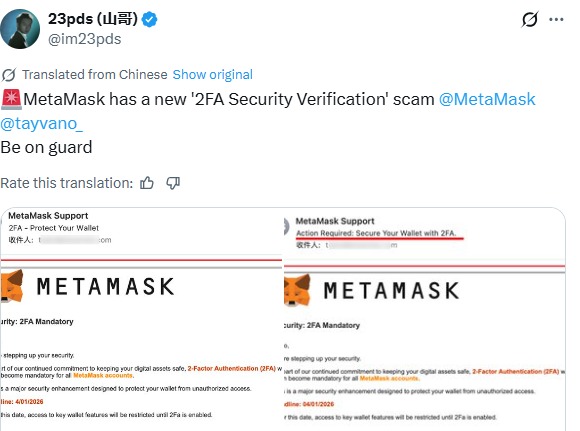
Source: X (formerly Twitter)
Fake 2FA Alerts Are Tricking Users
This usually begins with a warning that claims a MetaMask wallet is at risk.
Users are told that two-factor authentication must be completed right away to keep their funds safe.
The page looks official and often includes a timer counting down. This creates stress and makes people act without thinking.
In the final step, users are asked to enter their recovery phrase as part of the “verification.”
This is where the scam becomes clear. The platform does not ask for seed phrases. Once someone enters it on a fake site, the wallet can be emptied in minutes.
Look-Alike Websites Add to the Risk
Another reason why the MetaMask phishing scam can be very harmful is that they display fake website URLs. Scammers purchase domains which are almost alike in appearance and formatting compared to the original website. The difference may be in the FORM of an extra letter or a spelling variation that can be easily overlooked.
Many users will believe a site is SAFE simply because it looks familiar. It is because of this that users are warned not to click on links sent via email or messages and always check the site address.
Social Engineering Is the Real Threat
Most wallet losses today do not come from technical hacks. They come from social engineering. Scammers rely on fear, pressure, and confusion to get what they want.
This 2FA scam attempt is an appropriate example. It does not break the wallet’s security. Instead, it convinces users to hand over access themselves.
Security researchers often say the same thing: if something feels rushed or threatening, it is probably not real.
MetaMask Improves Phishing Detection
On the flip side, the wallet platforms are also attempting to counter the attacks. Some time back, MetaMask joined the network to defend against phishing attacks, together with other big wallets. The idea here is that they will identify phishing sites quicker.
That comes after a rising number of phishing attacks were recorded in 2025, forcing payments wallet providers to take action against scammers.
Just a Few Steps to Keep Safe
In order to avoid the phishing scam, the user needs to remember the following:
The platform will never ask you for your seed phrase
Urgent notices and countdown timers are warning signs
Use only authorized MetaMask apps & bookmarks
Before taking any security prompt, pause a moment to consider its authenticity and In crypto markets, it is often advised to keep calm as it can sometimes keep your funds safe better than acting fast.
