Solana’s Latest Signature Phishing Scam Triggers OKX Wallet High-Risk Alert

Another day, another crypto scam—but this one's got the big players worried.
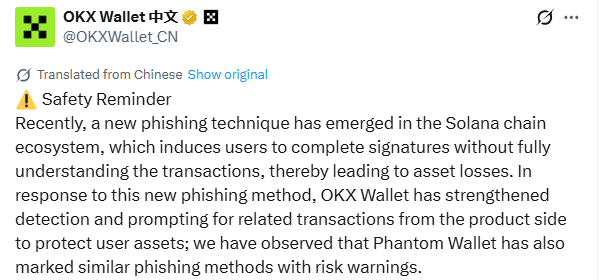
OKX Wallet just slapped a high-risk warning on a new signature phishing attack targeting Solana users. It's the kind of sophisticated trick that makes you wonder if the 'decentralized' in DeFi sometimes just means 'decentralized responsibility.'
How the Attack Works
Forget clunky fake websites. This attack operates at the transaction level. Users sign what looks like a legitimate request, but hidden permissions give attackers the keys to drain wallets later. It's a silent, patient threat that bypasses most common security checks.
The Industry's Reactive Dance
Wallets and exchanges are stuck playing whack-a-mole—issuing alerts after threats emerge rather than preventing them outright. It highlights a painful truth in crypto: security often evolves at the cost of user funds. The 'move fast and break things' ethos works until it's your portfolio getting broken.
So, while the tech promises a frictionless financial future, today's reality involves manually verifying every transaction like a medieval accountant checking for ledger forgeries. Progress? Sure. Just don't forget the cynical finance rule: in the race for adoption, the user's security is usually the last thing to cross the finish line.
The attack is particularly deceptive because it doesn't always show a visible transfer of tokens in the wallet’s simulation preview. Instead, it reconfigures the underlying authority of the account, effectively handing the "keys" to the attacker.
"Silent" Account Takeover: How the Scam Works
Unlike traditional scams that ask for a seed phrase, this Solana signature phishing method exploits Solana’s unique "Owner" permission field.
The Hook: Attackers lure users to a site often disguised as a "free airdrop," "staking reward," or "minting whitelist" and prompt them to sign a transaction.
The Deception: When the user reviews the transaction, most wallets simulate the outcome. Because no SOL or tokens are being transferred at that exact second, the simulation shows "No balance change," making the user feel safe.
How it happens: Think of this like a "Trojan Horse" signature. The transaction contains a hidden instruction that will change who “owns” your account. And if you click confirm, the hacker will become the owner of your Digital vault.
The result: Even if you still have your recovery phrase, it won't matter. The attacker now has total control and can empty your balance at any time. You essentially become a ghost in your own Digital vault. You can see your money, but you can’t touch it.
Wallet Providers Step Up Defenses
OKX Wallet has already updated its product side to strengthen the detection and prompting of these specific malicious instructions. The firm also noted that Phantom Wallet has implemented similar risk markings to flag these interactions.
However, OKX warned that many other mainstream wallets have not yet updated their security protocols to catch this specific technique. To prevent a cross-ecosystem crisis, OKX has sent safety reminder emails to other Digital vault teams and offered technical support to help them implement better detection.
Industry Reaction and Ecosystem Risk
Blockchain security firm SlowMist has previously noted that this "ownership modification" attack is one of the most counter-intuitive for users coming from the ethereum ecosystem. While Ethereum accounts are strictly controlled by private keys, Solana’s modular design allows for delegation of authority, a feature that is now being weaponized.
Experts estimate that phishing-driven losses in the Solana ecosystem reached approximately $90 million in the first half of 2025 alone, and this new "signature-based" method could push those numbers even higher in 2026 if not addressed by all Digital vault providers.
Conclusion
The beauty of Solana is its speed and flexibility, but that same flexibility is what scammers are now attacking. This isn't a "bug" in Solana; it’s an exploit of human habit. Most users have been trained to look for "Balance Changes" in their wallet pop-ups. By crafting transactions that show zero balance change while stealing the ownership rights, hackers have found a massive blind spot. If your Digital vault doesn't explicitly tell you that you are "assigning owner permission," you are flying blind.
