Kalshi CEO Champions US Bill to Curb Insider Trading in Prediction Markets

Prediction markets just got a powerful ally in Washington. The CEO of leading platform Kalshi is throwing his weight behind new legislation aimed at slamming the door on insider trading—a move that could reshape how we bet on everything from elections to interest rates.
Why This Bill Cuts Through the Noise
For years, prediction markets operated in a regulatory gray zone. The proposed law draws a bright line, explicitly banning trading on non-public information. It bypasses old legal ambiguities and gives regulators clear authority to prosecute bad actors. Think of it as applying Wall Street's rulebook to the world of event contracts.
A Push for Legitimacy—And Liquidity
The industry's backing isn't purely altruistic. Clear rules mean mainstream acceptance. Mainstream acceptance unlocks institutional capital. It's a calculated play to transform niche betting platforms into legitimate financial utilities. One might cynically note it's easier to get behind regulation when it helps your own bottom line—nothing boosts trading volume like the sheen of respectability.
The Bottom Line: Trust as a Tradable Asset
This isn't just about compliance. It's about building trust at scale. If prediction markets want to move beyond political novelties and become true risk-management tools, they need the market's confidence. This bill could be the cornerstone. The final verdict? A regulated, transparent prediction market might finally give traditional finance a run for its money—proving that sometimes, the house wins by cleaning up its own act first.
Kalshi CEO Backs New Bill to Ban Insider Trading on Prediction Markets
Prediction markets are once again in the spotlight as Kalshi CEO Tarek Mansour publicly endorsed a new U.S. bill aimed at banning insider trading in the rapidly growing sector.
The proposed legislation comes amid rising concerns over suspicious trading activity on offshore prediction platforms, especially after a controversial bet on Venezuelan politics made headlines.
What Did Kalshi’s CEO Say?
In a LinkedIn post shared this week, CEO Tarek Mansour said he fully supports a bill introduced by U.S. Representative Ritchie Torres that seeks to criminalize insider trading on prediction market platforms.
Mansour made it clear that Tarek already enforces strict insider trading rules and follows standards similar to those used by traditional financial markets like the NYSE and the Nasdaq.
According to him, the bill simply reinforces what regulated U.S. platforms are already doing.
“Kalshi is supportive of the bill… because we already implemented it,” Mansour wrote.
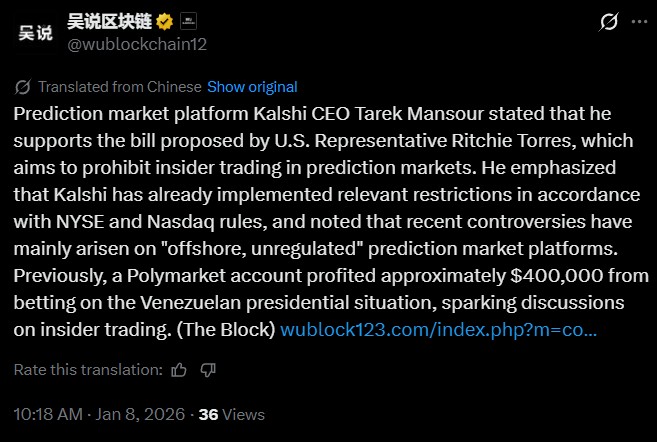
Source: Official X Page
What's Inside the New U.S. Bill?
The name of the bill, which is formally known as the Public Integrity in Financial Prediction Markets Act of 2026, is to ensure that sensitive government information is not abused.
If it passes, it WOULD prohibit Federal elected officials, Political appointees, and employees of the Executive branch from betting in predictive markets concerning government actions, policies, or political outcomes.
The relocation will safeguard the confidence of the people and ensure that no one makes a fortune at the expense of insider information.
The $400K Polymarket Controversy Sparked Debate
The new US crypto laws gained momentum when a $400K Polymarket controversy made that Venezuelan President Nicolas Maduro would be removed by the end of January.
This trade was done just before the capture of Nicolas Maduro, and it casts serious doubts that insider trading was done. This event became part of a wider debate concerning the functioning of the unregulated predictive markets and whether they are a threat to political integrity.
Regulated vs Offshore Prediction Markets
Mansour made his chance to distinctly distance Kalshi with platforms such as Polymarket that are offshore and are not subject to U.S. regulation.
He emphasized that:
Kalshi is controlled on the federal level.
The users will not be allowed to trade in case they possess non-public or insider information.
There are no similar legal standards that apply to offshore platforms.
The recent media reports have given the wrong impression of equating regulated U.S. sites with unregulated foreign sites (Mansour).
Prediction Markets Are Growing Fast
Despite the controversy, Predictions Market is seeing massive growth. In December alone:
Kalshi registered a trading volume of $6.26 billion monthly.
Polymarket recorded $2.28 billion, the best
Kalshi has been steadily increasing its volume as the largest predictive exchange since March 2025.
Bigger Picture: Regulation Is Catching Up
As the giants of the cryptocurrency economy, Crypto.Com, Gemini, and DraftKings enter the sphere of the prediction market, the regulation of the industry only grows.
This development signals a clear shift: U.S. regulators want stronger guardrails, especially as political betting becomes more popular. In the case of regulated platforms, such as Kalshi, the bill might enhance credibility--whereas offshore platforms might have more difficult inquiries to resolve in the future.
Conclusion
The evolution points to increasing regulatory scrutiny of the market with the rise in political betting, and the U.S. lawmakers demanding greater protection to maintain market integrity and limit the abuse of information.
Disclaimer: This is not financial advice. Please DYOR before investing. CoinGabbar is not responsible for any financial losses. Crypto assets are highly volatile, and you can lose your entire investment.
