Bitcoin Halving 2026: Why Experts Are Split on BTC’s Explosive Next Move

Bitcoin's next halving looms—and the market can't decide whether to brace for liftoff or a letdown.
The supply shock is coming. Every four years, Bitcoin's block reward gets cut in half—miners earn less, new coins slow to a trickle. Basic economics says scarcity drives value. But this time? The smart money's divided.
The Bull Case: Scarcity on Steroids
History doesn't repeat, but it often rhymes. Past halvings preceded parabolic rallies—supply shocks meeting rising demand. Institutional adoption isn't a maybe anymore; it's in the ledger. If demand holds steady while new supply drops? The math gets aggressive.
The Bear Counter: 'Priced In' and Fatigue
Then there's the cynical take: everyone sees it coming. Traders front-run the event, miners hedge, the narrative gets stale. What if the halving is just a ceremonial cut—already factored into today's price? Markets have a habit of humbling consensus.
The Wild Card: A New Market Psychology
This cycle feels different. Regulatory frameworks are emerging, ETFs are live, and Bitcoin's becoming infrastructure—not just a speculative asset. The halving might act less like a rocket trigger and more like a structural reinforcement, tightening supply amid maturing demand.
One cynical finance jab? Wall Street will spin the halving as both a guaranteed boom and a prudent hedge—charging fees on both sides of the bet.
So where does that leave us? Split. The halving remains crypto's ultimate built-in catalyst—a scheduled scarcity event in a world of printed money. Whether it ignites a frenzy or becomes a 'sell the news' moment hinges on a market that's wiser, more liquid, and infinitely more unpredictable. Buckle up.
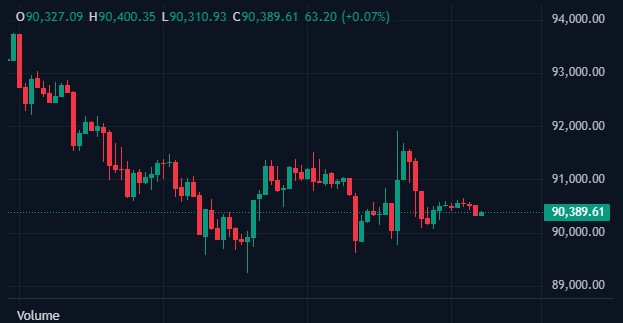
Unlike earlier cycles, institutional adoption and regulation are now influencing BTC alongside its traditional halving-driven supply mechanics.
What is Bitcoin Halving? Why It Still Matters in 2026
The Bitcoin halving is a built-in rule that reduces new token supply in half every four years. In other words, miners earn new Bitcoins for running the network, but every four years, this reward is cut in half. This event is called the halving. For example:
Before April 2024, miners earned 6.25 BTC for each block.
After the 2024 supply halve, they earn 3.125 BTC.
That means far fewer new bitcoins enter the market each day.
Today, only about 450 new coins are created daily, compared to 900 before the halving.
This matters because the digital asset has a fixed supply of 21 million coins, making it fundamentally different from fiat currencies that can be printed endlessly.
When supply goes down but demand stays the same or increases, prices usually rise over time. This is why the BTC halving is often seen as a long-term price booster, not an instant pump.
Each halving lowers inflation, strengthens scarcity, and historically supports higher prices over time.
These projections reflect analyst opinions and historical patterns, not financial advice.
Bitcoin’s Current Situation: ETFs, Miners, and Resistance
While hopes from the gold asset are high, the current price at which the coin is trading in the market is within the range of $90,000 to $93,000, as it suffers many blows from different quarters.
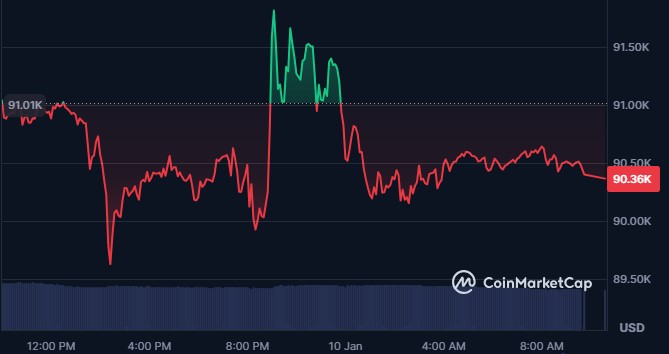
U.S. spot Bitcoin ETFs saw flows of $243 million on the 6th, dominated by Fidelity and Grayscale. Though BlackRock’s IBIT saw inflows, the macro data WOULD arguably reflect institutional profit-taking after Bitcoin’s rally in 2025 to a $126,000 ATH.
Rising energy costs and lower block rewards have squeezed some miners, forcing them to liquidate Bitcoins and cover expenses. As a result, hashrate has dipped, and miners sold close to $50M worth of coins recently, adding to short-term pressure.
BTC continues to struggle below key levels NEAR $91,500, which keeps traders cautious. According to analysts, a loss of support near $88,000–$90,000 could trigger deeper corrections.
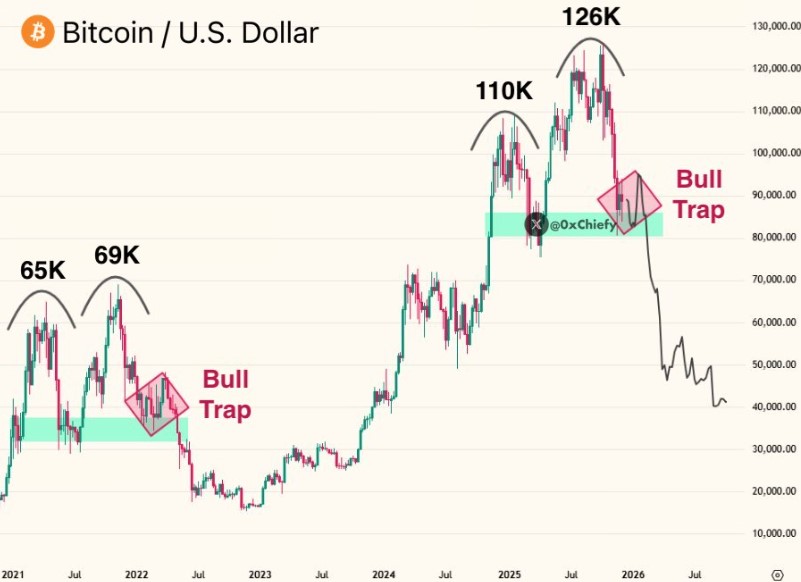
Some analysts are cautioning that, were the classic 4-year Bitcoin cycle still intact-and resistance around $90k still a catalyst for its sharp pullback into bear territory-extreme bearish models suggest even $40k on the table.
Long-Term Outlook Still Remains Strong, Why?
Despite short-term weakness, the Bitcoin halving narrative remains intact for long-term holders.
On-chain data shows large wallets buying over 3,000 BTC near the $90,000 level. Historically, whale accumulation near support zones often signals confidence in long-term value rather than short-term speculation.
Spot Bitcoin ETFs have absorbed far more Bitcoins than miners produce annually, disrupting old four-year cycle patterns. This explains why the virtual coin reached a new all-time high before the 2024 supply halve, something never seen before.
Expected crypto market structure laws in early 2026 could allow banks to offer custody and payment services. Regulatory clarity has historically unlocked large waves of institutional capital.
Historically, the coin peaks 12–18 months after a halving, followed by a consolidation or bear phase lasting 1–2 years. In this cycle, much of the rally happened early due to ETF inflows.
2026–2027: Likely consolidation and accumulation period
2028: Next Bitcoin-halving (expected March–April 2028)
Post-2028: Reduced supply may restart long-term bullish momentum
Several high-profile investors remain bullish on the asset despite its pullback from the 2025 peak. Billionaire venture capitalist Tim Draper says 2026 will be big, sticking to his $250k target.
BlackRock’s Larry Frank says $300k is possible, while Tom Lee of Fundstrat doubled down in early January, projecting BTC could reach $200,000–$250,000 in 2026.
Other forecasts vary widely, with analysts placing 2026 price targets anywhere from $75,000 to over $225,000, reflecting uncertainty but strong long term conviction.
With this the consensus is clear that the Bitcoin halving cycle is not broken, it is evolving.
