Tether Teams With UN in Major Cybersecurity Push to Target Global Financial Crime

Tether just flipped the script on crypto's regulatory narrative—partnering directly with the UN to hunt down illicit finance. This isn't a PR move; it's a strategic offensive.
The New Alliance: From Target to Enforcer
For years, regulators painted stablecoins as a shadowy loophole. Tether's response? Cut a deal with one of the world's largest multilateral bodies. The partnership focuses on tracking and freezing assets linked to terrorist financing and organized crime across developing economies. It's a proactive play to embed compliance directly into the blockchain layer.
How the Tech Actually Works
The initiative leverages Tether's real-time transaction monitoring system. By collaborating with the UN's Office on Drugs and Crime, they're creating a shared intelligence framework. Suspicious wallet activity gets flagged, traced, and neutralized—often before traditional banking systems even file a report. It's a speed and transparency advantage only a digital asset network can provide.
The Bigger Picture: Legitimacy as a Service
This move does more than just chase bad actors. It strategically positions Tether's infrastructure as essential global financial plumbing. Every illicit transaction frozen is a data point proving the system's traceability and control. Suddenly, the narrative shifts from 'unregulated danger' to 'indispensable security tool.' A cynic might say it's the ultimate regulatory arbitrage—adopting the world's most stringent watchdog to pre-empt smaller, peskier ones.
The partnership signals a maturation phase. Digital assets aren't asking for permission anymore; they're building the new rulebook. For the UN, it's access to cutting-edge forensic tools. For Tether, it's the ultimate legitimacy coup. And for the old-guard finance sector? Let's just say their compliance departments now have some very expensive, very slow software to justify.
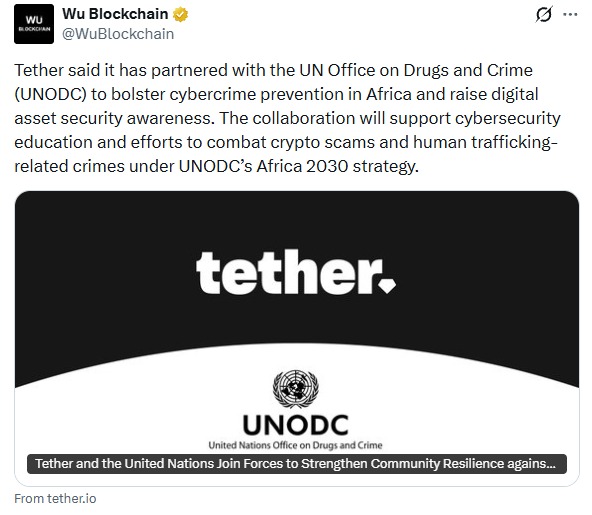
Africa is currently the third-fastest-growing crypto region on the planet, but that growth has painted a target on the continent’s back. Last year, a massive Interpol operation called "Operation Catalyst" sniffed out over $260 million in dirty money tied to everything from romance scams to terrorism. The goal is to turn digital finance from a risky frontier into a trusted infrastructure; this Tether cybersecurity initiative gives local regulators the exact data and training needed to keep bad actors out.
Why the Tether Cybersecurity Initiative Matters for 2026 and Beyond
What makes the Tether cybersecurity initiative different from previous efforts is its focus on the human element. Under the UNODC’s "Strategic Vision for Africa 2030," the goal isn't just to arrest people; it's to build a "firewall" around vulnerable communities. For the first time, a private stablecoin issuer is helping the UN fund shelters for victims of human trafficking while simultaneously teaching the next generation of coders how to spot a scam before it happens.
In Senegal, for instance, the initiative is launching a massive "Digital New Deal" bootcamp. This isn't your typical classroom setting; it’s a high-intensity mentorship program where young people learn the ins and outs of blockchain security. By handing out micro-grants to student innovators, Tether is essentially hiring a grassroots army to keep the African digital economy clean and transparent.
The Global Ripples: From Nigeria to the Pacific
The reach of this project is surprisingly wide. While most of the focus is on heavy hitters like Nigeria, Ethiopia, and the DRC, the partnership has even stretched to Papua New Guinea. There, university students are competing to build blockchain-based solutions that can stop financial fraud in its tracks.
Tether’s CEO, Paolo Ardoino, has been vocal about the fact that "innovation without protection" is a recipe for disaster. By working with the UN, he’s trying to prove that stablecoins can be a force for good—helping the unbanked participate in the global economy without becoming prey for transnational gangs.
Conclusion
Looking ahead at the rest of 2026, it’s clear that the Tether cybersecurity initiative is more than just a corporate program it is a bold experiment in what happens when the private sector and the UN actually put their heads together. Sylvie Bertrand, the UNODC’s regional rep, really hit the nail on the head when she pointed out that digital assets can only unlock Africa’s true potential if the underlying "engine" is actually SAFE to use.
By combining the raw transparency of blockchain with the massive, boots-on-the-ground reach of the United Nations, this partnership is setting a brand-new bar for how crypto companies should own their global impact. We won’t see the first "mass filing" of progress reports until 2027, but for the time being, the digital landscape in Africa feels a lot more secure than it did just a few months ago.
YMYL Disclaimer
This article is for informational purposes only and does not constitute financial, legal, or investment advice. Digital assets involve risk, and readers should consult qualified professionals before making decisions.
