Bitcoin Soars as Supreme Court Delays Trump Tariff Decision - Crypto Markets React

Bitcoin rockets upward as judicial uncertainty injects fresh volatility into global markets. The Supreme Court's decision to postpone a ruling on Trump-era tariffs sends shockwaves through traditional finance—and crypto traders are capitalizing.
Decoupling from Macro Jitters
While stocks wobble on the news, Bitcoin charts its own course. The delay creates a regulatory gray zone—a familiar playground for digital assets. Investors flock to crypto as a hedge against potential trade war escalations and dollar instability. No official numbers? The price action tells the whole story.
Tariff Limbo Fuels Digital Gold Narrative
Every institutional memo now mentions 'digital gold' when tariffs hit the headlines. The Court's pause extends the economic uncertainty that first fueled Bitcoin's modern adoption cycle. Traditional portfolios rebalance toward crypto exposure—not because they believe in decentralization, but because they fear centralized policy failures.
Finance's Ironic Twist
Here's the cynical jab: Wall Street spent years dismissing crypto as a speculative toy. Now those same firms trade Bitcoin futures to hedge against decisions made by their golfing buddies in government. The 'unregulated' market becomes the safety net when regulated systems stall.
Markets move faster than courts. While justices deliberate, algorithms execute. Bitcoin's surge today isn't about the tariff decision itself—it's about the system's inability to make one.
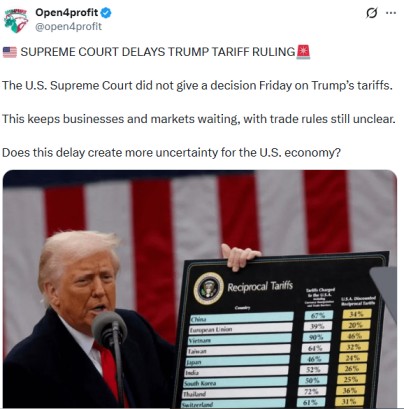
Source-Open4Profit
Bitcoin Pumps Fast
After the Trump tariff decision, the crypto market was to be seen stable for a long time as the traders and investors feared about the risk. The Supreme Court was about to give its verdict on Friday, but after the results were delayed, the crypto market rose in a short span of time. It's good to see that Bitcoin pumped $2100 in just 45 minutes, after the Supreme Court delayed the tariff verdict.
Bitcoin Holds Ground Despite 1% Dip
At the time of writing, Currency was stable at $90,433, which was 1% down as compared to the price of the last 24 hours. Daily trading volume was about $45 billion, and currency total market value fell slightly to around $1.80 trillion.
Even with this small drop, Bitcoin’s price is still stable NEAR recent highs. From its highest price from the last week, it is just 2% below and 1% above its lowest price during the same period.
At present the total circulating supply of asset is around 19.97 million, much closer to its maximum limit which is 21 million coins. This limited supply continues to support long-term positive views on currency.
Trump Tariff Delay Eases Market Fears
According to experts, the delay in Trump tariff decision helped to calm the traders' fear and the cause of sudden economic problems. As the major concern of the government itself was that, if the proposal gets canceled, the government might have to return more than $130 billion to importers.
Bitcoin Dips Amid Policy Uncertainty
No doubt, crypto currency is now seen as a macro-sensitive asset, because its price reacts to government policies, market liquidity, and global political events. Because of this, big legal and political decisions can affect Bitcoin’s short-term price, even though its long-term growth and adoption remain strong.
In the start of January, the currency price jumped sharply, but we can see that now the market is cooling down due to the Trump tariff decision. The market is quite struggling. As a result some of the traders started taking profits as the price struggled to MOVE higher.
Conclusion
From a technical view, traders are closely watching currency at the $90,000–$91,000 range as an important support level. If price starts to fall below this level, bitcoin could drop toward the high $80,000 range. However, if Bitcoin moves back above $92,000, it may continue rising toward higher resistance levels.
Disclaimer: This is not financial advice. Do Your Own Research before investing. CoinGabbar is not liable for any financial loss. The crypto assets are risky, and you may lose all your investments. Not all regions can offer some of the services or assets discussed.
